Showing posts with label war. Show all posts

Thursday, 16 October 2025

STARRY NIGHT

“I hate war as only a soldier who has lived it can, only as one who has seen its brutality, its futility, its stupidity.” - Dwight D. Eisenhower

The New What’s Going On Blog has set as its theme today "ekphrastic poetry”. I have used one of my paintings, which was inspired by Vincent van Gogh’s “Starry Night”, but brought up to date as it were, considering the number of wars and conflicts that are raging around the world at the present time. Some of us may be lucky enough to sleep and rest in a country at peace, but we must not forget how many people are living in the hell of combat - sleep and rest being only an unattainable dream…

Starry Night

Heavens are vivid, clear tonight
The golden stars are blazing bright;
We watch transfixed and glorify
The Maker’s grace that gave us sky.

The city sleeps content and still,
As sleeper’s dreams with pleasure fill.
Nightbirds sound the hours’ passing
And distant music sleep trespassing.

Calmness of peace awards us rest
And every child is quiet, blessed.
The moon looks down and sweetly smiles
Surveys the countryside around for miles.

Heaven is burning hot tonight,
Alight with violent fires that smite;
The missiles fall, explode and strike
King, peasant, young and old alike.

The city is embraced by a wild panic
All go to shelters, running manic;
Explosions, screams, war cries resound
Even in cellars deep, far underground.

Fury of battle and warmongers’ folly
Make every soul dire, melancholy;
Ashamed, the moon hides in the clouds
Wrapping herself in smoky shrouds.

Oh, foolish, crazy, deluded human,
Why peace forsake and become inhuman?
Your days are short, so very dear
Why waste them only to live in fear?

The poem is set to music again, and you can find all my music in my “Otidorchestre” channel or listen to it on YouTube, SpotifyAmazon, Deezer, Flo, Pandora, and other music sharing sites. Please note that there is some delay in publication of music on these platforms and generally the fastest publication is on YouTube, however, they will all make the music available within a few days.

Thursday, 14 August 2025

SERENITY...

“Surely we have a responsibility to leave for future generations a planet that is healthy and habitable by all species” - Sir David Attenborough

The prompt from “Poets and Storytellers United” this week is to write something about “something with both spooky and summery themes”. I am watching with horror the terrible Summer wildfires in Europe, the worsening situation in Israel/Gaza, the ongoing war in Ukraine. I see the world leaders of many countries blithely following a path of totalitarianism and self-interest, ignoring a looming climate catastrophe and a path leading to more warfare… I look at the increasing destruction of world wilderness areas, the effects of our pollution, and our thoughtless use of natural resources, and yes, I am spooked by all this…

Serenity...

The news is bleak, the world is marred,
We live in fear, our lives are scarred.
Our leaders crazy, and the people crazed
Crime, greed and murder, society’s razed.

The planet’s suffering, the climate’s changed
Animals dying, nature’s deranged.
Fires are raging, floods drowning each city,
While nature’s turned on us with no pity.

All that I wish for is peace, serenity,
And all I get is conflict, obscenity.
All that I need is a home and love,
And what I get is bombs from above.
Oh, please, give me serenity!

Oceans are poisoned, rivers polluted,
Species extinct, resources looted;
The air is toxic, our water’s blighted
The people uncaring, deeply benighted.

The threat of war, total destruction,
The earth beset by an evil fluxion;
We dread the worse but choose inaction
It’s time to shake off vapid abstraction.

All that I wish for is peace and quiet,
And all I get is conflict, evil, riot.
All that I need is care, affection
And what I get is scorn, rejection.
Oh, please, no more disquiet!

All that I wish for is peace, serenity,
Give me true justice, give me lenity…
Oh, please, give me serenity!

This poem is set to music, and you can find all references to my music in my “Otidorchestre” channel, or listen to it on YouTubeSpotifyAmazon, Deezer, Flo, Pandora, and other music sharing sites.

Please note that the song has been submitted to music sharing sites, but there is a variable period of delay until the song is publicly released. YouTube is generally the most prompt.

Tuesday, 7 January 2025

TRAVEL TUESDAY 478 - BOSRA, SYRIA

“The age in which we live can only be characterised as one of barbarism. Our civilisation is in the process not only of being militarised, but also being brutalised. Alva Myrdal

Welcome to the Travel Tuesday meme! Join me every Tuesday and showcase your creativity in photography, painting and drawing, music, poetry, creative writing or a plain old natter about Travel.
There is only one simple rule: Link your own creative work about some aspect of travel and share it with the rest of us. Please use this meme for your creative endeavours only.
Do not use this meme to advertise your products or services as any links or comments by advertisers will be removed immediately.
The Roman Theatre at Bosra (Arabic: المسرح الروماني ببصرى) is a large Roman theatre in Bosra, in the district of Dar'a in south-western Syria. It was built in either the second quarter or the second half of the second century AD, and is constructed of black basalt.  It is likely that the theatre was built during the reign of Trajan. The theatre was originally built outside the walls of the town, but was later completely enclosed by an Ayyūbid fortress. The city of Bosra had its fortifications expanded between 481 and 1251. When later integrated into the fortifications, its role was to serve as a citadel and to guard a road leading to Damascus.
The theatre is 102 metres across and has seating for about 17,000 people; it is thus among the largest of the Ancient Roman civilisation.  It served a city that once had 80,000 inhabitants. It is also one of the best preserved both in Syria and across the Roman empire. It was substantially restored between 1947 and 1970, before which it contained large quantities of sand, which may have helped to protect the interior.
Palmyra, a UNESCO world heritage site that once linked Persia, India and China with the Roman empire and the Mediterranean area, has already seen destruction at the hands of the Islamic State group. The ancient town first fell to IS militants in May 2015, when they held it for 10 months. During that time, IS damaged a number of its relics and eventually emptied it of most of its residents, causing an international outcry. 
In 2017, Islamic State militants destroyed parts of the amphitheatre, as well as an iconic monument known as the Tetrapylon in Syria's historic town of Palmyra. It was another of the group's latest attack on world heritage, an act that the UN cultural agency called a "war crime.” As of July 2018, the site is still on the UNESCO's list of World Heritage in Danger. The theatre was added to the list in 2013.

You are invited to the Inlinkz link party!

Click here to enter

Tuesday, 30 January 2024

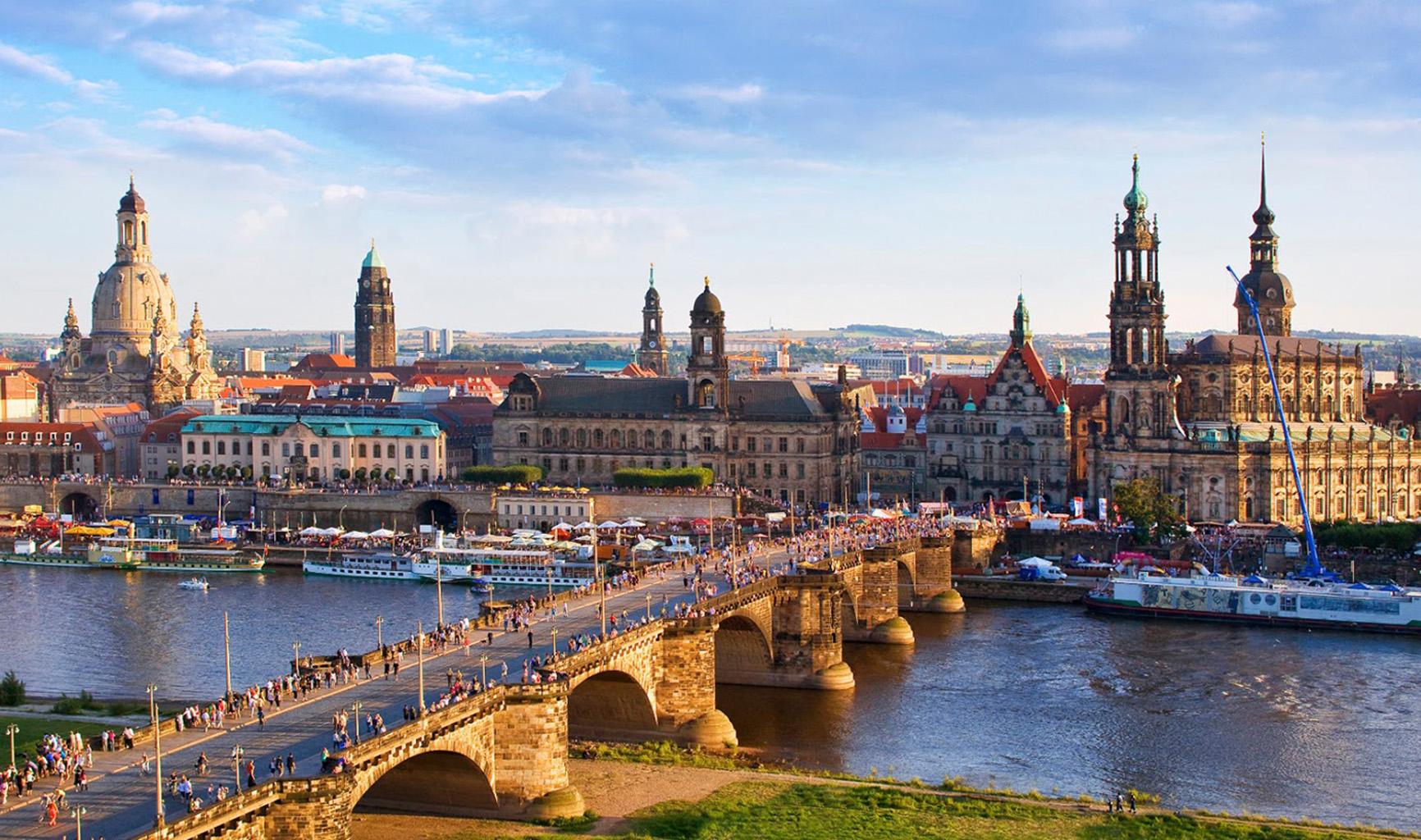
TRAVEL TUESDAY 429 - DRESDEN, GERMANY

“If we don't end war, war will end us.” -  H. G. Wells

Welcome to the Travel Tuesday meme! Join me every Tuesday and showcase your creativity in photography, painting and drawing, music, poetry, creative writing or a plain old natter about Travel. 
There is only one simple rule: Link your own creative work about some aspect of travel and share it with the rest of us.
Please use this meme for your creative endeavours only. Do not use this meme to advertise your products or services as any links or comments by advertisers will be removed immediately.
Dresden is the capital city and, after Leipzig, the second-largest city of the Free State of Saxony in Germany. It is situated in a valley on the River Elbe, near the border with the Czech Republic. Dresden has a long history as the capital and royal residence for the Electors and Kings of Saxony, who for centuries furnished the city with cultural and artistic splendour, and was once by personal union the family seat of Polish monarchs. The city was known as the Jewel Box, because of its baroque and rococo city centre.

The controversial American and British bombing of Dresden in World War II towards the end of the war killed approximately 25,000 people, many of whom were civilians, and destroyed the entire city centre. After the war, restoration work has helped to reconstruct parts of the historic inner city, including the Katholische Hofkirche, the Zwinger and the famous Semper Oper. Since German reunification in 1990 Dresden is again a cultural, educational and political centre of Germany and Europe.

You are invited to the Inlinkz link party!

Click here to enter

Tuesday, 10 November 2020

TRAVEL TUESDAY 261 - FLANDERS FIELDS

“In Flanders fields the poppies blow, Between the crosses, row on row.” - Lt.-Col. John McCrae (1872 - 1918)

Welcome to the Travel Tuesday meme! Join me every Tuesday and showcase your creativity in photography, painting and drawing, music, poetry, creative writing or a plain old natter about Travel.

There is only one simple rule: Link your own creative work about some aspect of travel and share it with the rest of us. Please use this meme for your creative endeavours only.
Do not use this meme to advertise your products or services as any links or comments by advertisers shall be removed immediately.

Papaver rhoeas (common names include common poppy, corn poppy, corn rose, field poppy, Flanders poppy or red poppy) is an annual herbaceous species of flowering plant in the poppy family, Papaveraceae. This poppy is notable as an agricultural weed (hence the common names including “corn-” and “field-”), and after World War I as a symbol of dead soldiers. Before the advent of herbicides, P. rhoeas sometimes was so abundant in agricultural fields that it could be mistaken for a crop. However, the only species of Papaveraceae grown as a field crop on a large scale is Papaver somniferum, the opium poppy.

Papaver rhoeas is a variable, erect annual, forming a long-lived soil seed bank that can germinate when the soil is disturbed. In the northern hemisphere it generally flowers in late spring, but if the weather is warm enough, other flowers frequently appear at the beginning of autumn. It grows up to about 70 cm in height. The flowers are large and showy, 50 to 100 mm across, with four petals that are vivid red, most commonly with a black spot at their base. The flower stem is usually covered with coarse hairs that are held at right angles to the surface, helping to distinguish it from Papaver dubium in which the hairs are more usually appressed (i.e. held close to the stem). The capsules are hairless, obovoid (egg-shaped), less than twice as tall as they are wide, with a stigma at least as wide as the capsule. Like many other species of Papaver, the plant exudes white to yellowish latex when the tissues are broken Its origin is not known for certain.

As with many such plants, the area of origin is often ascribed by Americans to Europe, and by northern Europeans to southern Europe. Its native range includes West Asia, North Africa and Europe. It is known to have been associated with agriculture in the Old World since early times and has had an old symbolism and association with agricultural fertility. It has most of the characteristics of a successful weed of agriculture. These include an annual lifecycle that fits into that of most cereals, a tolerance of simple weed control methods, the ability to flower and seed itself before the crop is harvested, and the ability to form a long-lived seed bank. The leaves and latex have an acrid taste and are mildly poisonous to grazing animals. A sterile hybrid with Papaver dubium is known, P. x hungaricum, that is intermediate in all characters with P. rhoeas.

Due to the extent of ground disturbance in warfare during World War I, corn poppies bloomed in between the trench lines and no man's lands on the Western front. Poppies are a prominent feature of the poem “In Flanders Fields” by Canadian Lieutenant Colonel John McCrae, one of the most frequently quoted English-language poems composed during the First World War. During the 20th century, the wearing of a poppy at and before Remembrance Day (November 11) each year became an established custom in English-speaking western countries. It is also used at some other dates in some countries, such as at appeals for Anzac Day in Australia and New Zealand.

This post is part of the Our World Tuesday meme,
and also part of the Ruby Tuesday meme,
and also part of the Wordless Wednesday meme.

You are invited to the Inlinkz link party!

Click here to enter

Tuesday, 16 June 2020

TRAVEL TUESDAY 240 - DOVER, UK


“There’ll be bluebirds over The white cliffs of Dover Tomorrow, just you wait and see…” – Vera Lynn (lyrics by Nat Burton)

Welcome to the Travel Tuesday meme! Join me every Tuesday and showcase your creativity in photography, painting and drawing, music, poetry, creative writing or a plain old natter about Travel.

There is only one simple rule: Link your own creative work about some aspect of travel and share it with the rest of us. Please use this meme for your creative endeavours only.

Do not use this meme to advertise your products or services as any links or comments by advertisers shall be removed immediately.
The White Cliffs of Dover are cliffs that form part of the English coastline facing the Strait of Dover and France. The cliffs are part of the North Downs formation. The cliff face, which reaches up to 110 m, owes its striking appearance to its composition of chalk accented by streaks of black flint. The cliffs stretch along the coastline for 13 km, spreading east and west from the town of Dover in the county of Kent, an ancient and still important English port.

The cliffs have great symbolic value in Britain because they face towards continental Europe across the narrowest part of the English Channel, where invasions have historically threatened and against which the cliffs form a symbolic guard. The National Trust calls the cliffs “an icon of Britain”, with “the white chalk face a symbol of home and war time defence.” Because crossing at Dover was the primary route to the continent before the advent of air travel, the white line of cliffs also formed the first or last sight of Britain for travellers. In World War II, thousands of allied troops on the little ships in the Dunkirk evacuation saw the welcoming sight of the cliffs.

This post is part of the Our World Tuesday meme,
and also part of the Wordless Wednesday meme.

You are invited to the Inlinkz link party!
Click here to enter

Tuesday, 24 April 2018

TRAVEL TUESDAY - MELBOURNE ANZAC

“What you leave behind is not what is engraved in stone monuments, but what is woven into the lives of others.” - Pericles

Welcome to the Travel Tuesday meme! Join me every Tuesday and showcase your creativity in photography, painting and drawing, music, poetry, creative writing or a plain old natter about Travel.

There is only one simple rule: Link your own creative work about some aspect of travel and share it with the rest of us. Please use this meme for your creative endeavours only.

Do not use this meme to advertise your products or services as any links or comments by advertisers will be removed immediately.
The Shrine of Remembrance is Victoria’s largest and most visited war memorial and is probably Melbourne’s most recognised landmark. It is a permanent and lasting memorial to the ANZAC spirit and acknowledges those who served and those who died in the Great War of 1914-1918 and armed conflicts and peacekeeping duties since. The Shrine is located on Melbourne’s most famous boulevard, St Kilda Road, just south of the Melbourne central business district.

Designed by architects Phillip Hudson and James Wardrop who were both World War I veterans, the Shrine is in a classical style, being based on the Tomb of Mausolus at Halicarnassus and the Parthenon in Athens. Built from Tynong granite, the Shrine originally consisted only of the central sanctuary surrounded by the ambulatory.

The Shrine went through a prolonged process of development, which began in 1918 with the initial proposal to build a Victorian memorial. Two committees were formed, the second of which ran a competition for the memorial’s design. The winner was announced in 1922. However, opposition to the proposal (led by Keith Murdoch and The Herald) forced the governments of the day to rethink the design, and a number of alternatives were proposed, the most significant of which was the ANZAC Square and cenotaph proposal of 1926.

In response, General Sir John Monash used the 1927 ANZAC Day march to garner support for the Shrine, and finally won the support of the Victorian government later that year. The foundation stone was laid on 11 November 1927, and the Shrine was officially dedicated on 11 November 1934.

Anzac Day is a national day of remembrance in Australia and New Zealand that broadly commemorates all Australians and New Zealanders “who served and died in all wars, conflicts, and peacekeeping operations” and “the contribution and suffering of all those who have served.” Originally 25 April every year was to honour the members of the Australian and New Zealand Army Corps (ANZAC) who fought at Gallipoli in the Ottoman Empire during World War I. Anzac Day is also observed in the Cook Islands, Niue, Pitcairn Islands, and Tonga.
Lest we forget...

This post is part of the Our World Tuesday meme,
and also part of the Wordless Wednesday meme.

Monday, 30 October 2017

MYTHIC MONDAY - EGYPT 33, RESHEPH

“Thunder makes a loud noise but it’s the quiet sky that lasts.” ― Marty Rubin

Resheph (also Rešef, Reshef; Canaanite ršp רשף; Eblaite Rašap, Egyptian ršpw) was a deity associated with plague (or a personification of plague) in the ancient Canaanite religion. The originally Eblaite and Canaanite deity was adopted into ancient Egyptian religion in the late Bronze Age during the Eighteenth Dynasty of Egypt (late 15th century BC) as a god of horses and chariots. In Biblical Hebrew, רֶשֶׁף‎ resheph is a noun interpreted as “flame, lightning” but also “burning fever, plague, pestilence”.

Ršp was an important Ugaritic deity. He had the byname of tġr špš “door-warden of the Sun”. Sacrifices to Ršp (ršp gn) were performed in gardens. Ugaritic Ršp was equated with Mesopotamian Nergal. One of Ršp’s epithets (ḥṣ) is interpreted as “arrow” and identifies Ršp as a plague god who strikes his victims with arrows as Homeric Apollo (Iliad I.42–55), and is therefore seen to be the Ugaritic equivalent of Apollo.

Resheph was adopted as an official deity in Egypt under Amenhotep II during the Eighteenth Dynasty of Egypt as god of horses and chariots. Originally adopted into the royal cult, Resheph became a popular deity in the Twentieth Dynasty while disappearing from royal inscriptions. In this later period, Resheph often appears with Qetesh and Min. In this time, however, most his stelae are found in Deir el-Medina, a settlement of Syrian (Levantine) craftsmen. The theonym is usually written as hieroglyphic ršpw, where the final -w is added in analogy to other Egyptian divine names.

Resheph was invoked for his power to cure ordinary people’s disease. He was thought to be able to repel the ‘akha’ demon, which causes abdominal pains. He also became the approachable deity who could grant success to those praying to him. Resheph was closely associated with the native Egyptian war god, Monthu and with many other deities. He was also known as “Lord of Sky”, “Lord of Eternity”, “Lord of Heaven” or “Governor of all the Gods” and an area of the Nile valley was renamed the “Valley of Reshep”.

Monday, 18 September 2017

MYTHIC MONDAY - EGYPT 28, APEDEMAK

“I liked myths. They weren’t adult stories and they weren’t children’s stories. They were better than that. They just were.” ― Neil Gaiman 

Apedemak (or Apademak), was a lion-headed warrior god worshiped by the Meroitic peoples inhabiting Nubia. A number of Meroitic temples dedicated to this deity are known from the Butana region: Naqa, Meroë, and Musawwarat es-Sufra, which seems to be his chief cult place. Interestingly, inscriptions at Musawwarat al-Sufra are in hieroglyphs, not in Meroitic script, indicating a close link with Egyptian religion.

In the temple of Naqa built by the rulers of Meroe Apedemak was depicted as a three-headed leonine god with four arms, and as a snake with a lion head. At Naqa, walls are filled with reliefs of Apedemak together with Egyptian deities, forming a triad with Isis, with Horus as their son. Apedemak is also represented together with Hathor and Amon. The god is also depicted as a man with a lion head. Apedemak was a minor deity in the ancient Egyptian religion, being instead a product of the Meroitic culture.

Apedemak was called “The Lord of Royal Power”. In Nubia, with the kingdoms of Cush, the royal throne was always depicted as a lion. Temple reliefs could show kings subdued by lions, and even eaten. There are great similarities between Apedemak and the obscure Egyptian god, Maahes, who also represented a specific religious dimension in the oases of the Western Desert. Also, it is possible that the cult of Sekhmet, Egypt’s lion goddess, was introduced from Nubia, and related to that of Apedemak.

Sunday, 28 May 2017

ART SUNDAY - IMRE ÁMOS

“The Holocaust illustrates the consequences of prejudice, racism and stereotyping on a society. It forces us to examine the responsibilities of citizenship and confront the powerful ramifications of indifference and inaction.” - Tim Holden

Imre Ámos (1907 in Nagykálló, Hungary – 1944 or 1945 in Ohrdruf, Germany) was a twentieth century Hungarian Jewish painter. Following his studies at the Technical University, Budapest from 1927 to 1929, he enrolled in the Art School where he was a pupil of Gyula Rudnay. He married Margit Anna, also a painter.

His painting was initially influenced by József Rippl-Rónai and Róbert Berény. From the mid-1930s onwards, his style emulated that of Chagall whose influence affected his artwork in his paintings such as ‘The Old Church Servant Thinks of Heaven’, and ‘The Dream of Bear Leader’. In 1936, he was elected to be a member of the New Society of Artists, which entailed working in Szentendre during the summer months.

He visited Paris in 1937 where he met Chagall. Ámos became a member of the National Salon in 1938. Some of his works show the influence of legends about the famous Chassidic Kaliver Rebbe, Rabbi Yitzchak Isaac Taub (1744–1828), who was also from Nagykálló.

In 1940 during World War II he became a victim of the Holocaust because he was Jewish. He was taken to a forced labour camp in Vojvodina, then to the battlefield in the east. In 1944 he was deported to a concentration camp in Saxony where he later died cruelly. Throughout the war he painted about his tragic experiences in shocking visions such as ‘A Series of Dark Times’, ‘Escaping’, and ‘War’.

He died aged only 37 or 38. Some of the works by Imre Ámos and his wife can be seen in the Museum of Margit Anna and Imre Ámos in Szentendre. On 23 June 2014, the Jewish Historical Institute opened the exhibit “Where is your brother? - Imre Ámos and the 20th century.”

The painting above is “Sötet Idok VIII: Ember par Apokalipszis ben”. I have been unable to find a good translation of this title, but it encapsulates the notion of a dark couple in an apocalyptic setting. It is a rich yet sombre work, looking toward the past but somehow being oddly prophetic too. It has the immediate appeal of a depiction of a couple enjoying music and literature (perhaps Abelard and Heloise?), but in the background through the open window, the world seems to be collapsing, as it was happening in WWII Europe…

Monday, 12 December 2016

MOVIE MONDAY - WAGNER AND ME

“How did such sublime music come from such a warped man? Maybe art really does have the power to ferret out the best in us.” – Anthony Tommasini 

Richard Wagner was born in Germany on May 22, 1813, went on to become one of the world’s most influential (and controversial!) composers. He is famous for both his epic operas, including the four-part, 18-hour Ring Cycle, as well as for his anti-semitic writings, which, posthumously, made him a favourite of Adolf Hitler. There is evidence that Wagner’s music was played at the Dachau concentration camp to “re-educate” the prisoners. Wagner had a tumultuous love life, which involved several scandalous affairs. He died of a heart attack in Venice on February 13, 1883.

Wagner is not one of favourite composers, although some of his music can be rousing and emotionally charged, occasionally sublime and in some instances abhorrently noisy. You can either love or hate Richard Wagner, but in any case he is not one to ignore. It is perhaps unfortunate that Wagner was the favourite composer of Adolf Hitler, who claimed to have seen Wagner’s opera “Rienzi” at least 40 times. This coupled with the use of Wagner’s music for Nazi ceremonial occasions and “rehabilitation” purposes of concentration camp inmates have stained Wagner’s reputation in terms of anti-Semitic sentiments.

We watched the 2010 Patrick McGrady documentary “Wagner and Me” starring Stephen Fry in which Wagner’s life, oeuvre and life perspective are explored in terms of Fry’s reaction to the man and his music. As such, the documentary examines more Stephen Fry’s life and psychology rather than Wagner’s. It is very much Wagner viewed through Fry’s eyes, or more importantly, listened to via Fry’s ears.

Stephen Fry first fell in love with the music of Wagner when he was 14 and thus began a lifetime’s intense enjoyment and involvement for the music.  The complicating factor is that Stephen Fry is Jewish and has lost family members in the Holocaust at Auschwitz Concentration Camp. Therein lies the conflict in Fry’s enjoyment of the music of a man who clearly had hateful views about the Jews and whose music was tainted by its association with the Nazis later on.

The documentary is beautifully shot and offers amazing views of Bayreuth in preparation for the annual Festival in which performances of operas by Wagner are held. There is also footage of Nuremberg, which is famous for Hitler’s massive Nazi rallies. While many historians, musicians, Holocaust survivors and performers are interviewed, the documentary is primarily Stephen Fry’s. It is an almost apologetic and embarrassing admission by Fry that despite everything he still loves Wagner’s music…

While there are glimpses of Wagner’s life and some performances of small parts of his work, Wagner music lovers may well be disappointed by this documentary because it more about Fry than about Wagner. Nevertheless, we found it an excellent introduction to the composer and his music, with the ambivalence of Fry’s views acting as a means of resolving the thorny of issue of balance: On the one hand there is artistic and creative genius, and on the other political views and prejudices that may influence the listener’s perception of the music…

Monday, 14 November 2016

MOVIE MONDAY - RED

“I love conspiracy theories. I used to just live on it. You know it’s all hype and garbage, but you’re still really paranoid afterwards. It’s fun entertainment.” - Doug Stanhope

We watched an amusing film at the weekend. Pure escapist nonsense, but we weren’t in the mood for anything else and this one seemed to be just the thing. On reflection, it wasn’t quite politically correct and it gave conflicting messages, but it was enough of a spoof to give it the ultimate thumbs up. However, one has to worry about subliminal messages delivered and how these are perceived by younger audiences…

It was the 2010 Robert Schwentke comedy/action movie “RED”, starring Bruce Willis, Helen Mirren, Morgan Freeman, Mary-Louise Parker, Karl Urban, Rebecca Pidgeon, John Malkovich, Brian Cox, Richard Dreyfuss and Ernest Borgnine. Yes, the old familiar faces kept popping up throughout the movie. The screenplay was based on a graphic novel and one could detect the excesses of violence and action that these are replete with.

RED refers to “Retired, Extremely Dangerous” and this describes perfectly Francis, or Frank to his friends (Bruce Willis). He is a retired, bored, and lonely ex-CIA agent living off his government pension in an ordinary house in an ordinary suburb of an ordinary town. The only highlight in Frank’s life is his calls to the government pension processing centre when he gets to talk to his case worker, Sarah (Mary-Louis Parker). Sarah is as bored and lonely as Frank and marks her conversations with the unknown Frank and her spy novels as the only things fun in her life.

Suddenly out of the blue, Frank is attacked in his home by some armed CIA agents who obviously want him utterly dead. Frank’s old skills ensure he survives, but he goes to meet Sarah as he perceives she is also under threat. An initially reluctant Sarah is taken by Frank in tow as he tries to discover who wants them dead and why. Along the way, Frank’s ex-colleagues (Freeman, Malkovich, Mirren) join them and the intrigue is gradually uncovered. Along the way, the motley crew of REDs have to deal with CIA baddies Cooper (Urban) and Wilkes (Pidgeon) who are desperately trying to liquidate them.

The film is violent and there is a lot of use of weaponry of every description, meaning there are lots of bullets flying all the time, explosions, chases, bloody altercations, deaths and vaporisations. This action is quite extreme, to the extent that it resembles comic book violence although people are show to be injured and killed. Although there is presentation of a baddie as an illegal arms dealer, the use of lethal weaponry by the good guys is widespread as well. As I said this gave me a conflicting message and one has to question the film’s advocation of the use of weapons by “good guys” as a good thing. The whole USA gun-thing and the “right to bear arms” reared its ugly head, but we couldn’t be bothered to take issue with that.

The bottom line is, if the film is not taken seriously it is good entertainment value. The acting is good and the actors have fun with the excesses of the plot and the send-up of the whole action/spy/shoot-‘em-up genre. Willis has his tongue firmly wedged in his cheek as he plays a comedy part that sends up similar “serious” roles he played before, and Malkovich steals every scene he appears in, playing a mentally deranged conspiracy theorist who refuses to retire peacefully from the CIA. The direction is suitably light, but also tight and the action scenes are well staged and suspense does build up. There is a running joke with postcards from the places the REDs go to and the movie is almost like a road trip that wreaks havoc in every place they stop.

If you watch this film and expect Shakespeare, you’ll be disappointed. If you are on some high and mighty morality bandwagon you will abhor the movie, vilify the director, pour scorn on the actors and excommunicate the writers. If you are an intellectual and expect witticisms, subtle humour and delightful repartee, go watch a Shaw play. If you begin with low expectations, have an hour and a half to pass, take this film lightly and with a grain of salt, you’ll quite probably be entertained. It is a comic book tale for grown ups, requires no thinking and you’ll enjoy it as long as you suspend belief and engage in a forgiving move. Otherwise go watch an Ingmar Bergman film…

Thursday, 10 November 2016

REMEMBRANCE DAY

“What a cruel thing war is... to fill our hearts with hatred instead of love for our neighbors.” - Robert E. Lee

Tomorrow is Remembrance Day here in Australia. This is because the eleventh hour of the eleventh day of the eleventh month marks the signing of the Armistice, on 11th November 1918, which signalled the end of World War One. At 11 a.m. on 11th November 1918, the guns of the Western Front fell silent after more than four years of continuous warfare. Initially, when WWI ended, the day was known as Armistice Day but was renamed Remembrance Day after WWII. In the USA the day is known as Veterans’ Day.

Each year Australians observe one minute’s silence at 11 a.m. on 11th November, in memory of all those men and women who have died or suffered in all wars, conflicts and peace operations. This is a simple yet very effective way of remembering the massive loss of life and immense suffering that humankind has been subjected to in all of the various armed conflicts that have blotted recorded history. In Australia, Remembrance Day ceremonies are held in almost every city and town across Australia. All major cities have a Shrine of Remembrance and every town has a monument honouring the fallen Anzacs.

Melbourne’s Shrine of Remembrance and the Australian War Memorial in Canberra hold formal ceremonies that are very well organised and well-attended. This year, ceremonies will be very significant for the families of Australian soldiers recently killed in Afghanistan. The National Remembrance Day Ceremony includes a formal wreath-laying and will be attended by many high level dignitaries and diplomats. Australian’s Federation Guard and the Band of the Royal Military College will be on parade. Members of the public are of course also invited to join the National Remembrance Day Ceremony at the Australian War Memorial.

Lest We forget...

Monday, 9 May 2016

MOVIE MONDAY - THE IMITATION GAME

“I’m a walking, talking enigma. We’re a dying breed.” - Larry David

Alan Mathison Turing OBE FRS (23 June 1912 – 7 June 1954) was a pioneering English computer scientist, mathematician, logician, cryptanalyst and theoretical biologist. He was highly influential in the development of theoretical computer science, providing a formalisation of the concepts of algorithm and computation with the Turing machine, which can be considered a model of a general purpose computer. Turing is widely considered to be the father of theoretical computer science and artificial intelligence.

During the Second World War, Turing worked for the Government Code and Cypher School (GC&CS) at Bletchley Park, Britain's codebreaking centre. For a time he led Hut 8, the section responsible for German naval cryptanalysis. He devised a number of techniques for breaking German ciphers, including improvements to the pre-war Polish bombe method and an electromechanical machine that could find settings for the Enigma machine. Turing played a pivotal role in cracking intercepted coded messages that enabled the Allies to defeat the Nazis in many crucial engagements, including the Battle of the Atlantic; it has been estimated that this work shortened the war in Europe by as many as two to four years.

After the war, he worked at the National Physical Laboratory, where he designed the ACE, among the first designs for a stored-program computer. In 1948 Turing joined Max Newman’s Computing Machine Laboratory at the Victoria University of Manchester, where he helped develop the Manchester computers and became interested in mathematical biology. He wrote a paper on the chemical basis of morphogenesis, and predicted oscillating chemical reactions such as the Belousov–Zhabotinsky reaction, first observed in the 1960s.

Turing was prosecuted in 1952 for homosexual acts, when such behaviour was still a criminal act in the UK. He accepted treatment with DES (chemical castration) as an alternative to prison. Turing died in 1954, 16 days before his 42nd birthday, from cyanide poisoning. An inquest determined his death as suicide, but it has been noted that the known evidence is equally consistent with accidental poisoning. In 2009, following an Internet campaign, British Prime Minister Gordon Brown made an official public apology on behalf of the British government for “the appalling way he was treated”. Queen Elizabeth II granted him a posthumous pardon in 2013.

I preface Movie Monday with Turing’s mini biography as the film we watched at the weekend concerned him. It was  Morten Tyldum’s 2014 film The Imitation Game starring Benedict Cumberbatch, Keira Knightley, Matthew Goode, Rory Kinnear and Allen Leech. The film is based on the book by Andrew Hodges, “Alan Turing: The Enigma”, the screenplay by Graham Moore.

The film is set in Bletchley Park where the cryptanalysis team, run by Alan Turing, cracked the code of the German Enigma Machine during World War II. The film is well structured in that it alternates between the efforts of the code-breaking team to solve the Enigma code, and the life of the young Alan Turing and the events after the war that destroyed his life. The non-linear narrative and flashbacks allows the viewer to develop an understanding of how complex a man Turing was. The movie is further enhanced by the inclusion of newsreel footage and scenes of the world at war. It is not all doom and gloom, there is quite a lot of humour in the film too.

Benedict Cumberbatch delivers an amazing performance as Turing. It is a fine actor who can convince you that you are looking at a real, living, breathing character replete with his mannerisms, flaws, good qualities and allow you to piece together a mental image of what the person is like, what he may be thinking and what he may be feeling. Keira Knightley turns in a fine supporting role as Turing’s colleague  Joan Clarke. Her role may not be as meaty as Cumberbach’s but she makes the most of her lines and her presence gives Turing a three-dimensional quality and increases the “based on a real story” appeal of the movie. The remaining actors also deliver great performances. The cinematography of Oscar Faura is good, the editing by William Goldenberg crisp and the music score by Alexandre Desplat appropriate and non-obtrusive.

The important thing to realise about the film is that it is not a documentary, it is a bio-pic. Facts do not get in the way of the good story and one has to take the film with a grain of salt. There are inaccuracies, anachronisms and a little bit of lionisation. However, as film it has to do all of that in order to appeal to the masses… The film makes a point about society’s prejudice against anyone who is “different” and deviates from acceptable societal norms. It stretches the truth a little in order to drive home these points.

It was an engaging film, quite seriously watchable, but at the same time one has to keep on reminding oneself, that the Turing one sees on screen is sufficiently different from the real Turing, but yes, one does appreciate somewhat who that person was and what he did. If you want the real truth, read a biography or watch a bona fide documentary. This was a movie!

Monday, 25 April 2016

MOVIE MONDAY - ANZAC DAY & GALLIPOLI

“Heroes who shed their blood and lost their lives! You are now lying in the soil of a friendly country. Therefore rest in peace. There is no difference between the Johnnies and Mehmets to us where they lie side by side here in this country of ours. You, the mothers, who sent their sons from far away countries wipe away your tears; your sons are now lying in our bosom and are in peace. After having lost their lives on this land they have become our sons as well.” - Mustafa Kemal Atatürk

In Australia and New Zealand we observe Anzac Day on April 25th as a day of commemoration for those who died in the service of their country, and is a day for honouring returned servicemen and women, whichever battle or war they served in The 25th day of April is the anniversary of the landing of the Australian and New Zealand Army Corps (ANZACs) at Gallipoli in 1915. On the first anniversary of that landing services were held throughout both countries in remembrance of the thousands of Australian and New Zealand soldiers who died during the eight-month Gallipoli Campaign.

Since 1916 Anzac Day has evolved to the observance we commemorate today. The day of observance begins before dawn with a march by returned and service personnel to the local war memorial, where they are joined by other members of the community for the Dawn Service. This is a solemn and grave ceremony which brings to mind the lives lost and the terrible futility of warfare, whether it happened in Gallipoli, in the Middle East, in America, in Vietnam, in Afghanistan, the Gulf or in Korea…

The assault on the Gallipoli Peninsula began on the 25th April 1915, as an attempt by Allied Command to weaken the strategic position of Germany, Austro-Hungary and Turkey who were allied in the first world war. It was the Australasian Expeditionary Force’s first major engagement of the First World War after their training in Egypt. By the end of the first day of warfare on the Gallipoli peninsula, about 2,000 allied troops lay dead. The bloody fighting continued, and by the end of the first week more than 6500 ANZACs had been killed or wounded. No ANZACs ever reached the Turkish trenches, however, many thousands of Turks also died there.

In 1919, after the war was over, several ANZACs went back to Gallipoli to bury their dead properly. At the Nek, they found the bodies of more than 300 Australians in an area smaller than a tennis court. After eight long months of bitter fighting, the British High Command decided that the war at Gallipoli was too costly when they were also fighting other battles in Europe. The ANZACs alone had lost 10,000 men, and so the order came for a withdrawal.

Since the first anniversary of the Gallipoli landing in 1916, Anzac Day has evolved to acknowledge the sacrifice and service of subsequent wars and to encompass new understandings of the full impact of armed conflict on those who have served their country.

The 1981 Peter Weir film “Gallipoli” captures the spirit of Anzac Day and makes for poignant viewing, especially for anyone who has been in a war zone of been affected by warfare. It is acted well by the young Mel Gibson, Mark Lee and Bill Kerr and it is a film that established Gibson as an international star.

It is an excellent anti-war film that establishes this premise subtly and often with wry humour. It is Australia’s version of “All Quiet on the Western Front”, but instead of using the soldiers’ conscience as its premise at that film does, Gallipoli hinges on the Australian cultural foundation of “mateship”. War brings together mates, then it cruelly separates them. The last twenty minutes of the film are particularly illustrative of the callous and brutal nature of war. I think that long though the film is, and a little slow at times, it still is one of the best Australian films, having substance and meaning, but also emotional strength and a pillar in Australia’s culture.

Wednesday, 25 November 2015

POETS UNITED - SURVIVAL

“The ultimate value of life depends upon awareness and the power of contemplation rather than upon mere survival.” - Aristotle

This week, Poets United has as its theme “Survival”. Violence is all around us and it seems that the world is embarking on a renewed cycle of warfare fuelled by extremist, fanatical views that place little value on life, civilisation and peaceful pursuits. Even in the home, violence rears its ugly head and abuse against those who are weakest causes much misery or even deaths.

Are we humans by our nature basically evil or are we fundamentally good? This question has been around for centuries and many a fine philosophical mind has tried to answer it. I would like to believe that humans are basically good and it takes effort to make humans evil. That is the optimist in me raising his voice. The following poem is my contribution to the PU Midweek Motif:

Survival

The arid sands of the desert hide a secret,
Ensconced deep in their dry, lifeless depths:
A seed enclosed securely in a tough carapace.

The sun glares and broils the hellish plains,
The wind howls and lifts up clouds of dust:
The seed awaits, for life knows of patience.

And years may pass, for deserts are timeless,
And nights may grow icy cold and freeze the earth:
A seed can bide its time too, its life suspended, frozen.

Our world has grown harsh, just like a desert,
Arid, merciless, sharp, cruel and hostile:
A human soul that is in goodness steeped, survives.

Around us evil thrives, and what has stood for centuries,
Is easily within a day destroyed by wanton fanatics:
The human intellect and its creative fire cannot be quashed.

Our fellow human beings have turned to wild beasts,
Grown hungry for the flesh and blood of others of their own kind:
A human heart that loves and hopes cannot be thus infected.

As seed awaits the desert rain to sprout and bloom,
All that is good in our humanity will rise and overcome malice.
As flower in the desert sets a hundred seeds to disperse them,
Our better nature and our innate goodness will prevail.
For it is the seed’s nature to germinate and flower,
And it is a human’s nature to overcome adversity,
To survive, to create, to nurture, and to flourish.

Wednesday, 18 November 2015

POETS UNITED - MERCY

“Cowards are cruel, but the brave love mercy and delight to save.” - John Gay

“Mercy” is this week’s theme challenge for participants of Poets United. We seem to be losing this quality of mercy as our civilisation progresses. Everything can be bought and sold, including people, consciences and allegiances. Mercenaries have always existed, but nowadays they form a readily available fighting force to be had by the highest bidder.
Here is my entry:

Death of a Soldier

Senseless
Killing of innocents without regard
Blind to unending pain:
Mercenary without a heart.

Killing of innocents without regard
Immune to pleas of mercy.
Mercenary without a heart -
His gun spits out death, victims’ bodies lie senseless.

Immune to pleas of mercy
Mercenary hardened to death
His gun spits out death, victims’ bodies lie senseless.
Lying there, still.

Mercenary hardened to death
Blind to unending pain
Lying there, still,
Senseless…

Saturday, 14 November 2015

MUSIC SATURDAY - FOR PARIS

“Lord, make me an instrument of thy peace. Where there is hatred, let me sow love.” - Francis of Assisi

On the evening of 13 November 2015, a series of coordinated terrorist attacks occurred in Paris and its northern suburb of Saint-Denis. The attacks consisted of mass shootings, suicide bombings, bombings, and hostage taking. Beginning at 21:16 CET, three separate explosions and six mass shootings occurred, including bombings near the Stade de France in Saint-Denis.

The deadliest attack was at the Bataclan theatre, where attackers took hostages and engaged in a standoff with police until it was ended at 00:58 14 November CET. At least 129 people were killed, 89 of them at the Bataclan theatre. 352 people were injured by the attacks, including 99 people described as being in a serious condition. In addition to the civilian casualties, eight attackers were killed and authorities continued to search for any accomplices that remained at large.

In a televised statement at 23:58 CET, French President François Hollande announced a state of emergency, the first state of emergency since the 2005 riots, and subsequently placed temporary controls on the country’s borders. According to some English-language sources, the first citywide curfew in Paris since 1944 was also put in place.

On 14 November, the Islamic State of Iraq and the Levant (ISIL) claimed responsibility for the attacks. According to The Wall Street Journal, the attacks were motivated by ISIL as “retaliation” for the French role in the Syrian Civil War and Iraqi Civil War. Hollande also said the attacks were organised from abroad “by Daesh”, the Arabic acronym for ISIL, “with internal help”, and described them as “an act of war”.

The attacks were the deadliest to occur in France since the Second World War and the deadliest in the European Union since the Madrid train bombings in 2004. The attacks came just a day after an ISIL terrorist attack in Lebanon that killed 43 people and the killing of ISIL member “Jihadi John”; and 14 days after the crash of the Russian-chartered Metrojet Flight 9268, which killed 217 passengers and seven crew members, and for which ISIL’s Sinai branch claimed responsibility. Prior to the attack, France had been on high alert since the January 2015 attacks in Paris that killed 17 people, including civilians and police officers.

I cannot fathom the depth of the hate that has caused these attacks, nor am I naïve enough to believe that religious causes are at the bottom of it. Islam is a religion that has peace and submission to God as its cornerstone and tolerance towards other people is something that the Qur’an espouses:
“We have appointed a law and a practice for every one of you. Had God willed, He would have made you a single community, but He wanted to test you regarding what has come to you. So compete with each other in doing good. Every one of you will return to God and He will inform you regarding the things about which you differed.” (Surat al-Ma’ida, 48, the Holy Qur’an

Numerous families in France have been plunged into the blackest of despair and mourn loved ones. All people of all faiths around the world who love peace, freedom, equality and fraternity sympathise with the victims and their families. This tribute is especially for them.

Gabriel Fauré’s Requiem Op.48 with Paavo Jarvi, Orchestre de Paris, Chen Reiss, Matthias Coerne.

Tuesday, 10 November 2015

REMEMBRANCE DAY 2015

“Never in the field of human conflict was so much owed by so many to so few.” - Winston Churchill

On the 11th day of the 11th month at 11:00 o’clock in the morning, Australians will pay tribute to the men and women who served our country during wartime. This is our Remembrance Day, originally called Armistice Day, to commemorate the end of the hostilities for the Great War (World War I), the signing of the armistice, which occurred on 11 November 1918 - the 11th hour of the 11th day of the 11th month.

Armistice Day was observed by the Allies as a way of remembering those who died, especially soldiers with ‘no known grave’. On the first anniversary of the armistice, in 1919, one minute’s silence was instituted as part of the main commemorative ceremony. In London, in 1920, the commemoration was given added significance with the return of the remains of an unknown soldier from the battlefields of the Western Front.

The Flanders poppy became accepted throughout the allied nations as the flower of remembrance to be worn on Armistice Day. The red poppies were among the first plants that sprouted from the devastation of the battlefields of northern France and Belgium. Soldiers' folklore had it that the poppies were vivid red from having been nurtured in ground drenched with the blood of their comrades.

After the end of World War II in 1945, the Australian and British governments changed the name of Armistice Day to ‘Remembrance Day’ as an appropriate title for a day which would commemorate all war dead. In October 1997, then Governor-General of Australia, Sir William Deane, issued a proclamation declaring 11 November as Remembrance Day and urging Australians to observe one minute’s silence at 11.00 am on Remembrance Day each year to remember the sacrifice of those who died or otherwise suffered in Australia’s cause in wars and war-like conflicts.

In 1993, to mark the 75th anniversary of the 1918 armistice, the Australian Government exhumed the remains of an unknown Australian soldier from the Western Front for entombment at the Australian War Memorial’s Hall of Memory, Canberra. As Australia’s Unknown Soldier was laid to rest, World War I veteran Robert Comb, who had served in battles on the Western Front, sprinkled soil from Pozières, France, over the coffin and said, “Now you’re home, mate”.

Lest we forget…