Sunday, 21 February 2016

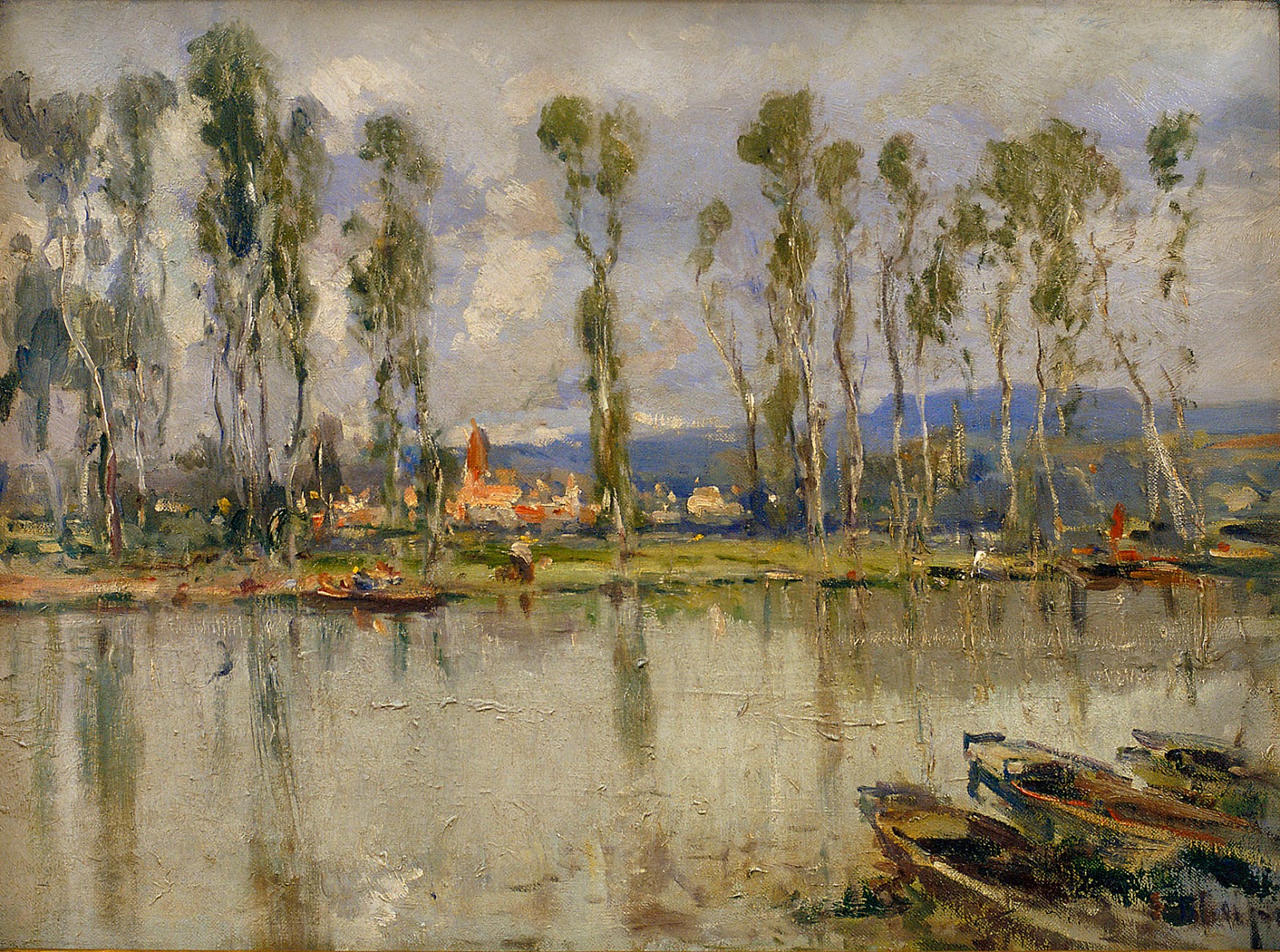
ART SUNDAY - ELISEU MAIFRÈN

“Life is like a landscape. You live in the midst of it but can describe it only from the vantage point of distance.” - Charles Lindbergh

Eliseu Meifrèn i Roig (24 December 1857/59, Barcelona - 5 February 1940, Barcelona) was a Catalonian Impressionist painter. After a conventional youth culminating with his enrolment at University to study medicine, Meifrèn decided that this was not his calling. Following his passion for art, he gave up the study of medicine and enrolled at the Escola de la Llotja, where his teachers were Antoni Caba and Ramon Martí Alsina.


In 1879, as a young man, he went to Paris and supported his studies by selling small canvases and sketches of cityscapes. His style was, however, decisively influenced by a brief tour of Italy. Upon his return to Spain in 1881, he participated in the National Exhibition of Fine Arts. Venice. The following year, he married, honeymooned in Paris, and settled there. His first personal exhibition came in 1890 at the Sala Parés in Barcelona, where he presented seventy oils in a rather conventional landscape style, and surprised everyone by auctioning off the works that did not sell, with his friend Santiago Rusiñol acting as the appraiser.


Meifrèn used the proceeds to return to Italy. In 1892, he went back to Paris and began to associate with the Impressionists, with his canvases showing their influence in his more adventurous use of colour. Five years later, he accepted an invitation from the President of the “Gabinete Literario”, and moved to Las Palmas in the Canary Islands. His home there became a makeshift art academy, where Néstor Martín-Fernández de la Torre was one of his students.


His fame peaked at the turn of the century, with exhibitions in South America as well as Europe. However, after the commercial failure of his works at the “Real Círculo Artístico de Barcelona”, he decided to move to Buenos Aires. He arrived there in 1903, held his first exhibition shortly after and organised a large exposition of Catalonian painters in 1904, including five pastels by Pablo Picasso.


In 1905, he was offered the position of Director at the “Escola de d’Arts i Oficis de Palma” on Mallorca, accepted, and moved again. He continued to travel however, to France, Italy, Buenos Aires and Brussels, where he participated in the International Exposition, winning the Silver Medal. In 1915, he travelled to the United States to promote himself at the Panama-Pacific International Exposition, receiving honourable mention, and won the Grand Prize at an exhibition in San Diego. He then settled briefly in New York, where he displayed his paintings of Mallorca and Cadaqués, a village where he had spent his summers since 1886.


Finally, in 1917, he returned to Barcelona to stay. His wife died in 1924 and he remarried in 1930. When the Spanish Civil War began, he and his family fled to Manresa, where they lived as refugees until 1939. In December of that year, his final exhibition was held in Barcelona at the Sala Gaspar. It was a critical and financial success, but he was too ill to attend. A few weeks later, his health worsened rapidly and he died in February.


Meifrèn was a very prolific, solid and skilful painter and stood out for his landscapes and seascapes, whose initial realism gradually opened up to the boldness of impressionism, although he did not fully espouse this influence until the 1920s–1930s. His later canvases are lively and fresh filled with the sun of the Mediterranean coast.


The painting above is “El Marne” from 1932, showing his fully developed impressionist style. The influence of Monet is apparent in both subject matter, colour and technique. The painting is an oil on canvas, 60.5 x 80.5 cm, and is exhibited in the Museu Nacional d’Art de Catalunya, in Barcelona.

Saturday, 20 February 2016

MUSIC SATURDAY - GEORG MUFFAT

“I’m not interested in having an orchestra sound like itself. I want it to sound like the composer.” - Leonard Bernstein

Georg Muffat (1 June 1653 – 23 February 1704) was a French Baroque composer. He is most well known for the remarkably articulate and informative performance directions printed along with his collections of string pieces Florilegium Primum and Florilegium Secundum (First and Second Bouquets) in 1695 and 1698.

Georg Muffat was born in Megève, Duchy of Savoy (now in France), and was of Scottish descent. He studied in Paris between 1663 and 1669, where his teacher is often assumed to have been Jean Baptiste Lully. This assumption is largely based on the statement: “For six years ... I avidly pursued this style which was flowering in Paris at the time under the most famous Jean Baptiste Lully.” This is ambiguous (in all of the languages in which it was printed) as to whether the style was flourishing under Lully, or that Muffat studied under Lully. In any case, the style which the young Muffat learned was unequivocally Lullian and it remains likely that he had at least some contact with the man himself.

After leaving Paris, he became an organist in Molsheim and Sélestat. Later, he studied law in Ingolstadt, afterwards settling in Vienna. He could not get an official appointment, so he travelled to Prague in 1677, then to Salzburg, where he worked for the archbishop for some ten years. In about 1680, he travelled to Italy, there studying the organ with Bernardo Pasquini, a follower of the tradition of Girolamo Frescobaldi; he also met Arcangelo Corelli, whose works he admired very much. From 1690 to his death, he was Kapellmeister to the bishop of Passau. Georg Muffat should not be confused with his son Gottlieb Muffat, also a successful composer.

Muffat was, as Johann Jakob Froberger before him, and Handel after him, a cosmopolitan composer who played an important role in the exchanges between European musical traditions. The information contained within the Florilegium Primum and Secundum is nearly unique. These performance directions were intended to assist German string players with the idiom of the French dance style, and include detailed rules for the tempo and order of bow strokes in various types of movement, as well as more general strategies for good ensemble playing and musicianship. These texts remain extremely valuable for modern historically-interested musicians.

Here are his 12 Concerti Grossi, played by Musica Aeterna conducted by Peter Zajíček.

Friday, 19 February 2016

FOOD FRIDAY - SUMMER PUDDING

“Summer is a promissory note signed in June, its long days spent and gone before you know it, and due to be repaid next January.” - Hal Borland

We have a range of fresh berries in the greengrocer’s at the moment and this is the time of the year that we get to enjoy a very traditional English dessert. It’s very simple to make, but making it taste good depends so much on the good quality of all the ingredients used.


English Summer Pudding

Ingredients
3 tbsp maraschino liqueur
180 g caster sugar
500 g washed, mixed summer fruits as available (raspberries, strawberries, red and blackcurrants, damsons and blackberries)
180 g plain sponge cake, cut into 1 cm slices
Whipped cream, or chilled vanilla yoghurt

Method

Stir the liqueur and sugar together and bring to a gentle boil. Add all the berries and fruits except strawberries. Stew the fruits very gently and not for too long. They should simply be softened but still retain their shape. Once they are ready put to one side (juice and all) and leave to cool.
Cut the slices of cake into triangles. They do not all have to match perfectly, but you will use these to line a 700 ml pudding basin.
Start by lining your pudding basin with cling film. Then continue by dipping a couple of cake triangles in the juices of the stewed fruits. Lay these in the bottom of the dish and then continue the same way but lining the sides of the basin with cake slices ensuring there are no gaps. Once completed, fill with the stewed fruits including the strawberries. Cover the top with more juice dipped cake slices.
Make sure to not add too much of the juices from the fruits as this may cause the cake to lose its shape. There must be enough to soak into the cake though. Place a saucer on the top of the basin and weigh down with something heavy. Place in the refrigerator and leave overnight. The next day, before serving, turn the pudding out onto a pretty serving plate and serve with either the whipped cream or chilled vanilla yoghurt.

Add your favourite recipes below using the Linky tool:


Thursday, 18 February 2016

ALL ABOUT GERBERAS

“The Japanese say, If the flower is to be beautiful, it must be cultivated.” - Lester Cole

Gerbera is a genus of plants in the Asteraceae (daisy) family. It was named in honour of German botanist and medical doctor Traugott Gerber (1710-1743) who travelled extensively in Russia and was a friend of Carl Linnaeus. Gerbera is native to tropical regions of South America, Africa and Asia. The first scientific description of a Gerbera was made by J.D. Hooker in Curtis’s Botanical Magazine in 1889 when he described Gerbera jamesonii, a South African species also known as Transvaal daisy or Barberton Daisy. Gerbera is also commonly known as the African Daisy.


Gerbera species bear a large capitulum with striking, two-lipped ray florets in yellow, orange, white, pink or red colours. The capitulum, which has the appearance of a single flower, is actually composed of hundreds of individual flowers. The morphology of the flowers varies depending on their position in the capitulum. The flower heads can be as small as 7 cm (Gerbera mini 'Harley') in diameter or up to 12 cm (Gerbera ‘Golden Serena’). Gerbera is very popular and widely used as a decorative garden plant or as cut flowers. The domesticated cultivars are mostly a result of a cross between Gerbera jamesonii and another South African species Gerbera viridifolia. The cross is known as Gerbera hybrida. Thousands of cultivars exist. They vary greatly in shape and size. Colours include white, yellow, orange, red, and pink. The centre of the flower is sometimes black. Often the same flower can have petals of several different colours.


Gerbera is also important commercially. It is the fifth most used cut flower in the world (after rose, carnation, chrysanthemum, and tulip). It is also used as a model organism in studying flower formation. Gerbera contains naturally occurring coumarin derivatives. Gerbera is a tender perennial plant. It is attractive to bees, butterflies and/or birds, but resistant to deer. Their soil should be kept moist but not soaked.


Divide up your own gerbera clumps in late Summer or Autumn outside the tropics, or all year round in northern Australia. When planting gerberas make sure that the crown (the part of the plant from which the new growth arises) is 1-2cm above the soil level. This will reduce the likelihood of disease such as rot, which affect the crown and stems.


As cut flowers gerberas are available at florist shops most of the year. If you are growing gerberas yourself, you can pick your own flowers. Pick flowers that are fully open. As cut flowers gerberas should last 10 to 14 days. Careless picking can leave behind a spot that can become infected. Instead of cutting the stem, waggle it at its base until it pulls away cleanly. To arrange the flower cut off the hairy white part on the bottom of the stem, or the flower won’t be able to absorb any water.


In the language of flowers, white gerberas indicate innocence; yellow Gerberas say “I’ll try harder” and orange gerberas say “You are my sunshine”; red gerberas signify “You are a beauty”, while a bouquet of multicoloured gerberas means “cheer up!”.


This post is part of the Floral Friday Fotos meme.

Wednesday, 17 February 2016

POETS UNITED - MARRIAGE

“Since a politician never believes what he says, he is quite surprised to be taken at his word.” - Charles de Gaulle

This week, PoetsUnited has as its theme “Marriage”. My take on this motif is a little unconventional. Here is my offering:

A Marriage of Convenience

The wily politician, has ample words;
So many words that spout forth seductively:
A demagogue inciting followers effortlessly
To ill-advised and thoughtless actions.

He espouses home-grown values,
Homeland, family, religion all uppermost
In his diatribes, while hypocrite that he is,
Has secret vices that make even the broad-minded blush.

His actions wedded to his specious arguments,
Ostensibly show him to be the champion of freedom,
But really fan flames of hatred, bigotry, intolerance
And lead the masses to violent altercations.

He flaunts his trophy wife at every opportunity,
And uses her to gain political advantage,
To further his nefarious aspirations
And breed his dynasty, ensuring a line of succession.

A liar pledging his troth easily
To any cause that furthers his designs,
All his untruths are easily swallowed by the gullible,
Allowing him to quickly ascend the staircases of power.

The politician marries his public office
In a marriage of convenience,
And as we the people, officiate the travesty,
We give him free reign to do as he will with our lives…

The painting above is “The Orator”, by Magnus Zeller (Germany, 1888-1972), painted circa 1920.

Tuesday, 16 February 2016

TRAVEL TUESDAY #14

“Happy is he who has gained the wealth of divine thoughts, wretched is he whose beliefs about the gods are dark.” - Empedocles

Welcome to the Travel Tuesday meme! Join me every Tuesday and showcase your creativity in photography, painting and drawing, music, poetry, creative writing or a plain old natter about Travel!

There is only one simple rule: Link your own creative work about some aspect of travel and share it with the rest us! Please use this meme for your creative endeavours only.

Do not use this meme to advertise your products or services as any links or comments by advertisers will be removed immediately.
The Temple of Olympian Zeus (Greek: Ναός του Ολυμπίου Διός, Naos tou Olympiou Dios), also known as the Olympieion or Columns of the Olympian Zeus, is a colossal ruined temple in the centre of the Greek capital, Athens, that was dedicated to Zeus, king of the Olympian gods. Construction began in the 6th century BC during the rule of the Athenian tyrants, who envisaged building the greatest temple in the ancient world, but it was not completed until the reign of the Roman Emperor Hadrian in the 2nd century AD some 638 years after the project had begun.

During the Roman periods it was renowned as the largest temple in Greece and housed one of the largest cult statues in the ancient world. The temple's glory was short-lived, as it fell into disuse after being pillaged in a barbarian invasion in the 3rd century AD. It was probably never repaired and was reduced to ruins thereafter. In the centuries after the fall of the Roman Empire, it was extensively quarried for building materials to supply building projects elsewhere in the city. Despite this, a substantial part of the temple remains today, and it continues to be a major tourist attraction.

Fifteen columns remain standing today and a sixteenth column lies on the ground where it fell during a storm in 1852. Nothing remains of the cella or the great statue that it once housed. The temple was excavated in 1889-1896 by Francis Penrose of the British School in Athens (who also played a leading role in the restoration of the Parthenon), in 1922 by the German archaeologist Gabriel Welter and in the 1960s by Greek archaeologists led by Ioannes Travlos.

The temple, along with the surrounding ruins of other ancient structures, is a historical precinct administered by Ephorate of Antiquities of the Greek Interior Ministry. On 21 January 2007, a group of Hellenic neopagans held a ceremony honouring Zeus on the grounds of the temple. The event was organised by "Ellinais", an organisation which won a court battle to obtain recognition for Ancient Greek religious practices in the Autumn of 2006.

This post is part of the Our World Tuesday meme,
and also part of the Wordless Wednesday meme.

Monday, 15 February 2016

MOVIE MONDAY - THE BAFTAs

“There’s a lot of great movies that have won the Academy Award, and a lot of great movies that haven’t. You just do the best you can.” - Clint Eastwood

The British Academy of Film and Television Arts (BAFTA) is an independent charity that supports, develops and promotes the art forms of the moving image – film, television and game in the United Kingdom. In addition to its annual awards ceremonies, BAFTA has an international, year-round programme of learning events and initiatives offering access to talent through workshops, masterclasses, scholarships, lectures and mentoring schemes in the UK and the USA.

BAFTA started out as the British Film Academy, was founded in 1947 by a group of directors David Lean, Alexander Korda, Roger Manvell, Laurence Olivier, Emeric Pressburger, Michael Powell, Michael Balcon, Carol Reed, and other major figures of the British film industry. David Lean was the founding Chairman of the Academy. The first Film Awards ceremony took place in May 1949 and honouring the films “The Best Years of Our Lives”, “Odd Man Out” and “The World Is Rich”.


The Guild of Television Producers and Directors was set up in 1953 with the first awards ceremony in October 1954, and in 1958 merged with the British Film Academy to form the Society of Film and Television Arts, whose inaugural meeting was held at Buckingham Palace and presided over by HRH The Duke of Edinburgh. In 1976, HM The Queen, The Duke of Edinburgh, The Princess Royal and The Earl Mountbatten of Burma officially opened the organisation’s headquarters at 195 Piccadilly, London, and in March the Society officially became known as the British Academy of Film and Television Arts.


BAFTA’s annual film awards ceremony is known as the British Academy Film Awards, or “the BAFTAs”, and reward the best work of any nationality seen on British cinema screens during the preceding year. In 1949 the British Film Academy, as it was then known, presented the first awards for films made in 1947 and 1948. Since 2008 the ceremony has been held at the Royal Opera House in London’s Covent Garden, having previously been held in the Odeon cinema on Leicester Square since 2000. The ceremony previously was performed during April or May of each year, but from 2002 since it has been held in February to precede the Academy of Motion Picture Arts and Sciences’ (AMPAS) Academy Awards, or Oscars.


In order for a film to be considered for a BAFTA nomination its first public exhibition must be displayed in a cinema and it must have a UK theatrical release for no fewer than seven days of the calendar year that corresponds to the upcoming awards. A movie must be of feature length and movies from all countries are eligible in all categories, with the exception of the Alexander Korda Award for Outstanding British Film and Outstanding Debut, which are for British films or individuals only.


The 69th BAFTAs Award Ceremony was held on 14 February 2016 at the Royal Opera House in London. The nominees were announced on 8 January 2016 by Stephen Fry and actress Gugu Mbatha-Raw, with “Bridge of Spies” and “Carol” both having the most nominations at 9 each.  The ceremony was broadcast on BBC One with a two hour delay. The ceremony was watched by 4.5 million people, down from 4.9 million viewers in 2015 and the lowest television audience since 2010.


Despite leading the field in nominations with nine each, “Carol” failed to gain any awards and “Bridge of Spies” won only one; Mark Rylance for Best Supporting Actor. The American film “The Revenant” won the most awards at the event, winning five including Best Film. Director Alejandro G. Iñárritu won the award for Best Director, Emmanuel Lubezki for Best Cinematography and Leonardo di Caprio won the award for Best Actor. Di Caprio's win was his first from four nominations. Lubezki's win was his third consecutive BAFTA, and fourth in total, having previously won awards for “Children of Men”, “Gravity” and “Birdman”. Other winners in the acting categories included Brie Larson, who won Best Actress for her role in “Room”, and Kate Winslet, who won Best Supporting Actress for her role in “Steve Jobs”. Winslet’s win was her third BAFTA. “Mad Max: Fury Road” won four BAFTAs in the editing, production design, costume design and makeup and hair categories. Sidney Poitier was awarded the Academy Fellowship for his contribution to cinema.


Many people regard the BAFTAs as the event to watch in order to predict possible winners for the Oscars, and although there are often concordances, in many other cases the awards are quite disparate. The full list of BAFTA Awards can be found on their website (http://www.bafta.org/)

Sunday, 14 February 2016

ART SUNDAY - LUDVÍK KUBA

“The streets of Prague were a fantasia scarcely touched by the twenty-first century – or the twentieth or nineteenth, for that matter. It was a city of alchemists and dreamers, its medieval cobbles once trod by golems, mystics, invading armies. Tall houses glowed goldenrod and carmine and eggshell blue, embellished with Rococo plasterwork and capped in roofs of uniform red. Baroque cupolas were the soft green of antique copper, and Gothic steeples stood ready to impale fallen angels.” - Laini Taylor

Ludvík Kuba (April 16, 1863 in Poděbrady, Bohemia – November 30, 1956 in Prague) was a Czech landscape painter, musician, writer, and a professor in the Academy of Fine Arts. He was a representative of late Impressionism, but was also very interested in folk culture of the Balkans, collecting folksongs, folk tales, customs and cultural heritage.

Kuba was the second of eleven children of Ludvík Luba Sr, a locksmith, and his wife Anna, née Mikšovský. Ever since his youth the young Ludvík showed artistic leanings and of his siblings, only his brother Charles shared this, later becoming a blacksmith specialising in decorative ironwork. Apart from drawing Kuba had talent in music, gradually learning to play the violin, piano, organ and other musical instruments. From 1873 he attended primary school in Podebrady.

In the years 1877 - 1879 he studied at the Prague Organ School at Francis Zdenek Skuherského. He then undertook further studies at the pedagogical institute in Kutna Hora, the director of which at that time was Gustav Adolf Lindner. There, he often painted parts of the historic city and its surroundings. At the same time he began to study Slavic languages and was interested in ethnographic study. After graduating in 1883 he worked for two years as an assistant teacher and also intensively worked on the first volume of the collection “Slavonic Peoples in their Songs”, which came out in 1884. In the same year he decided to leave his teaching career and pursue a profession as an ethnographer and writer. He undertook frequent study trips to Lausitz, Halič, Ukraine and Russia. Most often, however, he visited the Balkans, Montenegro, Bosnia and Herzegovina.

From 1888 he decided to continue his painting education, and at Karl Liebscher’s recommendation, he enrolled in 1891 in the Prague Academy of Painting. In 1893 he went to Paris, where he studied painting at the private Académie Julian. This trip was important to as it was there he met his compatriot Olga Joujovou, who in 1895 became his wife. Soon after the wedding, the couple went to Mostar where Kuba wanted to paint a cycle of Slav traditional life. But this failed to be completed because it seemed to him that he was not sufficiently in control of the technique of oil painting.

He decided to study painting further, this time in Munich, with Slovenian painter Anton Ažbeho. Kuba lived in Vienna between 1904 and 1910, and then, before returning to his homeland, he undertook a three-month trip to Italy, where he visited major art centres, Venice, Florence, Rome and Naples. From 1911 he settled in Prague. After some disagreements with the Artistic Association Mánes he mainly focused on ethnographic activities, for which he received over the years a number of awards at home and abroad. He undertook a study tour and worked on compiling collections of Slavic Folksong.

In 1921 he traveled regularly with his family to Březnice Pribram, where the parents of his wife had their house. Here he painted genre pictures of the town and surrounding area. From there he also went on trips to paint landscapes in South Bohemia.  In 1937 he participated as a member of an official delegation in an exhibition of Czechoslovak art in Moscow.

During his long life he painted prolifically and almost until the end of his life organised exhibitions of his paintings. He collected over 4,000 folk songs and published widely on ethnographic and folk musical matters. He died in Prague on 30 November 1956 at the age of 93 years. The urn with his ashes was in possession of his only son, Louis Maria Cuba until 1992, when it was deposited in the Urn Grove in Kluk (Poděbrady).

The painting above is “Square in Pardubice”, painted in 1911. This was when the artist had come back to Prague after his further studies in Vienna and this is a confident, freely executed work, capturing the vivid sunlight and bold triangular shadowy area on the left, which nevertheless highlights the warmly glowing ornate building façades.

Saturday, 13 February 2016

MUSIC SATURDAY - LIEBESTOD

“Let no one who loves be called altogether unhappy. Even love unreturned has its rainbow.” - J.M. Barrie

In the early 1850s, Richard Wagner (1813-1883) began reading the works of the German philosopher Arthur Schoepenhauer (1788-1860). For Schoepenhauer, music occupied a station above all other arts, including poetry, which meant that the text of an opera was relegated to a supporting role. Wagner resonated to this ad he started to show evidence of his exposure to Schoepenhauer by the mid-1850s. “Tristan und Isolde”, the composer’s major operatic project of the decade reflected this influence and the music of the opera assumed an overarching role, soaring above and beyond the lyrics.

Until “Tristan und Isolde”, no one had quite imagined the extent to which music alone could embody drama. In one long musical utterance, Wagner lays bare the inner lives of the opera’s title characters, as their love, doomed from its beginning, finds fulfillment in death. The “Prelude and Liebestod” (Love-Death) comprise the beginning and ending of the opera.

The Prelude opens with the cellos softly playing four notes. The last note fades into an extraordinary chord played by oboes, bassoons, and English horn. This chord, the famous “Tristan chord,” sounds strange because it is an unresolved dissonance, an academic way of saying that it sounds like it is leading to something which our ear finds acceptable and “final”. But because Wagner, at this point, withholds resolution, the chord is, at this point, a beginning without an end.

What follows is a lush orchestral work that charts the psychology of the opera, which itself explores the unexplainable, primal nature of love. The chord returns during the course of the opera, but it is only resolved during the work’s final, ecstatic closing “Liebestod”. It is the culmination of the opera’s tragic events, set in motion when Tristan and Isolde drink a love potion. Tristan, though, has claimed Isolde on behalf of his lord, King Marke. When Marke discovers the lovers together, one of the king’s knights stabs Tristan, who returns to his fortress to die.

Isolde has just arrived to find Tristan dead when the “Liebestod” begins. Her worldly surroundings fade away as she contemplates sinking unconscious into supreme bliss and finally consummating her love with Tristan in death. The passage builds to a climax as “waves of refreshing breezes” begin envelop Isolde (at the words “Heller schallend, mich umwallend” i.e. “Sounding more clearly, wafting around me”) and again as she imagines expiring in “the vast wave of the world’s breath” (“in des Welt-Atems wehendem All”). She sinks down as the winds, over luminous violins, float to a final and satisfying resolution of the “Tristan chord” from the Prelude.

Here is the orchestral version of the “Prelude and Liebestod” played by the Chicago Symphony Orchestra conducted by Georg Solti.

And here is Stephen Fry exploring the “Tristan chord” and its significance to modern music.

And the painting above is “Tristan and Iseult” depicted by Edmund Blair Leighton (1853–1922).

Friday, 12 February 2016

FOOD FRIDAY - RATATOUILLE

“If you have a garden and a library, you have everything you need.” - Marcus Tullius Cicero

One of the prime joys of our back garden is the great variety of flowers that we have growing. Many annuals, flowering perennials, many rose bushes, Spring bulbs, summer tubers, etc. To have fresh blossoms for one’s vase, to wander in amongst the greenery and inhale the fragrance is wonderful. There is also a secondary joy, which is the inclusion of seasonal vegetables in amongst the flowers. Now in the summer garden, we have a couple of zucchini vines, some patio tomatoes, cucumbers, eggplants, capsicums and of course herbs.


It is so good to be able to pick garden fresh, organic produce from one’s own garden and make lunch or dinner! We made such a dish a couple of days ago, with our very own produce. Here is the recipe. If you do not have a garden, you are allowed to buy the vegetables at the greengrocer…


Ratatouille

Ingredients
2/3 cup extra-virgin olive oil
1 tbsp. dried, chopped herbes de Provence (tarragon, savory, sage, thyme, marjoram)
6 cloves garlic, smashed and peeled
2 large yellow onions, quartered
1 bay leaf
2 medium zucchini (about 500 g), cut into 5 cm pieces
1 medium eggplant (about 400 g.), cut into 5 cm pieces
1 red bell pepper, stemmed, seeded, and quartered
1 yellow bell pepper, stemmed, seeded, and quartered
10 whole peeled ripe tomatoes (or use canned tomatoes)
Salt and freshly ground black pepper, to taste
1 tbsp. chopped fresh basil leaves
1 tbsp. chopped fresh flat-leaf parsley

Method
Preheat oven to 200˚C.
Heat oil in a 6-Litre Dutch oven over medium heat. Add herbes de Provence, garlic, onions, and bay leaf; cover and cook, stirring occasionally, until soft and fragrant, about 10 minutes.
Increase heat to high; stir in the zucchini, eggplant, peppers, and tomatoes and season with salt and pepper. Uncover pot, transfer to the oven, and bake, stirring occasionally, until vegetables are tender and lightly browned, about 1 and 1⁄2 hours.
Stir in basil and parsley, transfer ratatouille to a serving bowl, and serve warm or at room temperature.
Add your favourite recipe below using the Linky tool.


Thursday, 11 February 2016

CORNFLOWERS

"A flower cannot blossom without sunshine, and man cannot live without love." - Max Müller

Centaurea cyanus (commonly known as cornflower, bachelor’s button, bluebottle, boutonniere flower, hurtsickle or cyani flower), is an annual flowering plant in the family Asteraceae, native to Europe. The name “cornflower” is also used for chicory, and a few other Centaurea species; to distinguish C. cyanus from these it is sometimes called common cornflower.

It is an annual plant growing to 40-90 cm tall, with grey-green branched stems. The leaves are lanceolate, 1–4 cm long. The flowers are most commonly an intense blue colour, produced in flowerheads (capitula) 1.5–3 cm diameter, with a ring of a few large, spreading ray florets surrounding a central cluster of disc florets. The blue pigment is protocyanin, which in roses is red because of the specific chemical environment of the rose petals.

In the past this flower often grew as a weed in cornfields (in the broad sense of the word “corn”, referring to grains, such as wheat, barley, rye, or oats), hence its name. It is now endangered in its native habitat by agricultural intensification, particularly over-use of herbicides, destroying its habitat; in the United Kingdom it has declined from 264 sites to just 3 sites in the last 50 years. In reaction to this, the conservation charity Plantlife named it as one of 101 species it would actively work to bring ‘Back from the Brink’. It is also, however, through introduction as an ornamental plant in gardens and a seed contaminant in crop seeds, now naturalised in many other parts of the world, including North America and parts of Australia.

Several cultivars have been selected to grow as an ornamental plant in gardens with varying pastel colours, including white, pink and purple. Centaurea is also grown for the cut flower industry in Canada for use by florists. The most common colour variety for this use is a doubled blue variety such as 'Blue Boy' or 'Blue Diadem'. White, pink, lavender and black (actually a very dark maroon) are also used but less commonly. It is also occasionally used as a culinary ornament.

Cornflowers have been used and prized historically for their blue pigment. Cornflowers are often used as an ingredient in some tea blends and herbal teas, and are famous in the Lady Grey blend of Twinings tea. A relative, Centaurea montana, is a perennial plant which is also cultivated as a garden plant. Cornflowers germinate quickly after planting in full sun. It flowers all summer. The cornflower is considered a beneficial weed, and its edible flower can be used to add colour to salads.


In folklore, cornflowers were worn by young men in love; if the flower faded too quickly, it was taken as a sign that the man’s love was not returned. In traditional Western herbalism, a decoction of cornflower is used in treating conjunctivitis, and as a wash for tired eyes. The blue cornflower has been the national flower of Estonia since 1968 and symbolizes daily bread to Estonians. The blue cornflower was also one of the national symbols of Germany, while in Austria the blue cornflower is a political symbol for pan-German and rightist ideas.


In France the "Bleuet de France" is the symbol of the 11th November 1918 armistice and, as such, a common symbol for veterans (especially the now defunct poilus of World War I), similar to the Remembrance poppies worn in the United Kingdom, Australia and in Canada. The cornflower is also the symbol for motor neurone disease and amyotrophic lateral sclerosis.


The cornflower is also often seen as an inspiration for the German Romantic symbol of the “Blue Flower”. A Blue Flower (German: Blaue Blume) is a central symbol of inspiration. It stands for desire, love, and the metaphysical striving for the infinite and unreachable. It symbolises hope and the beauty of things. The blue flower also symbolises the joining of human with nature and the spirit, so that a complete understanding of nature and the human’s place in it is reached.


This post is part of the Floral Friday Fotos meme,

and also part of the Blue Monday meme.

Wednesday, 10 February 2016

POETS UNITED - THE INANIMATE

“And you left your mark on me... With the destruction of us, finally, we became no one.” ― Nadège Richards

This week, PoetsUnited has as its Midweek Motif, “The Inanimate & The Non-Human”. We humans are so anthropocentric that it is seldom that we do not imbue the inanimate and non-human with human qualities… Here is my poem:

Your Door

When I loved you, I loved you so
That even your door, shut as it was,
Was a thing beloved.
When I loved you, I loved you so
That I had to spend each night outside your window,
Until you turned off your light.
When I loved you, I loved you so
That tears would flow from my eyes,
Whenever I but thought of you.

Now so much time has passed,
That your door, even though open wide,
For me has no appeal.
Now so many things have come between us,
That even though your light burns all night,
I would not even know it.
Now so much has my heart hardened,
That the tears that you may shed for me
Are but scattered raindrops in a parched desert.

Tuesday, 9 February 2016

TRAVEL TUESDAY #13

“Egypt is not a country we live in but a country that lives within us.” - Pope Shenouda III

Welcome to the Travel Tuesday meme! Join me every Tuesday and showcase your creativity in photography, painting and drawing, music, poetry, creative writing or a plain old natter about Travel!

There is only one simple rule: Link your own creative work about some aspect of travel and share it with the rest us!

Please use this meme for your creative endeavours only. Do not use this meme to advertise your products or services as any links or comments by advertisers will be removed immediately.
The Great Pyramid of Giza (also known as the Pyramid of Khufu or the Pyramid of Cheops) is the oldest and largest of the three pyramids in the Giza pyramid complex bordering what is now the suburb of Cairo, El Giza, in Egypt. It is the oldest of the Seven Wonders of the Ancient World, and the only one to remain largely intact.

Based on a mark in an interior chamber naming the work gang and a reference to fourth dynasty Egyptian Pharaoh Khufu, Egyptologists believe that the pyramid was built as a tomb over a 10 to 20-year period concluding around 2560 BC. Initially at 146.5 metres, the Great Pyramid was the tallest man-made structure in the world for more than 3,800 years. Originally, the Great Pyramid was covered by casing stones that formed a smooth outer surface; what is seen today is the underlying core structure. Some of the casing stones that once covered the structure can still be seen around the base.

There have been varying scientific and alternative theories about the Great Pyramid's construction techniques. Most accepted construction hypotheses are based on the idea that it was built by moving huge stones from a quarry and dragging and lifting them into place. There are three known chambers inside the Great Pyramid. The lowest chamber is cut into the bedrock upon which the pyramid was built and was unfinished. The so-called Queen's Chamber and King's Chamber are higher up within the pyramid structure.

The main part of the Giza complex is a setting of buildings that included two mortuary temples in honour of Khufu (one close to the pyramid and one near the Nile), three smaller pyramids for Khufu's wives, an even smaller “satellite” pyramid, a raised causeway connecting the two temples, and small mastaba tombs surrounding the pyramid for nobles.

This post is part of the Our World Tuesday meme,
and also part of the Wordless Wednesday meme.

Monday, 8 February 2016

MOVIE MONDAY - THE RED SHOES

“The dance can reveal everything mysterious that is hidden in music, and it has the additional merit of being human and palpable. Dancing is poetry with arms and legs.” - Charles Baudelaire

Last week we watched a classic old film, which although I had heard lots about I had never actually seen. It was Michael Powell’s and Emeric Pressburger’s 1948 film “The Red Shoes”, starring  Anton Walbrook, Marius Goring, Moira Shearer and Robert Helpmann. It is loosely based on a Hans Christian Andersen fairy tale, but is more of a chronicle of the world of ballet dancers, teachers and impresarios. It is one of the early British colour films and it quickly became one of the most popular British films in the post-WWII period. The film is included among the “1001 Movies You Must See Before You Die”, edited by Steven Schneider.

The film has original music by Brian Easdale and cinematography by Jack Cardiff, and is well regarded for its creative use of Technicolor. Filmmakers such as Brian De Palma and Martin Scorsese have named it one of their all time favourite films. The movie employs the story within a story device, with the lives of the dancers, choreographers and impresarios being the main story, and a ballet they are producing being the other story. The film includes a staging of the ballet they are working on, which runs for about 15 minutes.

The plot is as follows: Under the authoritarian rule of charismatic ballet impresario Boris Lermontov (Wallbrook), his protégés realise the full promise of their talents, but at a price: Utter devotion to their art and complete loyalty to Lermontov himself. Under his near-obsessive guidance, young ballerina Victoria Page (Shearer) is poised for superstardom, but earns Lermontov’s scorn when she falls in love with Julian Craster (Goring), composer of “The Red Shoes”, the ballet Lermontov is staging to showcase her talents. Vicky leaves the company and marries Craster, but still finds herself torn between Lermontov’s demands and those of her heart.

Pressburger originally wrote the screenplay for Alexander Korda as a vehicle for Korda’s future wife Merle Oberon. After some years had passed without the film being made, Powell and Pressburger rewrote the screenplay, including more emphasis on dancing, and produced it themselves. Powell and Pressburger decided early on that they had to use dancers who could act rather than actors who could dance a bit. To create a realistic feeling of a ballet company at work, and to be able to include a fifteen-minute ballet as the high point of the film, they created their own ballet company using many dancers from The Royal Ballet. The principal dancers were Robert Helpmann (who also choreographed the main ballet), Léonide Massine (who also choreographed the role of The Shoemaker), Ludmilla Tchérina and Moira Shearer.

Boris Lermontov is the film’s dominant character, and is an obvious portrait of Sergei Pavlovich Dyagilev (1872-1929), one of the 20th century’s greatest cultural figures and the driving force of the ‘Ballets Russes’. Walbrook plays this character with restraint and is a perfect “bad guy” in a gentlemanly sort of way. Shearer and Goring as the lovers are rather more conventional leading actors and give good but perhaps slightly clichéd performances. Nevertheless Shearer is quite enchanting once she starts to dance.

The film gives an insight into the creative process in the arts, especially so the ballet, but also highlights the sad lot of the composer of the music used in ballet… The conflict between professional life and personal is well depicted, as well the way that true artists are passionate about their art. One exchange that stuck with me was: “Why do you want to dance?” Boris Lermontov asks Victoria Page; “Why do you want to live?”, is her response.

The 15 minute ballet “The Red Shoes” is a highlight of the film and this is a gloriously cinematic view of a ballet sequence. The music conducted flawlessly by Sir Thomas Beecham suits the action well and the choreography by Robert Helpmann and Leonide Massine is amazing. The glorious Technicolor cinematography by Jack Cardiff is quite stunning. Incidentally, we watched the film on Bluray, which was the copy of the 2006 digital restoration of the film done by Warner Bros. Motion Picture Imaging. The digital pictures were frame by frame digitally restored at Prasad Corporation to remove dirt, tears, scratches, and other artifacts, giving the film its original look.

Quite an amazing film and indeed well worth looking at, especially if you like ballet, music, the arts and the creative process.

Sunday, 7 February 2016

ART SUNDAY - ANDRÉ DERAIN

“I do not innovate. I transmit.” - Andre Derain

André Derain (1880-1954) was considered by leading critics in the 1920s to be the most outstanding French avant-garde painter and at the same time the upholder of the classical spirit of French tradition. He was born on June 10, 1880, in Chatou, and began to paint when he was about 15. He studied at the Academy Carrière in Paris (1898-1899), where he met Henri Matisse. Derain was a close friend of Maurice Vlaminck, with whom he shared a studio in 1900 and also his radical views on painting, literature, and politics.

Derain was drawn, through Vlaminck and Matisse, into the art movement known as Fauvism. Derain’s first artistic attempts were interrupted by military service (1901-1904), after which he devoted himself exclusively to art. He experienced impressionism, divisionism, the style of Paul Gauguin and Vincent Van Gogh, and Vlaminck’s and Matisse’s techniques by applying them to his own work. He copied in the Louvre and travelled a great deal in France to paint its various landscapes. He spent the summer of 1905 at Collioure with Matisse and that fall exhibited with the Fauves.

The art dealer Ambrose Vollard signed a contract with Derain in 1905, and the following year the artist went to London to paint some scenes of the city commissioned by Vollard. Derain’s Westminster Bridge is one of his Fauve masterpieces. About 1908 Derain became interested in African sculpture and at the same time explored the work of Paul Cézanne and early cubism. He became a friend of Pablo Picasso and worked with him in Catalonia in 1910.

In Derain’s work, which comprises landscapes, figure compositions (sometimes religious), portraits, still lifes, sculptures, decors for ballets, and book illustrations, we can discern various periods, all of which are distinguished by masterpieces. About 1911 he was attracted by Italian and French primitive masters; he also admired the “primitive” art of Henri Rousseau.

After World War I, during which Derain served at the front, he studied the masters of the early Renaissance and then Pompeian art. All these left traces in his work. Finally he emerged as a realist and intensified his contact with nature. In rejecting the cerebral art of cubism and abstraction, he defended the return of the human figure to painting. His development as an artist was dramatic, and although Picasso called him a guide de musées, in other words, not an innovator but a traditionalist, Derain's best work will survive many of the experimental attempts of his contemporaries because of its inherent painterly qualities.

Toward the end of his life Derain lived, practically forgotten, in his country home at Chambourcy. The retrospective exhibition in Paris in 1937 was the climax of his fame. He died in Garches on Sept. 2, 1954. The large retrospective exhibitions organized from 1955 to 1959 established a new appreciation of Derain as a major artist.

The painting above is “The Dance”, painted in 1906. After receiving an African fang mask in 1906 by one of Derain’s fauvist contemporaries, Derain started an impressive collection of African art. “The Dance” is an example of the influence that Derain’s African art collection had on his painting. The painting features a brightly coloured landscape, with three main human figures and one figure in the background. The piece references both African art and Fauvism. With the wildly, vibrant colours its apparent that the painting is fauvist in nature. The rest of the painting references African art through African masks, primitive body painting, and curvy forms that reflect ancient stylised female figurines. These heads reflect African fang masks, in particular the face of the figure on the very left. Overall, the canvas is full of vibrant colour, exuberant movement and a rhythm that typifies vivacious African dances.