Sunday, 27 July 2008

ART SUNDAY - WHISTLER


“As music is the poetry of sound, so is painting the poetry of sight.” – James Abbott McNeill Whistler

A painting by James Abbott McNeill Whistler (1834-1903) today: “Portrait of the Artist's Mother Arrangement in Grey and Black” 1871 - Musee d'Orsay, Paris (144.3 x 162.4 cm).

James Abbot McNeill Whistler was born in America, yet he spent much of his life abroad. Early years were spent in Russia and then in London, only moving back to America with his family out of necessity when his father died of cholera. While a child in Russia, Whistler had attended drawing classes, but it wasn't until 1855 after dropping out of West Point Military Academy that he embarked on an artistic career. He moved back to Europe from America, settling in Paris.

This was the beginning of a lifetime commitment to art. He quickly made his presence felt due to his flamboyant, eccentric ways. He would go about Paris wearing a straw hat, a white suit, highly polished black patent leather shoes and a monocle. Whistler first achieved critical and commercial success as an etcher, producing meticulously drawn prints of working-class life in rural France and London. His earliest important oil paintings evidence Courbet's influence, featuring the commonplace subjects and vigorous brushwork characteristic of the older artist's work.

Whistler's art changed dramatically in the 1860s. Influenced by Greek sculpture, Asian porcelain, and Japanese prints, he rejected the idea that the success of an art object could be measured by its accuracy as a representation or the effectiveness with which it told a story or suggested a moral. Instead, he became convinced that an art object was best understood as an autonomous creation to be valued only for the success with which it organized color and line into a formally satisfying and therefore beautiful whole. Abandoning the idea that paintings should create the illusion of pictorial depth, he developed the flatter, more purely decorative style for which he is best known.

In 1863 Whistler's mother moved to England to be with her son. In 1871 his style moved towards greater simplicity when he painted “Arrangement in Grey and Black: Portrait of the Painter's Mother”. The figure sits in profile on a light background. The horizontal lines of the skirting boards are what holds the elements in place. The only decoration seen in the light dabs of paint defining a pattern on the curtain. The great expanses of black and grey make this portrait an extremely formal one, something re-enforced by the stiff pose of the sitter. The portrait perhaps hints at the relationship Whistler had with his mother. He paints a woman who gazes straight ahead and who sits stiffly and inflexibly. Her face still has vestiges of beauty, although her age has tempered perhaps her once joyful mien. Her son was a roué and his life of pleasure and wastrel ways could hardly find approval with this woman, one would think. Whistler paints a conservative, cold portrait of a woman he perhaps respects more than he loves…

Saturday, 26 July 2008

DEDICATION


“The bond that links your true family is not one of blood, but of respect and joy in each other's life.” - Richard Bach


My Very Own Strangers
My very own strangers, the most distant ones,
Are those who live with me.
I look at them, I touch them, I speak to them,
I open my heart to them.
But each one travels alone,
In his own unknown soul;
Each one fights for his life,
In his own foreign land.
My very own strangers, the most beloved ones…
My very own people live far away,
And love from afar.
Thus the world grows, but so does the heart,
And we remember thus, wherever we may go.
But each travels on his own,
Searching for his soul mate.
And on the pieces of his crystal heart,
Carves his own truth.
My very own people, my heart’s places…

Οι Δικοί Μου Ξένοι

Οι δικοί μου ξένοι, οι πιο μακρινοί,
Είναι αυτοί που ζουν κοντά μου.
Τους κοιτάζω, τους αγγίζω, τους μιλώ,
Τους ανοίγω την καρδιά μου.
Μα καθένας ταξιδεύει μοναχός
Μες στην άγνωστη ψυχή του
Ο καθένας στη δική του ξενιτιά
Πολεμάει για τη ζωή του.
Οι δικοί μου ξένοι, είναι οι αγαπημένοι…

Οι δικοί μου ανθρώποι ζούνε μακριά,
Κι από μακριά αγαπάνε.
Κι έτσι μεγαλώνει ο κόσμος κι η καρδιά,
Και θυμόμαστε όπου πάμε.
Μα ο καθένας ταξιδεύει μοναχός,
Κι αδελφή ψυχή γυρεύει.
Και στα κρύσταλλα κομμάτια της καρδιάς
Την αλήθεια του λαξεύει.
Οι δικοί μου ανθρώποι της καρδιάς μου οι τόποι,
Οι δικοί μου ανθρώποι της καρδιάς μου οι τόποι.

“Family quarrels are bitter things. They don't go by any rules. They're not like aches or wounds; they're more like splits in the skin that won't heal because there's not enough material.” - F. Scott Fitzgerald

Friday, 25 July 2008

MERRY CHRISTMAS!


“I will honour Christmas in my heart, and try to keep it all the year.” - Charles Dickens

Merry Christmas! Yes, it’s Christmas in July in Australia. It is a typically Australasian tradition and it is being celebrated increasingly “as a bit of fun”. The beginnings of the tradition are sometimes attributed to an Irish tourist group that enjoyed the winter snow in Sydney's Blue Mountains and decided to party. However, the precise beginnings of Christmas in July is not known, nor does it need to be, as it is a simple idea that has been enjoyed by many here who remember the northern hemisphere's snow blanketed Christmas.

Australians too love a traditional Christmas dinner, however, the typical midsummer heat here on Christmas Day, means that many families are forced to focus on a BBQ by the beach, salads and ice cream cake, because it is just too hot to get enthusiastic about a traditional big roast, ham, turkey and pudding. So over the years many Australian families and organisations have opted to have an addition Christmas dinner in July, in the middle of winter when it's nice and cool and great for tucking in to a sumptuous big feast. A Christmas in July dinner usually includes Christmas decorations Christmas candles, colourful streamers, bonbons, Christmas hats and whistles.

This Christmas in July tradition is so well entrenched in Australia now, that most restaurants, clubs and dining halls, have an official advertised annual catered menu for Christmas in July, and are often booked well in advance. It's always a great excuse for work teams to get together and party, and at a time when they don't have to battle to reserve a table and pay premium prices.

It is in the Australian snowfields that Christmas in July traditions are really celebrated. July is the peak season for the snowfields they all have special events connected with their Christmas in July celebrations. The main Australian snowfields resorts are at Thredbo, Perisher Blue, Mt. Buller, Charlotte Pass, Mt Selwyn, Falls Creek, Hotham, Baw Baw, Mt. Buffalo, Ben Lomond and Corin Forest. Of course all of the young revellers love to build a snowman when they are in the snowfields, Santa skiing on the slopes is a quite a treat and, since everyone that is there, is on holidays, the nights are full of dining and cheer and merriment, so it is a perfect scene for Christmas in July celebrations. Many families make the brief excursion to the Australian snowfields just for the Christmas in July celebrations.

So what better than a Christmas Cake recipe for this Christmas in July Food Friday?

CHRISTMAS BRANDY FRUITCAKE

Ingredients
500g Raisins
500g chopped Pitted Dates
125g Sultanas
125g Currants
200g Glace Cherries
1 Cup Brandy
250g Butter Cut Into Small Pieces
2 Cups Dark Brown Sugar
1 Tablespoon Vanilla Essence
4 X 60g Eggs
200g Dark Chocolate
1 Cup Plum Jam
2 Cups Plain Flour
1⁄2 Cup Self Raising Flour
1 Tablespoon Cinnamon

Method
Mix the dried fruit in a bowl and add the brandy, leaving it marinate for 1-2 hours. Line a 23 cm deep round cake tin (or 2 x 18cm tins) with a double layer of baking paper on sides and base. Wrap outside of tin with a double thickness of brown paper and tie with string or secure join with a paper clip. Heat oven to 160°C.

Beat the butter and sugar, until creamy. Add the vanilla and then the eggs one by one, beating well. Add to the fruit and mix well. Melt chocolate in a small saucepan over simmering water, or in the microwave for about 60 seconds, and then stir in the plum jam and pour over the fruit. Fold in the flour and cinnamon, and pour the cake mixture into the prepared tin. Smooth off the top and shake the pan to settle contents and remove air pockets.
Bake for 2 1⁄2 - 3 hours (2-2 1/4 hours for smaller cakes) until a skewer test comes out clean. Remove from the oven, leave in the tin, wrap in tea towels and rest overnight before serving.
Preparation Time: 30 minutes (plus marination) - Cooking Time: 2-3 hours

Thursday, 24 July 2008

THESAURUS THURSDAY - ASTROLOGY


“I don't believe in astrology; I'm a Sagittarius and we're skeptical.” - Arthur C. Clarke

Astrology is a controversial subject. Most people will not readily admit that they believe in astrology, but nearly everybody will cast a glance at their horoscope in the newspaper. Astrology has its firm adherents, also, and many a scholarly treatise has been written on its merits, its scientific basis and on the numerous way in which the planets and stars influence our lives. There are many astrologers that earn hundreds of thousands of dollars and their clients include the rich and famous. In some countries, astrologers are consulted before marriages, before beginning new business ventures and before any important decision is made. Today, the heavens shift and the sun moves into the royal house of Leo, the Lion.

LEO THE LION: July 24th - August 23rd. Ruled by the Sun. A fixed, masculine, positive, fire sign. Polar or opposite sign is Aquarius. Fixed Star: Regulus.

Affectionate, Bold, Bossy, Brave, Confident, Courageous, Extravagant, Flattery-seeking, Generous, Gregarious, Leader, Open, Passionate, Persistent, Proud, Romantic, Vain.

The Leonian may be summarised with the verb: “I create”.

These individuals are the kings and queens, they act part of the lawgiver but often they may be represented as the divine child. A Leonian quote: “When I walk out, I am a great event. I do not have to think or even rehearse.” Sylvia Plath.

The Sun in Leo marks one who has a strong will and great ambition. These people usually enjoy being the center of attention and desire others to think well of them. Their creative accomplishments generally put them in the spotlight, usually outshining co-workers who may become jealous of their proud attitude. Leonians are more concerned with the “big picture” than with the numerous small details in life. As such, they tend to enjoy being in authority and using whatever means are available to achieve their desires. Tact should be developed when dealing with those the Leonian finds “inferior”.

The Leonian is clever, artistic and creative, often succeeding in the entertainment industry. Many a successful actor, dancer and entertainer is a Leo. As the Leonian is cheerful, good-natured, enthusiastic, optimistic and so good at organising things, he is often a company director, publicity manger, media presenter or show business executive. They love organising shows, events, productions and even other people’s lives.

In their personal relationships Leonians can be very unlucky. This is because although superficially very confident or brassy and seldom depressed, they are easily hurt and very sensitive. The Leonian can reach rock bottom and suffer a devastating despondency, which however, will not last long. In fact, the Leo character is never more evident than in adversity and the positive side will shine through. The negative aspects of Leo are snobbery, pomposity, encased in dogma and they can be frustratingly patronising. In most cases the charm and positivity wins. Extrovert a Leonian may be, but inside the bold and brassy exterior there is a loyal heart and a good and generous nature.

The Leonians are generally very successful in their lives and although they can be very generous and liberal with their money, their pocket is always full. Free-spenders they may be but they are rarely without money.

astrology |əˈsträləjē| noun
The study of the movements and relative positions of celestial bodies interpreted as having an influence on human affairs and the natural world.
Ancient observers of the heavens developed elaborate systems of explanation based on the movements of the sun, moon, and planets through the constellations of the zodiac, for predicting events and for casting horoscopes. By 1700 astrology had lost intellectual credibility in the West, but continued to have popular appeal. Modern astrology is based on that of the Greeks, but other systems are extant, notably those of China and India.

DERIVATIVES
astrologer |-jər| |əˈstrɑlədʒər| noun
astrological |ˌastrəˈläjikəl| adjective
astrologist |-jist| noun

ORIGIN late Middle English: From Old French astrologie, from Latin astrologia, from Greek, from astron ‘star.’ The term (in full natural astrology) originally denoted the practical uses of astronomy, applied in the measurement of time and the prediction of natural phenomena. The current sense (in full judicial astrology, relating to human affairs) dates from the mid 16th century. + From French -logie or medieval Latin -logia, from Greek, denoting a subject of study or interest.

Do you believe in astrology?

Wednesday, 23 July 2008

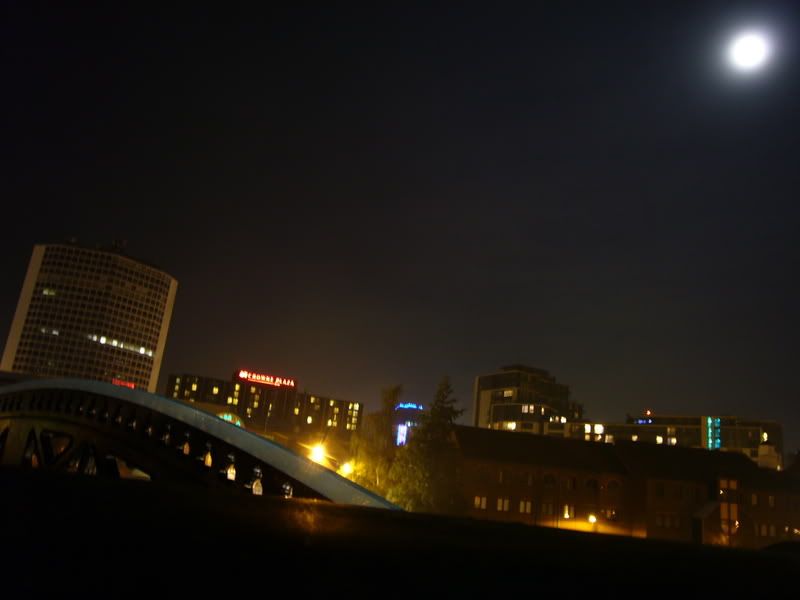
NIGHT


“The night walked down the sky with the moon in her hand.” - Frederick L. Knowles

Night

THE SCENE:
Deserted streets;
Cold lights;
Fogged up windscreen.
The street cleaners (pity them!)
Go hither and thither like wraiths.
Neon signs, cheap, inhospitable
Advertise dives that stay open the whole night long.
The taxi drivers (pity them!)
Earn a night’s living – barely awake.

The traffic lights:
Green,
Amber, red,
Amber, green.
Quiet streets,
Cars parked in rows like gravestones.
A thousand dark windows of houses,
Inside which loud snores, you think, resound.

The leaves, falling constantly
As if of silver, lit by the cruel street light.
A thousand leaves,
Swept by the wind
In waves, huge billows
Of silver, dead leaves.

PROTAGONIST:
And I.
I who drive alone in the frigid night.
Betrayed, rejected, forlorn.
And I who drive, seemingly, a thousand miles.
And I’ve forgotten – some stars that jeer
As though embroidered with silver thread on velvet sky,
A suitable backdrop to the impersonal high-rise apartment buildings,
Each hiding a thousand miseries.

CHORUS:
O night, enchantress,
You bewitch in your dark veils,
Night of a thousand secrets!
Dark goddess, obscure peri
Who conceals a thousand mysteries.
O night, child abductress
Beguiler, stealer, who
In your cloak’s deep folds corrupts unstoppingly.

Night of a thousand songs,
Moonlit and strange, silver-black
You give us without pity
A thousand flimsy dreams,
Only for to reclaim them each dawn
As the cock crows…

Tuesday, 22 July 2008

TRAVELS ON TUESDAY - POSTCARD FROM BRISBANE


“Like all great travellers, I have seen more than I remember, and remember more than I have seen.” - Benjamin Disraeli

Greetings from Brisbane! I am here for work for a couple of days and as usual the weather has been lovely for this time of the year. It is always pleasant to visit Brisbane between June and September, as it is relatively warm and fine (compared to Melbourne) and while temperatures in Melbourne hover around the 12-13˚C mark, Brisbane enjoys 22-24˚C. However, with the amount of work I had to get through I did not enjoy the great outdoors much…

The picture is part of Brisbane’s Southbank district. Southbank is adjacent to the City and along the Brisbane River. About 17 hectares of riverside recreational parkland within a 125 hectare precinct that lies across the waters of the Brisbane River from the high rises of the central business district, it is a place for visitors and the people of Brisbane alike to sun themselves, shop, dine and enjoy the arts. The best way to reach Southbank from the City is across the Victoria Bridge. Once across, one can see Melbourne Street which is flanked by the Old Museum and Art Gallery on the right and the Old Performing Arts Centre on the left, behind which one can see the curving shell of the Convention and Exhibition Centre.

Most of Southbank spreads off to one’s left, and is reached by the Clem Jones Promenade. Southbank was built on the World Expo 1988 site, and at that time was filled with pavilions and displays from around the world. The pagoda, a symbol of peace, was a gift from Nepal and one of the few things retained when the area was transformed into Southbank. A few steps past it, turning right, a boardwalk takes one through a shaded rainforest section filled with jungle noises and vegetation. A stream gurgles and the greenery refreshes the soul. Beyond this is an amphitheatre-style piazza that hosts regular performances, and at weekends the whole place becomes a market.

Back towards the riverbank, is a beach patrolled by professional life guards. This borders an artificial lagoon surrounded by palm trees and rocks. It is a wonderful site for City dwellers to enjoy a beach-style environment on their doorstep. Adjacent to it is an arbour (picture above), which is a meandering bougainvillea-covered path running the length of Southbank. A kilometre of blazing magenta, it is made of more than 400 slim, curving pillars linked by cables along which the bougainvillea is trained. In the evening it glows with mood lighting.

Numerous restaurants, cafés and bars make Southbank a mecca for the bon viveur and last night I dined in Kapsali restaurant. This was a friendly, Mediterranean restaurant with quite good food and ambience. The waiters were pleasant and the service fast. I had the grilled Barramundi fillet with lemon butter, creamed potato and wok tossed vegetables.

Enjoy the week!

Sunday, 20 July 2008

MOVIE MONDAY - "EL GRECO" 2007


"Artists create out of a sense of desolation. The spirit of creation is a excruciating, intricate exploration from within the soul." – El Greco (Domenikos Theotokopoulos)

We watched the 2007 film “El Greco” at the weekend, by Yannis Smaragdis starring Nick Ashdon, Juan Diego Botto, Laia Marull and Dimitra Matsouka. The film had received some rather controversial reviews and it was interesting to see it and make up our minds about it. Looking at it critically one easily finds fault with it and it can be dismissed as biofiction, which lacks any real depth or true characterisation. On the other hand if one changes one’s perspective, and approaches it without any expectations (and more importantly without prior knowledge of the artist, his work or his times), this film has several saving graces and one can see why it can appeal to a very large number of people.

Firstly, let me put on my tall, silk stovepipe hat of the harsh film critic who is well-versed in the life and times of Domenikos Theotokopoulos, the 16th century artist born in Venetian –occupied Crete, but who through Venice finally made a home for himself in Spain and became one of the most famous and well-regarded artists of all time. Remarkably little is known about he life of El Greco and there a few pieces of documentary evidence that will shed light on his travels and life. The film makes quite a few assumptions and is quite inventive as far as personal details are concerned, so as a biographical work it is closer to fiction than fact. The few indisputable facts about El Greco’s life are surely shown, but around them the tissue of fiction does more to obscure them than to clothe them.

The script is platitudinous to say the least and the two major themes that run through it are freedom (on a national as well as a personal level), and the belief in one’s abilities and personal credos versus on ones imposed by convention or people in power. The struggle of El Greco to establish himself as an artist through his controversial art is counterpointed with his personal relationships. A noble Venetian woman who loves him in Crete become a nun (who later saves him in true deus ex machina style) and the Spanish noblewoman who loves him and bears his son sees his struggle with the church and the establishment as too risky an undertaking and opts (at least initially) for abandoning him (however, to preserve the happy ending, they are reunited, at the conclusion of the film). El Greco’s relationship with Cardinal Niño El Guevara (who portrait he painted in magnificent red robes and rather fetching spectacles) is made much of. On the one hand, there is an almost passionate and perverse courting on the Cardinal’s part (although the homosexual undertones are never explicitly stated), while on the other, El Greco remains aloof and committed to his art, unwilling to compromise on sexual, religious, artistic or ideological grounds.

The Spanish Inquisition comes in, and in what is supposed to be the climax, El Greco is accused of heresy and blasphemy – his punishment for rejecting the advances of the Cardinal, however, a vision of angels chastens the Cardinal and El Greco’s impassioned (but rather trite speeches) end the film on a joyous and triumphant note. This is more soap opera than a work of art and the costumes and settings look a little more theatrical than realistic.

The music by Vangelis is good and the cinematography OK, but the script has let this production down. No character development, no thoughtfulness about the potentially conflicting situations that could have provided some very powerful scenes between the leads and a rather poor last appearance by Greek veteran actor Sotiris Moustakas (through no fault of his own), who delivers some very mind-numbing lines as El Greco’s teacher, Titian.

Rather a scathing review, wouldn’t you think? Let me take my high hat off and put on my layman’s cap (rather worn and with no pretensions of high-brow aspirations). In this incarnation I could view the film as an enjoyable introduction to a great artist’s life and his art, made approachable by engaging, instantly familiar situations and emotions, one that any person could relate to in an easily ingestible and digestible form. It is colourful, engaging (because of its lack of assumptions about the viewers’ prior knowledge or education) and one that gives a simple direct message. Besides, the good guys win and all is resolved happily in the end.

I must say that I was more harsh than lenient with my personal criticism because of all the hype that I had heard about the film before I saw it. I was expecting much more than the film delivered and besides I knew something about the life and art of Domenikos Theotokopoulos before I saw the film. As my expectations were very high, I was rather disappointed. However, don’t let me put you off seeing, although, be warned and don’t have high expectations. This is a biofiction, costume drama, better suited to a Sunday afternoon DVD session, rather than a special trip into a cinema.

It should be noted that there is an equally flawed 1966 “El Greco”, yet another version of the artist’s life, starting Mel Ferrer in the title role. In this one, the action concentrates on the artist’s Toledo period and his later years. I think overall, one is more likely to be satisfied by a visit to Spain and a view of the master’s incomparable masterpieces in some of the galleries…

ART SUNDAY - MAX LIEBERMANN


"When you start a painting, it is somewhat outside you. At the conclusion, you seem to move inside the painting." - Fernando Botero

It is Max Liebermann’s birthday today and he was a German impressionist painter. He was born in Berlin, on the 20th July 1847 and died in Berlin, on the 8th Feb 1935, the son of a Jewish businessman. His activities encompassed painting, drawing, printmaking and art collecting. He dominated the German art world from the 1890s to the 1930s. At the beginning of his career, he was a highly controversial figure, but after the turn of the century his art was regarded as “classic” and he was showered with honours. His Naturalist and Impressionist works have been consistently admired, despite being banned during the Nazi period. Liebermann's approach was that of a liberal cosmopolitan, and his work is distinguished by its honesty and commitment to social reform. Influenced by Dutch and French painting, he led the modernist movement in Germany away from the literary art of the 19th century.

His “Old Woman with Cat” was painted in 1878, and depicts an old woman sitting alone with a cat in front of a rough wall. Her head bowed to the side and her large coarse hands gently embracing the cat emphasise the emotional bond between the woman and her pet. Through such gestures, Max Liebermann filled the subject with his own understated and affecting humanity. He depicted the woman in bright light and wearing a richly colored skirt, thus omitting obvious signs of poverty and avoiding an unnecessary display of sentimentality.

Influenced by the Dutch Masters of the 1600s, Liebermann became fascinated with themes that concerned contemplative states. He also absorbed the lessons of French painters; his richly worked execution of this painting reflects the painterly style he learned in Paris in the 1870s. The Old Woman with Cat was painted in 1878 in Venice, where Liebermann went to recuperate after breaking his leg. He captured that city's famous golden light to harmonize the rich and disparate colors and textures of the woman and the setting.

Saturday, 19 July 2008

DRUGS


“He does not need opium. He has the gift of reverie.” - Anais Nin

I had some rather startling and very sad news today. From an old acquaintance I learnt that one of my university friends whom I had not seen for years had lost his job, got a divorce and in a few months time had lost everything and had become hooked on drugs. He had always been a bit of a loner, a rather withdrawn and introverted individual, quirky, sometimes acidly pessimistic. We all liked him nevertheless and whenever he drank (always whisky) he became morbidly facetious, quite brash. When we graduated he had become quite successful as an academic, then started his own business, finally to move interstate, where he got married. I had not heard form him for many years. And now this second hand news and what a melancholy lot it was too…

Apparently he’s been in and out of gaol, he’s tried to give up the drugs, but he’s been unsuccessful in his attempts. The last time anybody heard of him he was living in a disused factory with some fellow squatters. The factory has now been demolished, making way for apartments and so our old fellow student disappeared.

One hears about drugs, sees the news reports, reads the papers and magazines, even hears of it around one. Until it hits closer to home, until it is someone one knows, one does not realise how drugs destroy lives so completely…

For Song Saturday today, Greek song dedicated to my old fellow student


For My Own Good

I saw my world get demolished in front of me
I saw my neighbourhood become dilapidated
For my own good,
I saw the trees I used to climb on cut down,
I saw my dreams all loaded in a removalist’s truck
For my own good.
I saw the teacher beat me with zeal,
I saw my hands swollen from the strapping,
I saw my nerves become slowly shattered,
As they beat me with compassion and affection.

For my own good
For my own good,
Until my mind couldn’t take it any more,
It took backward turns, for my own good,
And now I’m in room number nine, for my own good,
In its serenity, hoping to find myself.

I saw them share their bread with me,
I saw them making clothes out of my old clothes,
I saw my mother weeping hopelessly,
I saw my old man emigrate,
For my own good,
I saw my friends trying to help me,
I saw them telling me to give you up.
I saw myself one dawn being dragged to the police station,
And so as to be set free to say whatever I needed to say…

For my own good
For my own good,
Until my mind couldn’t take it any more,
It took backward turns, for my own good,
And now I’m in room number nine, for my own good,
In its serenity, hoping to find myself.

For my own good,
For my own good,
There, where my brain and body become numb,
Injections, pills, electroshock treatments, for my own good,
Today they took away the man next to me, dead;
While I struggle to find myself,
And I have a hidden knife with me, for my own good…
Για το Καλό μου

Είδα ένα κόσμο να γκρεμίζεται μπροστά μου
Είδα να γίνεται γιαπί η γειτονιά μου,
Για το καλό μου.
Είδα τα δέντρα που σκαρφαλώνα κομμένα
Στο φορτηγό τα όνειρα φορτωμένα,
Για το καλό μου…
Είδα το δάσκαλο να με χτυπάει με ζήλο
Είδα τα χέρια μου πρησμένα απ’ το ξύλο,
Είδα τα νεύρα μου σιγά-σιγά να σπάνε
Με καλοσύνη και με στοργή να με χτυπάνε.

Για το καλό μου,
Για το καλό μου.
Ώσπου δεν άντεξε στο τέλος το μυαλό μου,
Πήρε ανάποδες στροφές γαι το καλό μου
Και είμαι στο θάλαμο εννιά για το καλό μου,
Στην ηρεμία, για να βρω τον εαυτό μου.

Είδα να κόβουν τη μπουκιά για τη μπουκιά μου
Ρούχα να φτιάχνουν απ΄τα ρούχα τα παλιά μου.
Είδα τη μάνα μου να κλαίει απελπισμένα
Είδα το γέρο μου να φεύγει για τα ξένα
Για το καλό μου,
Είδα τους φίλους μου να σκίζονται για μένα
Είδα να θέλουν να ξεκόψω από σένα.
Είδα χαράματα να με τραβάν στο τμήμα
Για να γλιτωσω το κελλί να πω το ποίημα.

Για το καλό μου,
Για το καλό μου.
Ώσπου δεν άντεξε στο τέλος το μυαλό μου,
Πήρε ανάποδες στροφές γαι το καλό μου
Και είμαι στο θάλαμο εννιά για το καλό μου,
Στην ηρεμία μήπως βρω τον εαυτό μου.

Για το καλό μου,
Για το καλό μου,
Εκεί μουδιάζει το κορμί και το μυαλό μου
Ενέσεις, χάπια, ηλεκτροσόκ, για το καλό μου.
Σήμερα πήρανε νεκρό τον διπλανό μου,
Ενώ παλεύω για να βρω τον εαυτό μου
Κι έχω κρυμμένο το σουγιά, για το καλό μου…

Friday, 18 July 2008

FOOD FRIDAY - APPLE PIE


"I never see any home cooking. All I get is fancy stuff."
- Prince Philip, Duke of Edinburgh

A very busy day at work today and hardly any time to do anything else except attend meetings, chair selection panels, and co-host a workshop. After a twelve-hour day, it was a wonderful to come home and relax. The smell of freshly-baked apple pie on days like this is a very welcoming and delightful smell to come home to. Here is how we make it at home:


APPLE PIE
Ingredients (for the pastry)
500 g flour
250 g butter cut in small pieces
2 whole eggs
2 egg yolks
250 g caster sugar
1/2 teaspoonful ground nutmeg and mace
zest of one lemon, pinch of salt.

(for the filling)
5 apples (Granny Smith are good)
3 tablespoonfuls apricot jam
5 tablespoonfuls caster sugar
1 cupful of sultanas
1 teaspoonful ground cloves/cinnamon

Method
Cream the butter and sugar until light and fluffy. Add to the butter/sugar mixture the eggs and yolks beaten together, but little by little so that they are incorporated without curdling. Sprinkle the spice and zest into the mixture and work well. Add the sifted flour little by little until a soft dough is formed. Cover with greaseproof paper and let the dough rest for half an hour in a cool place. Peel and core the apples, cutting them into slices. Stew them with the sugar and spices until they soften. Roll out half of the dough to about 4 mm thickness and line a buttered 25 cm flan tin with it. Spread the jam on the top of the pastry and layer the stewed apples mixed with the sultanas over it. Roll out the remaining dough and cover the pie, securing the edges by pressing the layers of pastry together and scalloping it. Cut out a small heart shape in the centre of the crust and sprinkle the top of the pie with coarse sugar. Bake the tart in a hot oven (400˚ F/210˚ C) for about 30 minutes until the pastry is golden brown in colour. Eat hot or cold with lashings of fresh, whipped cream.

Enjoy the weekend.

Thursday, 17 July 2008

DISABILITY


“One can never consent to creep when one feels an impulse to soar.” - Helen Keller

I spent most of my day today in a special disability workshop, where senior academics and management from our institution were taking part. This was to ensure we were up to date with legislation, that we have adequate policies and procedures in place to ensure fair treatment of people with disabilities and that we were sufficiently comfortable with educating people regarding diversity in the workplace and our student body. The workshop proved to be very useful and interesting and our staff got much out of it.

In a large teaching organization such as ours, we have both staff and students who have some disability. Impairment of vision or of hearing, locomotor disability, learning disabilities are very common, but also becoming much more common are various mental disabilities or disorders. It is quite interesting to look into a classroom and although everyone looks quite “normal” and “ordinary”, to know that about 6% of the people there have a disability that interferes with their learning. This is in contrast with the community, where the percentage of disabled people may be as high as about 18%.

By law we are required to provide disabled people with equal access to education and employment. Although this will often create problems for the organization in terms of adequate facilities and resources, trouble and expense, I feel is worthwhile as a diverse environment is an enriched environment. Disabled people often describe themselves as “differently abled” and I tend to agree with that characterisation. How often do you see a blind person being able to use their fingertips to read Braille efficiently and quickly, or be aware of sounds more acutely than a sighted person? Deaf people engaged in a rapid conversation using sign language, or being able to lip-read? People with a variety of motor disabilities being able to carry out the most complex tasks, eg. painting, with the aid of their lips and mouth.

The question then turned to inclusiveness in terms of age, gender, race, religion, culture, ethnicity, sexuality, language, etc. The same legal obligation binds us in all of these cases also. Discrimination based on any of these criteria is illegal and there have been numerous cases where people have sued successfully for being discriminated against on these grounds. I was pleased to say that all attendees came out of the seminar suitably enlightened, but I was also heartened by the broadmindedness and non-discriminatory attitude of our staff.

disability |ˌdisəˈbilitē| noun ( pl. -ties)
A physical or mental condition that limits a person's movements, senses, or activities : Children with severe physical disabilities.
• A disadvantage or handicap, esp. one imposed or recognized by the law: He had to quit his job and go on disability.

ORIGIN: From Latin, sometimes via Old French des- + late Middle English (also in the sense [easy to use, suitable] ): from Old French hable, from Latin habilis ‘handy,’ from habere ‘to hold.’

Wednesday, 16 July 2008

WINTER


“Nothing is permanent.” – Gautama Buddha

Silly argument;
The heart is now painted the
Colour of winter.

Tuesday, 15 July 2008

WORLD YOUTH DAY


“When we blindly adopt a religion, a political system, a literary dogma, we become automatons. We cease to grow.” – Anaïs Nin

There is quite a to-do in Australia these days with the celebration of World Youth Day, this year hosted by Sydney. It is organised by the Catholic Church and it involves young people between the ages of 16 to 35 years. It is the 23rd World Youth Day and it is to be celebrated between July 15-20. This international gathering of about 150,000 young people in Sydney is meant as a celebration of faith amongst young people from all over the world who will take part in prayer, catechism sessions, informal gatherings, and festival events. The Pope is here in Australia and is spending much of his time in doing the expected things, while also trying to be suitably “hip” by, for example, sending SMS messages to the registrants’ mobile phones.

The purpose of World Youth Day is threefold (and I quote from the official site):

1. Putting Trust in the Young:
World Youth Day is a coming together of young adults from the four corners of the world and a strong reminder of the strength and confidence the young bring to the Church today.

2. Gathering Together:
World Youth Day is not simply a gathering for the young people of the world, but a time to put trust in the world's youth. A calling for the world's youth to come together as one people.

3. Meeting the International World on a Human Level:
It is still a marvel in this the 21st Century to exchange with others and to be a part of an international experience. International events are able to stir much hope but also many fears (increase in fundamentalism, nationalism and other new conflicts. . .) The Church and Christians themselves have a role to play in preventing the development of these fears, and in aiding each person in finding their way and discovering hope.

Unfortunately, the celebrations are already being marred by adverse publicity, immigration scams, traffic gridlock, gloomy statistical data about the lack of faith shown by the young, disastrous media releases bordering on the racist and irresponsible by Sydney’s Catholic Archbishop, Cardinal Pell and a conservative, backward-looking dinosaurian mentality that is still showing how much out of touch with the 21st reality most of the world’s larger churches are. While Cardinal Pell was telling young people that no Western country was producing enough babies to keep the population stable and declaring himself as a climate change sceptic, the Pope was busy apologising to victims of sexual abuse by Catholic priests and telling the faithful to heed the scientists and do their bit to be “green”.

I am sure great fun will be had by all, and the Youth Day extravaganza will have its full share of pure faith, good intentions, drunken orgies, hits and misses, heady exuberance and wilted great expectations. It will take more than fairground policies to attract the young faithful to an aging church and once the party is over, the 21st century Y-generation will go back to following the dictates of their "fat relentless egos" (Cardinal Pell’s words, once again).

Call me a cynic, if you must, but I am skeptical of such large events and such public professions of faith and religion that is presented to the masses in technicolour, vistavision, Hollywood-style super productions…

Monday, 14 July 2008

FANNY AND ALEXANDER


“There are only two lasting bequests we can hope to give our children. One is roots; the other, wings.” – Hodding Carter

We watched Ingmar Bergman’s 1982 film “Fanny and Alexandrer” at the weekend. This is Bergman’s swansong and considered by some as his finest film, one of the best ever made. I had watched it in the eighties, but being younger and less reflective had found it rather pompous and boring. I watched through more mature eyes and through a more sympathetic and understanding prism this time around. The film is doubtlessly sumptuous and a cavalcade of tempora and mores of the Swedish pre-world-war-I reality. It also reads as an affectionate and nostalgic autobiographical note of the director’s own life (disturbing middle section notwithstanding).

The film is very long. In its entirety it is over five hours long, although it is usually shown in its curtailed 188 minute version. An epic either way. It is divided into three parts: An introductory lyrical and wonderfully evocative, joyous section of Christmas in the rambling Ekdahl household. A theatrical family with their many relatives and servants, upper middle class and certainly not niggardly in their ways, enjoying the bounties that life has given them. Oscar and Emilie Ekdahl, are the director and the leading lady of the local theatre company, Fanny and Alexander their young children. The lush Christmas décor in brilliant reds and vibrant greens is the backdrop of happy and often romping goings-on in which the characters are introduced and fleshed out.

The death of Oscar introduces the middle part of the film in which the widow Emilie is consoled by and then courted by the bishop, who finally marries her. Emilie, Fanny and Alexander move into his austere and forbidding house, where whites and greys dominate and the cold, barren rooms are locked with their windows barred. The children are forbidden to take their possessions with them and the bishop makes their life utterly wretched. Emilie regrets her marriage but is trapped in it by pregnancy.

The third part of the film is the liberation of Emilie and her children by Isaac, a family friend and lover of the children’s grandmother. The use of a Jew as a catalyst in this escape from the tyrannical bishop is a comment on the ways that religiosity shackles and tortures humanity, thwarting the epicurean philosophy so evident in the first part of the film. Bergman comments on religion, piousness, religiosity and ultimately, a thinly veiled tartuffian hypocrisy.

The world of children is explored and contrasted with that of adults. There is an earthy sexuality pervading the film – open and forgiving in the first part, ingrown and perverted in the middle. Redemption is foremost in the end with acceptance of the fruits of two dangerous liaisons. In the one instance, the redemption comes through generosity, while in the other purification is only resolved through the violence of hellfire.

The cinematography is absolutely breathtaking, the acting faultless and the direction masterly. Bergman has summed up his whole art in this film and has given us a beautifully haunting piece that enchants, disturbs, tantalises, frightens and amuses. It won four Oscars and numerous other awards, and has much in it to draw back the viewer for a second and third and fourth viewing. Not one to watch in one’s salad years, but certainly a film to savour in one’s port wine and stilton age.

Sunday, 13 July 2008

ART SUNDAY - JEAN-FRANÇOIS MILLET


“I want to make the trivial serve to express the sublime.” – Jean-François Millet

For Art Sunday today, a painter representing the “realist” school of France, active in the mid-19th century. Realists were very much concerned to paint the world "as it is" without idealisation. They reproduced objects as observed in nature (as opposed to drawing upon the imagination). They focussed on everyday and commonplace themes, not prettifying, nor compromising anything. They served a social purpose by depicting the labours and struggles of average workers and peasants. Their canvasses nowadays appear romantic and are tinged with an air of nostalgia, as the type of life they depicted is sufficiently far removed from our own reality, so as to evoke some lost golden age when life was less complicated and closer to the ideal. Theya re represented by Courbet, Daumier, Millet, Van Gogh’s early works and to an extent by Lautrec.

Jean-Francois Millet was born on October 4th, 1814, in Gruchy, near Gréville, France. He
died January 20th, 1875, Barbizon. He was renowned for his peasant subjects. Millet spent his youth working on the land, but by the age of 19 he was studying art in Cherbourg. In 1837 he arrived in Paris and eventually enrolled in the studio of Paul Delaroche, where he seems to have remained until 1839. After the rejection of one of his entries for the Salon of 1840, Millet returned to Cherbourg, where he remained during most of 1841, painting portraits. He achieved his first success in 1844 with “The Milkmaid” and a large pastel, “The Riding Lesson,” that has a sensual character typical of a large part of his production during the 1840s.

The peasant subjects, which from the early 1850s were to be Millet's principal concern, made their first important appearance at the Salon of 1848 with “The Winnower,” later destroyed by fire. In 1849, after a period of great hardship, Millet left Paris to settle in Barbizon, a small hamlet in the forest of Fontainebleau. He continued to exhibit paintings of peasants, and, as a result, periodically faced the charge of being a socialist. Letters of the period defending Millet's position underline the fundamentally classical nature of his approach to painting. By the mid-1860s, Millet's work was beginning to be in demand; official recognition came in 1868, after nine major paintings had been shown at the exposition of 1867. Important collections of Millet's pictures are to be found in the Museum of Fine Arts, Boston, and in the Louvre.

The earnest simplicity of some of Millet’s paintings can sometimes appear to approach a saccharine sweetness, which can seem almost kitch in its appeal. However, There is much to be admired in his work and it was Millet’s painting that set the scene for impressionism. Van Gogh admired his work greatly and copied several of his canvasses.

One of the most famous of Millet’s paintings, here reproduced is “The Angelus”. This is a prayer practice rich in doctrine and devotion. This practice commemorates the mystery of the Incarnation by reciting certain versicles and responses with three Hail Marys and a special concluding prayer. It used to be recited morning, noon and evening. The church bells rang –three tolls for each of the invocations and nine for the concluding prayer.

The Angelus traces its beginnings to the thirteenth century. In that era bells were often inscribed with the angelic salutation. Although the origin of the Angelus is obscure, it is certain that the morning, midday and evening Angelus did not develop simultaneously. By the sixteenth century the various customs were unified. The morning prayer was recited to commemorate Christ's resurrection; at noon, Christ's passion; and in the evening to recall the Incarnation, since St. Bonaventure taught that the angel's visit to Mary came at evening.

Millet depicts a man and a woman standing in a field. They are farmers. He holds his cap reverently as he stands with bowed head, and she in a white cap and long blue apron over her dress clasps her hands as a prayerful look sets her face. They pause in prayer near the end of the workday. At the woman's feet is a basket of potatoes, and at her far side rests a wheelbarrow full of empty sacks. At the side of the man is a pitchfork spiked upright in the ground. The breaking clouds are blushed with light as birds flit in the twilight. The viewer can almost hear the bells ringing in the spire of the church in the distant right of the painting. Millet was accused of mawkishness and sentimentality in his depiction of this simple scene. However, this was a familiar scene to him and one could observe it happening many a time in the fields of the French countryside during Millet’s time.

Saturday, 12 July 2008

SONG SATURDAY - RAIN


“And when it rains on your parade, look up rather than down. Without the rain, there would be no rainbow.” - G. K. Chesterton

RAIN

Listen to it pour,
And with every drop of rain
You know I love you more

Let it rain all night long,
Let my love for you go strong,
As long as we're together
Who cares about the weather?

Listen to the falling rain,
Listen to it fall,
And with every drop of rain,
I can hear you call,
Call my name right out loud,
I can here above the clouds
And I'm here among the puddles,
You and I together huddle.

Listen to the falling rain,
Listen to it fall.

It's raining,
It's pouring,
The old man is snoring,
Went to bad
And bumped his head,
He couldn't get up in the morning,

Listen to the falling rain,
Listen to the rain…

Jose Feliciano

Friday, 11 July 2008

FOOD FRIDAY - TAMARILLO


“Chacun à son gout” – French proverb

It’s the heart of winter in Melbourne and we are having cold nights and cool, grey days. It’s nice to come back home and feel the warmth after battling with the wind and sheets of fine rain that occasionally fall (not enough to break the drought, though!). The garden looks slightly dejected this time of the year and one is reluctant to venture there. However, in a back corner a surprise awaits – the tamarillo tree (tree tomato, Solanum betaceum). Its red, smooth egg-shaped fruit look like Christmas ornaments, brightening with their shiny gloss the darkest, gloomiest Winter day.

Some people do not like the taste of the tamarillo and some cooks are slightly confused – should it be treated as a fruit or as a vegetable? The answer is simple. Either! As there are quite a lot of fruit on our tree, this weekend it will be tamarillo cooking time:

Tamarillo Chutney
Ingredients
2 ½ kg tamarillos
4 medium onions chopped
3 apples, peeled and chopped
2 cloves garlic, crushed
2 tablespoons grated root ginger
1 tablespoon whole cloves
1 teaspoon peppercorns
1 teaspoon chilli powder
1/2 teaspoon curry powder
2 teaspoon salt
3 cups sugar
4 cups white vinegar

Method
Place tamarillos in a bowl and cover with boiling water allowing to soak stand for 3-4 minutes. Drain and cover with cold water. When cool enough to handle, peel the tamarillos and slice into a saucepan. Add the chopped onions, apples, garlic and root ginger.
Add the cloves and peppercorns (tied in muslin) and stir in the spices, salt, sugar and vinegar.
Bring to the boil, stirring until the sugar is dissolved. Reduce the heat and simmer for about 1 and 1⁄2 hours, until thick like jam. Pack into hot clean jars. Seal when cold. Makes about 8 cups.

A chutney (for the uninitiated) is from the Hindi cātnī (from cātnā, to taste), and is a spicy condiment that contains fruit, vinegar, sugar and spices. It can range in texture from chunky to smooth and in degrees of spiciness from mild to hot. Chutney is a delicious accompaniment to curried dishes. The sweeter chutneys also make interesting bread spreads and are delicious served with cheese.

My first encounter with tamarillos was a couple of decades ago (doesn’t that sound ages ago!?) in New Zealand, when I first tasted them in a gourmet dish of venison. Since then I have had a love-hate relationship with these curious fruits. If cooked well, they can taste wonderful, if badly, they are truly disgusting. If of a good variety and ripe they can be delicious in fruit salads, if unripe and eaten alone, they are awful. In the chutney recipe above, they are adequately disguised and can be eaten with relative safety…

The illustration is an oil painting by Melbourne artist, Judith Perrey” “Tamarillos and Batik”

Thursday, 10 July 2008

WORD THURSDAY


“Everything great in the world is done by neurotics; they alone founded our religions and created our masterpieces.” - Marcel Proust

Today, July 10th is the Bahamas - National Day. The Bahamas are a group of about 700 islands and 2,000 coral reefs to the North of Cuba and the Southeast of Florida. The country became independent of the UK in 1973, the capital being Nassau. The Bahamas are just under 14,000 square km in area and have a population of about 300,000. The major employer is tourism while other economic supports are ship registration and off-shore financing and banking. Fishing and domestic agriculture are under development in order to reduce imports.

Henbane, Hyoscyamus niger, is the birthday plant for this day. The generic name of the plant was given it by Dioscorides and is derived from two Greek words, hyos, “of a hog” and kyamos, “bean”, supposedly because hogs ate the fruit. The whole plant has an offensive smell and is poisonous. The plant has been used medicinally and has narcotic and analgesic properties. The poison hyoscyamine, derived from the young shoots and leaves of the plant was used by Dr Crippen in 1910 to murder his wife. The plant symbolises imperfection and is under the astrological rule of Saturn.

Today is the birthday of:
John Calvin, theologian (1509);
James McNeill Whistler, artist (1834);
Henryk Wieniawski, composer (1835);
Marcel Proust, novelist (1871);
Giorgio da Chirico, Italian artist (1888);
Carl Orff, composer (1895);
Saul Bellow, novelist (1915);
David Brinkley, TV personality (1920);
Owen Chamberlain, physicist (1920);
Fred Gwynne, actor/writer (1926);
Alice Munro, writer (1931);
Jerry Herman, composer (1933);
Arlo Guthrie, singer (1947);

Carl Orff (1895–1982) was a German composer and music educator. His best-known work is Carmina Burana (1937), a secular oratorio derived from medieval German and Latin poems. His system for teaching music to children, based on rhythmic and verbal patterns and the pentatonic scale, is widely used. He also wrote several operas, amongst which are (1937-8) and Der MondDie Kluge (1941-2).


"O Fortuna" (the introduction to Carl Orff's "Carmina Burana") is one of the most recognisable pieces of music all over the world. It is a wry comment on the vicissitudes of life and how fortune seems to rule our existence with its whimsical twists and turns.

vicissitude |vəˈsisəˌt(y)oōd|noun (usu. vicissitudes)
A change of circumstances or fortune, typically one that is unwelcome or unpleasant: Her husband's sharp vicissitudes of fortune.
• poetic/literary alternation between opposite or contrasting things : The vicissitude of the seasons.
DERIVATIVES
vicissitudinous |-ˈtjuːdɪnəs| adjective
ORIGIN
Early 17th century (in the sense [alternation] ): from French, or from Latin vicissitudo, from vicissim ‘by turns,’ from vic- ‘turn, change.’

Wednesday, 9 July 2008

HOPE


"Action is the antidote to despair." – Joan Baez

I met an old friend today and she sounded so tired, so aged, as if fatigued by life. Her eyes were filmed over with the hoary grey of hopelessness and the years had not been kind to her once beautiful face. She was alone, where once she had been partnered; indigent where once she had more money than she could spend; desperate where once she was full of joie-de-vivre and optimistic. It was a sad encounter and brought me face to face with my own increasing age, made me mindful of the vicissitudes of life and brought before me Solon’s wise saying, his advice to King Croesus: “Midena pro tou telous makarize” (Don’t be hasty to call someone truly fortunate, unless you see how his life has ended).

And yet even in the depths of despair, my friend was able to smile and in her weariness she could find strength to joke… She felt, like me, true joy to see an old friend and catch up. Life had once again surprised us both, as it does…

Life is Hope

Even if it be a Winter cold and grey,
If snow be falling –
White, pure, light and gelid cold –
Flake on dancing flake…

Somewhere in that snowy shroud
There lie in wait a thousand blooms –
Daffodils, cyclamens, crocuses, anemones,
A promise of the Spring that waits to come.

A storm at sea, if it were to be,
The waves like mountains high –
Rudderless, uncontrolled, whirling and lost –
The ship to be but barely floating…

Somewhere there is a calm seashore,
A harbour safe, waiting by –
Some linger anxiously and pray,
“Surely it will return…” they whisper.

Even if childhood dreams be lost,
If darkness reign for many a year –
Silent, sunless, sickly and sallow –
Solitude is your sole companion…

Look deep inside you a light to find
Like a gentle firefly beaming –
Azure and smiling, eternal, soft,
Hope flutters by.

Tuesday, 8 July 2008

JOB INTERVIEWS


“The best way to appreciate your job is to imagine yourself without one.” - Oscar Wilde

I had a very long day at work and much of it was spent interviewing people for jobs. This is a very demanding and responsible task and one has to be extremely conscious of the way that the whole process is carried out. One has to be fair, yet exacting, careful and cautious, yet not too tense so as to put the candidates off. The process has to be completely transparent and the panel must be careful to work together in order to get the most information out of each candidate. We had a good panel collaborating well and we were able to get through the interviews without too many problems.

However, we were all quite exhausted afterwards and with some people we interviewed, getting the information out of them was like drawing teeth out of their mouth. When an applicant was rather more communicative and voluble it made such a difference in the process… The hardest was when we knew the persons interviewed and while they had all of the qualifications and abilities to do the job, some of them interviewed very badly.

Other people are so self confident and have such an inflated belief in their abilities that they spend hardly any time in preparing their interview, so when they are asked some questions (the answers of which are staring them in the face in the job description!) they make a thorough mess of the answers. Definitely ones to avoid when appointing.

What is your experience of job interviews? Either being the interviewer or the interviewee?