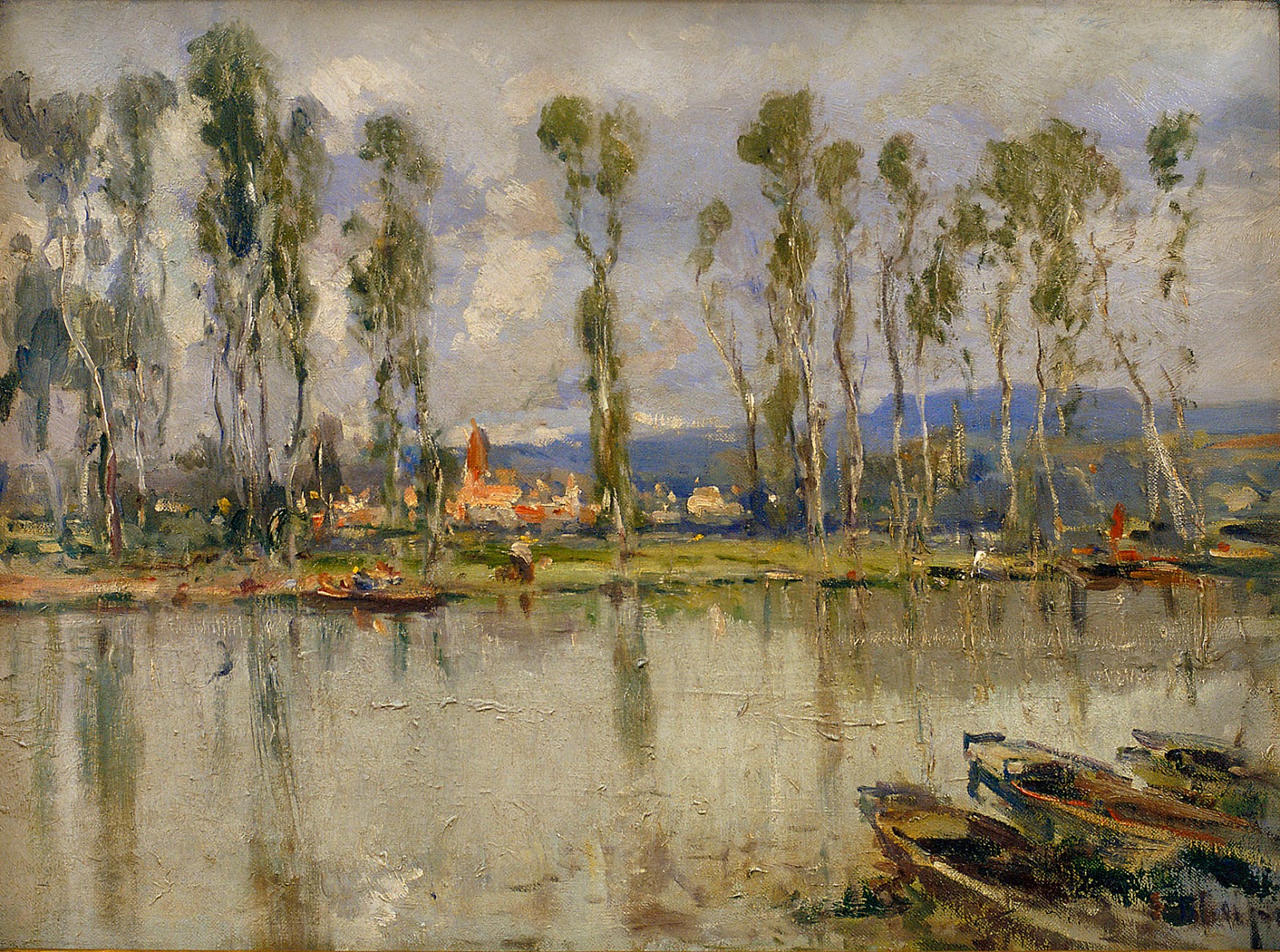
Showing posts with label impressionism. Show all posts

Sunday, 22 October 2017

ART SUNDAY - FEDERICO ZANDOMENEGHI

“After women, flowers are the most lovely thing God has given the world.” - Christian Dior 

Federico Zandomeneghi (June 2, 1841 – December 31, 1917) was an Italian Impressionist painter. He was born in Venice and his father, Pietro, and grandfather, Luigi, were neoclassic sculptors. The latter completed the monument to Titian found in the Frari of Venice.

As a young man, Zandomeneghi preferred painting to sculpture, enrolling in 1856 first in the Accademia di Belle Arti in Venice, and then in the Academy of Fine Arts of Milan. In 1860, he tried to join with the forces of Giuseppe Garibaldi (1807-1882) in his Expedition of the Thousand. This made it uncomfortable for him to reside in Venice, and in 1862, he moved to Florence for 5 years where he frequented the Caffè Michelangiolo. There he met a number of the artists known as the Macchiaioli, including Telemaco Signorini, Giovanni Fattori and Giuseppe Abbati, and he joined them in painting landscapes outdoors.

Painting outside of the studio, ‘en plein air’, was at that time an innovative approach, allowing for a new vividness and spontaneity in the rendering of light. In 1871 Pompeo Molmenti wrote glowing assessments of three young Venetian painters: Guglielmo Ciardi, Alessandro Zezzos, and Zandomeneghi. In 1874, he went to Paris, where he was to spend the rest of his life. He quickly made the acquaintance of the Impressionists, who had just had their first group exhibition. Zandomeneghi, whose style of painting was similar to theirs, would participate in four of their later exhibitions, in 1879, 1880, 1881, and 1886.

Like his close friend Edgar Degas, Zandomeneghi was primarily a figure painter, although Zandomeneghi’s work was more sentimental in character than Degas’. He also admired the work of Mary Cassatt and Pierre-Auguste Renoir, and his many paintings of women in their domestic routines follow their example. To supplement the meager returns from the sale of his paintings, Zandomeneghi found work drawing illustrations for fashion magazines.

He took up working in pastels in the early 1890s, and became especially adept in this medium. At about this same time his reputation and his fortunes were enhanced when the art dealer Durand-Ruel showed Zandomeneghi’s work in the United States. From then on he enjoyed continuing modest success until his death in Paris in 1917.

The pastel drawing above from 1893 is his “Taking Tea”. The composition is marvelous and the personalities of the young women who are drinking tea and partaking of a little “social criticism” at the same time is rendered delicately, although a little tongue-in-cheek. The texture of the surface and the rough flakes of pigment in parts recalls a little the pointillists, but the image is definitely clearly identifiable as belonging to the circle of the French Impressionists.

Sunday, 3 September 2017

ART SUNDAY - ALBERT BAERTSOEN

“Painting is easy when you don't know how, but very difficult when you do.” - Edgar Degas

Albert Baertsoen (9 January 1866 – 9 June 1922) was a Belgian painter, pastellist and graphic artist. He was born in Ghent. His father was an industrialist and textile manufacturer.

In 1882, Baertsoen began attending the Royal Academy of Fine Arts, where he studied under Gustave Den Duyts and Jean Delvin. His debut as a painter came in 1887, when he participated in an exhibition in Brussels held by the secessionist group L’Essor He continued his studies in Paris, at the art school of Alfred Philippe Roll, and exhibited at the Salon in 1889. The following year, he accompanied James Ensor, Frantz Charlet and other Belgian painters on a study trip to London.

In 1894, he helped found the “Cercle des Beaux-Arts d’Ostende”. The years 1894/95 saw another stay in Paris, where his painting “Oude Vlaamse Vaart” (Old Flemish Sails) was acquired by the Musée du Luxembourg and he participated in an exhibition held by La Libre Esthétique. From 1896 to 1901, he continued to exhibit throughout Europe, winning several Gold Medals.

In 1913, he served as a member of the art jury for the Ghent World’s Fair. During World War I, he lived in London, returning to Ghent in 1919. That same year, he was appointed a member of the Royal Academy of Belgium. Two years later, a retrospective of his work was held at the Galerie Georges Giroux in Brussels. He died in Ghent in 1922.

His work is impressionistic in nature, although much of his work can seem a little lugubrious to one used to the French impressionist works. However, he could also be a brilliant colourist, especially when travelling to sunnier climates. As well as a painter, Baertsoen was a fine draughtsman and his composition is always interesting and often surprising. The painting above is the “Rope Makers”.

Sunday, 27 August 2017

ART SUNDAY - KONSTANTIN A. KOROVIN

“If you want to make the most of travel to Russia, it is better to leave tight plans and preconceptions behind and just enjoy the journey.” - Tim Cope 

Konstantin Alekseyevich Korovin (Russian: Константи́н Алексе́евич Коро́вин, first name often spelled Constantin; 5 December [O.S. 23 November] 1861 – 11 September 1939) was a leading Russian Impressionist painter. Konstantin was born in Moscow to a merchant family officially registered as “peasants of Vladimir Gubernia”. His father, Aleksey Mikhailovich Korovin, earned a university degree and was more interested in arts and music than in the family business established by Konstantin’s grandfather. Konstantin’s older brother Sergei Korovin was a notable realist painter. Konstantin’s relative Illarion Pryanishnikov was also a prominent painter of the time and a teacher at the Moscow School of Painting, Sculpture and Architecture.

In 1875 Korovin entered the Moscow School of Painting, Sculpture and Architecture, where he studied with Vasily Perov and Alexei Savrasov. His brother Sergei was already a student at the school. During their student years, the Korovins became friends with fellow students Valentin Serov and Isaac Levitan; Konstantin maintained these friendships throughout his life. In 1881–1882, Korovin spent a year at the Imperial Academy of Arts in St. Petersburg, but returned disappointed to the Moscow School of Painting, Sculpture and Architecture. He studied at the school under his new teacher Vasily Polenov until 1886. In 1885 Korovin travelled to Paris and Spain. He later wrote: “Paris was a shock for me … Impressionists… in them I found everything I was scolded for back home in Moscow”.

Polenov introduced Korovin to Savva Mamontov’s Abramtsevo Circle: Viktor Vasnetsov, Apollinary Vasnetsov, Ilya Repin, Mark Antokolsky and others. The group's love for stylised Russian themes is reflected in Korovin’s picture “A Northern Idyll”. In 1885 Korovin worked for Mamontov’s opera house, designing the stage decor for Giuseppe Verdi’s “Aida”, Léo Delibes’ “Lakmé” and Georges Bizet’s “Carmen”.

In 1888 Korovin travelled with Mamontov to Italy and Spain, where he produced the painting “On the Balcony, Spanish Women Leonora and Ampara”. Konstantin travelled within Russia, the Caucasus and Central Asia and exhibited with the Peredvizhniki. He painted in the Impressionist, and later in the Art Nouveau, styles. In the 1890s Korovin became a member of the Mir Iskusstva art group. Korovin’s subsequent works were strongly influenced by his travels to the north.

In 1888 he was captivated by the stern northern landscapes seen in The Coast of Norway and the Northern Sea. His second trip to the north, with Valentin Serov in 1894, coincided with the construction of the Northern Railway. Korovin painted a large number of landscapes: “Norwegian Port”, “St. Triphon’s Brook in Pechenga”, “Hammerfest: Aurora Borealis”, and others. The paintings are built on a delicate web of shades of grey. The etude style of these works was typical for Korovin’s art of the 1890s. Using material from his trip, Korovin designed the Far North pavilion at the 1896 All Russia Exhibition in Nizhny Novgorod. He painted ten big canvasses for the pavilion as well, depicting various aspects of life in the northern and Arctic regions. After the closure of the Exhibition, the canvasses were eventually placed in the Yaroslavsky Rail Terminal in Moscow. In the 1960s, they were restored and transferred to the Tretyakov Gallery.

In 1900 Korovin designed the Central Asia section of the Russian Empire pavilion at the Paris World Fair and was awarded the Legion of Honour by the French government. In the beginning of the 20th century, Korovin focussed his attention on the theatre. He moved from Mamontov’s opera to the Mariinsky Theatre in St. Petersburg. Departing from traditional stage decor, which only indicated the place of action, Korovin produced a mood decor conveying the general emotions of the performance. Korovin designed sets for Konstantin Stanislavsky’s dramatic productions, as well as Mariinsky’s operas and ballets, sets that became famous for their expressiveness.

In 1905 Korovin became an Academician of Painting and in 1909–1913 a professor at the Moscow School of Painting, Sculpture and Architecture. One of the artist’s favourite themes was Paris. He painted “A Paris Café” (1890s), “Café de la Paix” (1905), “La Place de la Bastille” (1906), “Paris at Night”, “Le Boulevard Italien” (1908), “Night Carnival” (1901), “Paris in the Evening” (1907), and others.

During World War I Korovin worked as a camouflage consultant at the headquarters of one of the Russian armies and was often seen on the front lines. After the October Revolution Korovin continued to work in the theatre, designing stages for Richard Wagner’s “Die Walküre” and “Siegfried”, as well as Pyotr Ilyich Tchaikovsky’s “The Nutcracker” (1918–1920). In 1923 Korovin moved to Paris on the advice of Commissar of Education Anatoly Lunacharsky to cure his heart condition and help his handicapped son. There was supposed to be a large exhibition of Korovin’s works, but the works were stolen and Korovin was left penniless.

For years, he produced the numerous genre paintings of Russian Winters and Paris Boulevards just to make ends meet. In the last years of his life he produced stage designs for many of the major theatres of Europe, America, Asia and Australia, the most famous of which is his scenery for the Turin Opera House’s production of Nikolai Rimsky-Korsakov’s “The Golden Cockerel”. Korovin died in Paris on 11 September 1939. Konstantin’s son Alexey Korovin (1897–1950) was a notable Russian-French painter. Because of an accident during his childhood he had both feet amputated. Alexey committed suicide in 1950. 

The painting above is “Venice”, painted in 1894.

Sunday, 14 May 2017

ART SUNDAY - ANTONÍN CHITUSSI

“Prague is a dark place.” - Fred Durst 

Antonín Chittussi (1 December 1847, in Ronov nad Doubravou – 1 May 1891, in Prague) was a Czech Impressionist landscape and cityscape painter. His father came from a family of merchants who lived in Ferrara and moved to Bohemia during the Napoleonic Wars. After settling in Ronov, he married an innkeeper and later served as Mayor. At first, Antonín was expected to follow in the family business, but displayed an aptitude for art, which was noticed by his grammar school teachers in Čáslav, so he was sent to Kutná Hora where he studied drawing with František Bohumír Zvěřina.

At the age of eighteen, he went to Prague, with the intent to study engineering but, instead, he enrolled at the Academy of Fine Arts. However, he was dissatisfied with the courses being offered and went to Munich instead, but he became tired of their Academic approach. He was called to Vienna for military service, but was able to obtain a deferral, and briefly enrolled at the Academy of Fine Arts. Later, he returned to the Academy in Prague to study history painting.

In 1876, he participated in a protest by Czech students against Alfred Woltmann, a Professor of art history at the University of Prague, who was accused of German chauvinism, forcing him to flee the lecture hall. Clashes between Czech and German students ensued. After a police investigation and five days in jail, Chittussi and Mikoláš Aleš, who were identified as the ringleaders, were expelled from the Academy.

Afterward, Chittussi supported himself by providing illustrations for Česká Včela (The Czech Bee) and other magazines. This work introduced him to Prague’s patriotic social circles and found him a patron in František August Brauner, a member of the Imperial Council. He also befriended Brauner’s daughter, Zdenka, an aspiring artist who influenced Chittussi’s approach by introducing him to the work of the Barbizon school. In 1877, he and František Ženíšek, a friend from school, opened a studio. It was then that he became primarily interested in landscapes.

Following the conclusion of the Russo-Turkish War in 1878, the Austro-Hungarian Army moved in to occupy Bosnia-Herzegovina and, as an army reservist, he was called up and sent to the front. The death and destruction he witnessed had a profound effect on him, which he attempted to work through emotionally by corresponding with Zdenka. He was able to make a series of small drawings and watercolours, which he exhibited on his return and, with the help of friends, succeeded in financing a trip to Paris.

He arrived in time for the Fourth Impressionist Exhibition, but was not ready to accept what he saw. Eventually, though, he concluded that most of his earlier work had been in vain. In 1880, he rented a small studio and began to work on absorbing the new styles. He soon gained the support of the writer Élémir Bourges, who would later marry Zdenka’s sister, Anna. In 1882, he was invited to spend six months painting at the Radziwiłł estate near Ermenonville.

The following year, he exhibited at the Salon. Although successful, by 1884 he was ready to return home and held an auction of his works at the Hôtel Drouot. As it turned out, this meant a cooling of his relationship with Zdenka, as she actually began to spend more time in Paris than before, pursuing her career. He soon discovered an area in Southern Bohemia that inspired him to paint and helped him to assuage his hurt feelings.

Shortly after, he settled near Člunek. In 1887, he developed health problems, which were believed to be related to the time he spent outdoors, painting during inclement weather. He gradually grew weaker and was diagnosed with tuberculosis. In an effort to stop the disease’s progress, he went to the Tatra Mountains, but it was too late. In 1891, he died in Prague on the way home from treatment. A street in the Bubeneč district there is named after him and, in 1997, the Czech government used one of his paintings (a castle in Chantilly) on a postage stamp.

The painting above is his “Paris as Viewed from Montmartre” (1887).

Sunday, 26 February 2017

ART SUNDAY - ROMÀ RIBERA

“Fame can take interesting men and thrust mediocrity upon them.” - David Bowie

Romà Ribera i Cirera (13 December 1848, Barcelona - 29 May 1935, Barcelona) was a Catalonian genre painter. He specialised in contemporary scenes from upper-class social events, rendered in meticulous detail, but also did numerous scenes from life in the 17th and 18th centuries.

He studied at the Escola de la Llotja and at the private school operated by Pere Borrell del Caso. In 1873, he went to Rome to complete his studies. While there, he met Marià Fortuny, who works would influence his style. After leaving Italy, he visited London to exhibit. Once he had established himself, he settled in Paris. At a time when most artists were attracted to impressionism, he found inspiration in the works of James Tissot and Alfred Stevens.

In 1878, he enjoyed great success at the Exposition Universelle. This enabled to him retain Adolphe Goupil as his agent. To maximise his income, he chose to solicit clients from the upper classes; portraying their activities and possessions. He had a major showing at the exhibition at the 1888 Barcelona Universal Exposition, where he presented a series of watercolours. He returned to Barcelona in 1889, exhibiting at the Sala Parés. He pursued the same upper class client strategy there that he had in Paris. Occasionally, he travelled to exhibit in Madrid.

In 1902, he became a member of the Reial Acadèmia Catalana de Belles Arts de Sant Jordi and was chosen to sit on the Catalonian Museum Board. In Catalonia his works can be found exhibited in various public institutions, including the National Museum (MNAC), the Museum of Montserrat, the Girona Art Museum and the Library Museum Víctor Balaguer of Vilanova.

Ribera was skilled and well-trained, which was true of most of the artists of his generation. He was able to paint interesting scenes in a visually pleasing way, making for highly decorative paintings suitable for middle class tastes. His highly representational and studiously “painterly” style was helpful early in his career, but seems to have hindered his claim to international success and fame. The rapidly changing modern painting revolutions made his work increasingly passé, even in comparatively artistically conservative Spain.

The painting above is representative of his work and is titled: “De Soirée” (In the Evening) - 1894. The painting is faultless in its execution, the colours harmonious, the composition pleasing, the subject matter agreeable and yet if one compares it to the similarly themed Degas work “Woman Combing her Hair” of 1894, one immediately sees why Romà Ribera is relatively obscure while Degas retains his place as a trendsetter in late 19th century painting.

Sunday, 16 October 2016

ART SUNDAY - CAMILLE PISSARRO

“It is during our darkest moments that we must focus to see the light.” - Aristotle Onassis

For Art Sunday today, Jacob Abraham Camille Pissarro (1830 – 1903), one of the foremost French impressionist painters of the 19th century. He was born on July 10th, in the Danish West Indies, the third son of a Jewish French merchant of originally Portuguese descent. When Camille was 12 years old, his parents sent him away to a school in Passy, near Paris. The young Pissarro showed an early talent for drawing, and he began to visit the collections of the Louvre.


At age 17 he returned to St. Thomas, where his father expected him to enter the family business. Young Camille, however, was more interested in sketching and painting and ran away to Venezuela. He returned to St. Thomas in August 1854 and after convincing his parents that he wanted to become an artist, he moved to Paris in 1855. Pissarro arrived in time to see the contemporary art on display at Paris’s Universal Exposition, where he was strongly attracted to the paintings of Camille Corot. He began to attend private classes at the École des Beaux-Arts in 1856, and in 1861 he registered as a copyist at the Louvre.


He also attended the Académie Suisse, a “free studio,” where he met future Impressionists Claude Monet, Paul Cézanne, and Armand Guillaumin. Through Monet, he also met Pierre-Auguste Renoir and Alfred Sisley. Pissarro painted rural and urban French life, particularly landscapes in and around Pontoise, as well as scenes from Montmartre. His mature work displays an empathy for peasants and labourers, and sometimes evidence of his radical political leanings. He was a mentor to Paul Cézanne and Paul Gauguin and his example inspired many younger artists, including Californian Impressionist Lucy Bacon.


Pissarro’s influence on his fellow Impressionists is probably still underestimated; not only did he offer substantial contributions to Impressionist theory, but he also managed to remain on friendly, mutually respectful terms with such difficult personalities as Degas, Cézanne and Gauguin. Pissarro exhibited at all eight of the Impressionist exhibitions. Moreover, whereas Monet was the most prolific and emblematic practitioner of the Impressionist style, Pissarro was nonetheless a primary developer of Impressionist technique.


Whilst in Upper Norwood, Pissarro was introduced to Paul Durand-Ruel, the art dealer who overstocked a large amount of oil paintings for sale, who bought two of his ‘London’ paintings. Durand-Ruel subsequently became the most important art dealer of the new school of French Impressionism. Pissarro died in Paris on 13th November 1903 and was buried in Père Lachaise Cemetery. During his lifetime, Camille Pissarro sold few of his canvas paintings. By 2005, however, some of his works were selling in the range of U.S. $2 to 4 million.


Here is his “L'Avant-port de Dieppe, après-midi, temps lumineux” of 1902. In the first years of the twentieth century, Pissarro took to painting urban landscapes in carefully selected series. The current work derives from one such series, depicting a view of the harbour at Dieppe. Pissarro returned to the town of Dieppe on the Normandy coast in the summer of 1902, where he had already painted several depictions of the church of Saint-Jacques the year before. This time he rented a room on the second floor of the Hôtel du Commerce, which looked out onto the fish market. From his room he could see the port and the inner harbour, and he painted several pictures of these views, of which the present work is a brilliant and sun-drenched example.


The weather that summer was splendid, and Pissarro, who was very enthusiastic about his surroundings, encouraged his son Lucien to join him there: “I have a first-rate motif, indeed I have several. It is really a pity that you can’t come to Dieppe this year, but perhaps you will be able to escape for a little while.” After passing through several prominent French collections, “L'Avant-port de Dieppe, après-midi, temps lumineux” was sold in an auction at Hôtel Drouot in 1938 and has been in the same family since that sale. This was then sold in 2012 in New York by Sotheby’s for 1,538,500 USD.

Sunday, 11 September 2016

ART SUNDAY - EVA GONZALÈS

“Women hold up half the sky.” - Mao Zedong

Eva Gonzalès (April 19, 1849 – May 6, 1883) was a French Impressionist painter born in Paris into the family of the writer Emmanuel Gonzalès. In 1865, she began her professional training and took lessons in drawing from the society portraitist Charles Chaplin. Gonzalès became a pupil of the artist Édouard Manet in February 1869. Manet is said to have begun a portrait of her at once which was completed on 12 March 1870 and exhibited at Salon in that year.

Like her teacher, Édouard Manet, Gonzalès never exhibited with the Impressionist painters in their controversial exhibitions in Paris, but she is considered part of the group because of her painting style. She was Manet’s only formal student and modelled frequently for several members of the Impressionist school. Gonzalès posed for Manet in 1869 for the painting “Portrait of Mlle Gonzalès”, a work which has previously been discussed more than Gonzalès' oeuvre at her own 1885 retrospective and at Galerie Daber’s exhibition for her work in 1950.

While studying under Manet, Gonzalès self-portraits suggest she was exploring her individuality and identity as an artist by presenting subtle correctives to Manet’s version of her. Until 1872, she was strongly influenced by Manet but later developed her own, more personal style. During the Franco-Prussian War she sought refuge in Dieppe. She married the graphic artist Henri Guérard in 1879, and used him and her sister Jeanne Gonzalès as the subjects for many of her paintings.

Her work was exhibited at the offices of the art review L'Art in 1882 and at the Galerie Georges Petit in 1883. Her career was cut short when she died in childbirth at the age of thirty-four, exactly six days after the death of her teacher, Manet. In 1885, after her death a retrospective of 88 works was held at the Salons de La Vie Moderne.

The painting above is here “Awakening Girl” exhibited in the Kunsthalle Bremen, Germany. It is 81.5 cm by 100 cm, oil on canvas. This is a deceptively simple work with most of the canvas covered by the whiteness of the bed linens. The reclining figure along a diagonal from left to right divides the canvas and the eye is drawn to the beautiful face of the young woman, which is framed, in stark contrast, by her dark locks. The brown-beige background is balanced by the bed-side table on which the blue flowers seemingly provide the only other tone of colour in the painting until one notices the cool blue-gray shadows on the linen. The expression on the face of the woman is one of mild amusement, perhaps at the sight of her partner dressing…

Sunday, 3 July 2016

ART SUNDAY - LUDOVIC PIETTE

“Impressionism; it is the birth of Light in painting.” - Robert Delaunay

For Art Sunday, Ludovic Piette-Montfoucault (11 May 1826, Niort - 14 April 1878, Paris) who was a French Impressionist painter. A portrait of Piette by Camille Pisarro, painted in 1874 can be seen here.

He came from a family of the minor nobility and his father was the Registrar of Melleray. His first art lessons came from the Academic painters Thomas Couture and Isidore Pils. It was while studying with Couture that he met Édouard Manet, whom he admired and who was already experimenting with new styles. Then, while at the Académie Suisse, he became good friends with Camille Pissarro who, although younger than him, would have a decisive influence on Piette’s work. He and Pisarro formed a lasting friendship. He and other friends of Pissarro would often paint together, en plein-air. In 1857, he had his first show at the Salon. In 1860, Piette participated in the first exhibition of the Impressionists, invited by Pisarro.

He is said to have received a commission from Napoleon III to provide decorations for the apartments of Empress Eugénie, but there is no official record of this. In 1864, because of poor health (possibly cancer), he and his wife settled at his family’s farm, which he had inherited after his father’s death, near Lassay-les-Châteaux in Brittany. At that time, he began writing regularly to Pissarro, whose correspondence is an important record of the formative years of Impressionism, a period with little other documentation. While there, he served on the Municipal council as part of the Liberal Conservative faction.

As with many Impressionists, Piette tended to focus on landscapes with figures and cityscapes. Among his favourite areas for painting were Pontoise and Louveciennes. In 1877, at Pissarro’s invitation, he participated in the third Impressionist Exhibition. After his death, a retrospective of his work was presented at the fourth Exhibition in 1879. A street and a school in Pontoise are named in his honour. Also, at the Camille Pisarro Museum in Pontoise, several of Piette’s canvases are exhibited.

Piette produced paintings that show evidence of a worthy landscapist, and these works were always well appreciated by the paying public. In each of his works, Piette was an attentive observer of the social reality of rural life and his canvases abound with everyday detail, and in some cases amusing anecdote. His colours and modelling are impressionistic in style, but often his work reminds one of the subject matter favoured by the Brueghels, with crowds of people engaged in various everyday activities. The painting above is typical of Piette’s work. It is the “Market on the Rue de Chateau, Pontoise”, painted in 1876.

Sunday, 19 June 2016

ART SUNDAY - FREDERICK McCUBBIN

“I don’t believe in making pencil sketches and then painting landscape in your studio. You must be right under the sky.” - William Merritt Chase

Frederick McCubbin is one of Australia’s most famous and significant painters. He was born in Melbourne, 25 February 1855 and died in Melbourne, 20 December 1917. McCubbin was a baker’s son, who soon joined the family business and drove a baker’s cart before being apprenticed to a coach-painter. He started his training in art and design from 1869 at the local Artisans’ School of Design in Carlton, and by 1872 entered the School of Design, National Gallery of Victoria, Melbourne.

It was not until the Munich-trained George Folingsby (1828–91) was appointed master of the Gallery Art School in 1882 that McCubbin received a thorough academic training in figure painting. Folingsby evoked McCubbin’s interest in large-scale history pieces with a pronounced national flavour. From the colonial artist and Swiss émigré Abram-Louis Buvelot, McCubbin absorbed a more intimate, Barbizon-style vision of the Australian landscape. Julian Ashton directed his attention to subjects from contemporary life and introduced him to plein-air painting.

In the mid-1880s McCubbin’s growing adherence to plein-air Realism was strengthened by the influence of Portuguese-born Arthur Loureiro (1853–1912) and, more dramatically, by the impact of Tom Roberts, recently returned from Europe in 1885. With Roberts and Arthur Streeton he founded the painting camp at Box Hill, in the suburbs of Melbourne, that became known as the Heidelberg School. The Realists’ concern with the integrity and significance of the subject shaped McCubbin’s fundamental attitudes to art. Unlike Roberts and Charles Conder (a fellow Heidelberg painter), McCubbin was only marginally influenced by the Aesthetic Movement, and he exhibited a token five works at the famous “9 by 5 Impression” Exhibition in Melbourne in 1889.

As one of the founders of the Heidelberg school, McCubbin was a significant figure in the development of the Australian school of landscape and subject painting that emerged at the close of the nineteenth century. His work was directly influenced by the earlier traditions of Australian colonial art, late-Victorian subject pictures of a high moral tone. In later years McCubbin turned increasingly to landscape painting, portraying the lyrical and intimate beauty of the bush. The early influence of Corot gave way to that of J. M. W. Turner, as he turned from the quiet poetry of the shaded bush to the brilliant impressionistic effects of light and colour of his final manner.

McCubbin was a warm and gregarious personality and a gentle and intuitive teacher, who contributed greatly to the art world in Melbourne by his activities in various societies, through the conviviality of the McCubbin house which was always a focus for artists and students, and as a teacher of several generations of artists. He was a member of the Melbourne Savage Club.

The painting above is “Down on His Luck”, painted in 1889. It depicts a seemingly disheartened swagman, sitting by a campfire sadly brooding over his misfortune. “Swagman” an old Australian and New Zealand term describing an underclass of transient temporary workers, who travelled by foot from farm to farm carrying their traditional swag (bedroll).

According to an 1889 review, “The [man’s] face tells of hardships, keen and blighting in their influence, but there is a nonchalant and slightly cynical expression, which proclaims the absence of all self-pity… McCubbin’s picture is thoroughly Australian in spirit.” The surrounding bush is painted in subdued tones, reflecting his sombre and contemplative mood. Down on his luck the man may be, but this is only a temporary setback and the very next morning the swagman will move on, to better luck.

The artist’s model was Louis Abrahams, a friend and successful tobacconist in Melbourne who earlier supplied the cigar box lids for the famous 9 by 5 Impression Exhibition. The scene was staged near the Box Hill artists’ camp outside Melbourne, but it is thought that McCubbin would have made additional studies of Abrahams under studio conditions. The painting was owned by William Fergusson until 1896, when it was purchased by the Art Gallery of Western Australia in Perth.

Sunday, 12 June 2016

ART SUNDAY - ALFRED SISLEY

“I always start a painting with the sky.” - Alfred Sisley

Alfred Sisley (30 October 1839 – 29 January 1899) was an Impressionist landscape painter who was born and spent most of his life in France, but retained British citizenship. He was the most consistent of the Impressionists in his dedication to painting landscape en plein air (i.e., outdoors). He deviated into figure painting only rarely and, unlike Renoir and Pissarro, found that Impressionism fulfilled his artistic needs. Among his important works are a series of paintings of the River Thames, mostly around Hampton Court, executed in 1874, and landscapes depicting places in or near Moret-sur-Loing. The notable paintings of the Seine and its bridges in the former suburbs of Paris are like many of his landscapes, characterised by tranquillity, in pale shades of green, pink, purple, dusty blue and cream. Over the years Sisley’s power of expression and colour intensity increased.

Son of a well off British dealer established in Paris, Alfred Sisley was born in Paris in 1839. His father sent him in to London, where followed a commercial career from 1857 to 1861, but Sisley intended to be a painter rather than a dealer, in spite of his father’s wishes. In 1862, he enrolled in the School of Fine Arts of Paris, and also joined the studio of Charles Gleyre, where he became friendly with Auguste Renoir , Claude Monet and Frédéric Bazille . In 1864, at the same time as his friends, he left the School of Fine Arts at the time when Charles Gleyre ceased teaching there, and devoted himself to painting in open air in the area of Fontainebleau, at Chailly-en-Bière, then in Marlotte from 1865 to 1866, while living thanks to financial support which his father offered to him.

From his very beginnings, Sisley, just as Pissarro, devoted himself primarily to landscape painting and to lively representations of village streets or Parisian rivers. He frequently met Monet and Renoir to work with them. The early works of Alfred Sisley were influenced by the realism of Courbet, Corot and Daubigny. An art critic wrote about him, on the year of his death: “It is Corot who impresses him, the clear and silver plated Corot, at the same time light and solid, always broad, deep, infinite, Corot dreamer, calm and precise...”. Sisley was admitted to the Official Salon in 1866, 1868 and 1870. His paintings showed his keen interest for coloured impressions of trees and buildings, and for the changing effects of light and clouds above the landscape.

In the catalogue of the sale of Sisley’s studio organised to the benefit of his children after his death, the same critic remarks: “... in the small, hard-working and carefree group made up of Monet, Renoir, Sisley, Bazille, in Fontainebleau, Sisley represents cheerfulness, spirit, imagination”. In June 1866, he married Eugènie Lescouezec, a girl of a good family, and a model and florist, with whom he will have two children. Auguste Renoir painted them in 1868, the now famous painting entitled: “The Engaged Couple”" (also known as “Alfred Sisley and his wife”).

In 1869, he settled in Louveciennes, at 2 Princess St. The Franco-Prussian war of 1870 caused the ruin of his family, and Sisley, for the rest of his life, will no longer be a young man of good social standing, but an artist struggling to make ends meet in order to support his painting. The civil war “La Commune de Paris” in 1871 forced him find refuge in London, where he met the art dealer Durand-Ruel, who had opened a gallery to exhibit French artists. He returned to France, in Louveciennes a little after the civil unrest was quelled. Now ruined, he is obliged to definitively leave Paris and Louveciennes in 1874 to settle at Marly-le-Roi. In 1874 he was one of the 31 exhibitors of the first show of the Impressionists group, and will then exhibit at the following ones, in 1876 and 1877, without, however, gaining sympathy there, nor enthusiasm from critics. He then painted in Argenteuil, Marly and Bougival.

He would not leave Ile-de-France any more, except for three short trips he took, one in England in 1874, another in Normandy in 1894, and the last one in Wales in 1897. In 1883, however Durand-Ruel devoted a special exhibition to his works and buys some of his paintings, but the interest for Sisley paintings remains poor. After 1880, Sisley went to settle in a solitary retirement, at Moret-sur-Loing, chief town of the canton of Seine-et-Marne, near Fontainebleau. There, he found places of a great source of inspiration where he untiringly composed many now famous paintings.

Sidley always took great pleasure in painting in the open air and was inspired to do so in all seasons, painting the landscapes of Moret-sur-Loing. Alfred Sisley spent there the last years of his life. He died in 1899, without having been granted French citizenship, which he had requested since 1895. It was only after his death that he was recognised as one of the great Impressionist painters.

The pictorial language of Alfred Sisley was always strongly in keeping with Impressionism, but he also showed his attachment to his first inspirers, Corot and Daubigny. However what really distinguishes him, is his constant restraint, the sensitivity of his inspiration, his liking of peaceful landscapes. His work shows a great humility in his attempt to reproduce on canvas the enchantment which he felt in front of real landscapes. Because his scope was indeed restricted to landscapes, in which a few characters sometimes act as a focal interest, without any really personal touch, many saw in Sisley’s paintings a lack of artistic personality. However, Sisley’s paintings present a positive atmosphere of beauty, clarity and lightness, and represent a high degree of Impressionist accomplishment .

Shown above is his “Poplars at Moret Sur Loing, An August Afternoon”, 1888. Oil on canvas, 73 x 60 cm. Private Collection. This is a painting typical of Sisley’s style, conveying the artist’s love of nature and the joy of capturing on canvas the subtle nuances of light and colour.

Sunday, 22 May 2016

ART SUNDAY - CHARLES CONDER

“Voluptuaries, consumed by their senses, always begin by flinging themselves with a great display of frenzy into an abyss. But they survive, they come to the surface again. And they develop a routine of the abyss: ‘It’s four o clock. At five I have my abyss...’“ - Sidonie-Gabrielle Colette

For Art Sunday today, an Anglo-Australian artist, Charles Conder (1868-1909). Charles Conder, or ‘K’ as he was known to his friends, was the third of five children and was born on 24 October 1868 at Tottenham, Middlesex, England. He was a direct descendant of the great 18th-century sculptor Roubiliac.

In 1884 he emigrated to Australia, coming to Sydney to work for his uncle, a surveyor, but he gave this up for art. He mainly painted landscapes at this time and was influenced by Tom Roberts, whom he met in Melbourne, where Conder lived from 1888 to 1890 and was active in the Heidelberg School, the famous group of Australian Impressionists.

He returned to Europe, briefly visiting England before moving to Paris, where he studied at the Académie Julian and became part of a circle of artists, including Anquetin, Bonnard, and Henri de Toulouse-Lautrec (1864–1901). He appears in two of Lautrec's paintings of the Moulin Rouge, and like Lautrec was notoriously dissipated; his friend William Rothenstein said he was ‘often without a sou, but…never without a lady’.

In 1897 Conder settled in London, but he made frequent visits to Dieppe and Paris. His work was seen in numerous exhibitions, including one-man shows, and he became a well-known figure in the art world, but he fell seriously ill in 1906 from syphilis and stopped painting.

He is best known for landscapes, arcadian fantasies, and painted fans; Frank Rutter wrote that ‘As a water-colour painter on silk, as the creator of the most exquisite fans, Conder not only had no rival in his life-time, but no superior in the past or the present’. He also painted portraits and made a few lithographs and etchings.

In December 1891 Conder travelled to Mustapha near Algiers to recuperate from illness in a friend’s garden villa overlooking the sea. He was inspired to paint the gardens and views of Mustapha overlooking terraces and the Bay of Algiers. His Algerian pictures inaugurated a new sensitivity to symbolist colour and mood in his art. Later, Conder would suggest harem themes in some of his imagery and titles of his decorative paintings on silk panels.

His work, which is well represented in Tate, is often tinged with a feeling of fin de siècle decadence. He was influenced by Whistler, but Rothenstein commented that ‘Whistler never liked Conder and didn’t care for his work…He probably thought him too involved with his ladies of Montmartre, too fond of his absinthe.’

The painting above is “The Blue Sofa”, Oil on Canvas 86 x 112 cm painted in 1905. It depicts three voluptuous young women on a terrace quite relaxed and intent on doing nothing at all except looking, well, voluptuous. Conder’s weakness for the Bohemian lifestyle and his fondness for young, beautiful women comes to the fore in paintings such as these, which are so different to his Australian landscapes, for which he is better known here in Australia.

Sunday, 13 March 2016

ART SUNDAY - WILLIAM J. GLACKENS

“I look my best when I’m totally free, on holiday, walking on the beach.” – Rosamund Pike

William James Glackens was an American painter who was born on March 13, 1870 Philadelphia, Pennsylvania and died on May 22, 1938 Westport, Connecticut. His paintings of street scenes and middle-class urban life rejected the dictates of 19th-century academic art and introduced a matter-of-fact realism into the art of the United States.

Glackens studied at the Pennsylvania Academy of the Fine Arts and at the same time worked as an illustrator for the Philadelphia Record, the Public Ledger, and The Philadelphia Press. In 1895 he spent a year in Paris and then settled in New York City, where he worked as an illustrator for The New York Herald and the New York World. He went to Cuba in 1898 to cover the Spanish-American War for McClure’s Magazine. While establishing his reputation as a graphic artist, Glackens also began to paint in oils and was a regular participant in the Pennsylvania Academy’s annual exhibitions. “Hammerstein’s Roof Garden” (1901), a cabaret scene, was his first important oil painting and was exhibited at the Allen Gallery in New York.

Glackens joined a group of artists who were also interested in depicting contemporary life. Robert Henri, with whom Glackens had travelled to Paris in 1895, was the leader of this group, which included John Sloan, George Luks, and Everett Shinn, as well as the more romantic painters Ernest Lawson, Maurice Prendergast, and Arthur B. Davies. Known as The Eight, they held one memorable exhibition in 1908, but, because of diversity of viewpoints, they disbanded.

Among Glackens’s major early paintings, “At Mouquin’s” (1905) shows a lively New York restaurant in a vivid and robust manner. Later, he became interested in Impressionism and was particularly influenced by Pierre-Auguste Renoir. During the last two decades of his life, Glackens became a regular traveller to Europe, spending much of his time in Paris and the south of France. His extensive knowledge of European art trends made him an especially valuable adviser to the American collector Albert C. Barnes.

In 1916, Glackens served as the president of the newly founded Society of Independent Artists, whose mission was to provide broader exhibition opportunities for lesser-known artists. He continued to travel to France between 1925 and 1935 to study the work of the Impressionists and the Post-Impressionists. His paintings received gold medals from annual exhibitions at the Pennsylvania Academy of Fine Arts in 1933 and again in 1936. In contrast to many of his friends among The Eight, such as Sloan and Luks, whose personal lives were turbulent and whose finances were uncertain, Glackens enjoyed a happy marriage, a contented home life, and a steady career, though by the 1930s he was seen by a younger generation interested in abstraction, surrealism, and political art as an old-fashioned artist.

Glackens died suddenly while vacationing in Westport, Connecticut on May 22, 1938. His posthumous retrospective at the Whitney Museum of American Art several months later, also shown at the Carnegie Institute at Pittsburgh, was well received. His legacy is linked to that of the Ashcan school and The Eight. Although he distanced himself from some of their ideals, William Glackens continued to be considered an integral part of the realist movement in American art.

The painting above is “Summer”, painted in 1914. Glackens painted many similar such scenes of the beach and bathers and in it one can see the similarities of style, subject matter and colours with works of the French impressionists. However, Glackens’ subject matter and style did change throughout his life. Influenced by the work he saw during his time in Europe, from Hals and Manet to Frank Duveneck and the Impressionists, Glackens’ early work uses dark, dramatic colours and slashing, overlapping brushstrokes. He depicted scenes of urban life in Paris and its suburbs and painted the theatres and parks of Manhattan. He continued this style and subject matter for some time until he began to break away from The Eight. At that point, his most common subject matter was landscapes, especially beach scenes.

Later Glackens became best known for his portraits, and late in his life he focussed on still lifes. Despite the changing subject matter, Glackens’ work was clearly the product of a man who loved the fluid, unrestrained quality of oil on canvas. Forbes Watson asserted that Glackens focussed on strong colour effects, above all else, because “...the colour of the world makes him thoroughly happy and to express that happiness in colour has become his first and most natural impulse.” His paintings are, paradoxically, “haunted by the spectre of happiness, obsessed with the contemplation of joy.” In many ways, he was always the gentlest, least radical of the Ashcan artists.

Sunday, 21 February 2016

ART SUNDAY - ELISEU MAIFRÈN

“Life is like a landscape. You live in the midst of it but can describe it only from the vantage point of distance.” - Charles Lindbergh

Eliseu Meifrèn i Roig (24 December 1857/59, Barcelona - 5 February 1940, Barcelona) was a Catalonian Impressionist painter. After a conventional youth culminating with his enrolment at University to study medicine, Meifrèn decided that this was not his calling. Following his passion for art, he gave up the study of medicine and enrolled at the Escola de la Llotja, where his teachers were Antoni Caba and Ramon Martí Alsina.


In 1879, as a young man, he went to Paris and supported his studies by selling small canvases and sketches of cityscapes. His style was, however, decisively influenced by a brief tour of Italy. Upon his return to Spain in 1881, he participated in the National Exhibition of Fine Arts. Venice. The following year, he married, honeymooned in Paris, and settled there. His first personal exhibition came in 1890 at the Sala Parés in Barcelona, where he presented seventy oils in a rather conventional landscape style, and surprised everyone by auctioning off the works that did not sell, with his friend Santiago Rusiñol acting as the appraiser.


Meifrèn used the proceeds to return to Italy. In 1892, he went back to Paris and began to associate with the Impressionists, with his canvases showing their influence in his more adventurous use of colour. Five years later, he accepted an invitation from the President of the “Gabinete Literario”, and moved to Las Palmas in the Canary Islands. His home there became a makeshift art academy, where Néstor Martín-Fernández de la Torre was one of his students.


His fame peaked at the turn of the century, with exhibitions in South America as well as Europe. However, after the commercial failure of his works at the “Real Círculo Artístico de Barcelona”, he decided to move to Buenos Aires. He arrived there in 1903, held his first exhibition shortly after and organised a large exposition of Catalonian painters in 1904, including five pastels by Pablo Picasso.


In 1905, he was offered the position of Director at the “Escola de d’Arts i Oficis de Palma” on Mallorca, accepted, and moved again. He continued to travel however, to France, Italy, Buenos Aires and Brussels, where he participated in the International Exposition, winning the Silver Medal. In 1915, he travelled to the United States to promote himself at the Panama-Pacific International Exposition, receiving honourable mention, and won the Grand Prize at an exhibition in San Diego. He then settled briefly in New York, where he displayed his paintings of Mallorca and Cadaqués, a village where he had spent his summers since 1886.


Finally, in 1917, he returned to Barcelona to stay. His wife died in 1924 and he remarried in 1930. When the Spanish Civil War began, he and his family fled to Manresa, where they lived as refugees until 1939. In December of that year, his final exhibition was held in Barcelona at the Sala Gaspar. It was a critical and financial success, but he was too ill to attend. A few weeks later, his health worsened rapidly and he died in February.


Meifrèn was a very prolific, solid and skilful painter and stood out for his landscapes and seascapes, whose initial realism gradually opened up to the boldness of impressionism, although he did not fully espouse this influence until the 1920s–1930s. His later canvases are lively and fresh filled with the sun of the Mediterranean coast.


The painting above is “El Marne” from 1932, showing his fully developed impressionist style. The influence of Monet is apparent in both subject matter, colour and technique. The painting is an oil on canvas, 60.5 x 80.5 cm, and is exhibited in the Museu Nacional d’Art de Catalunya, in Barcelona.

Sunday, 3 January 2016

ART SUNDAY - FRÉDÉRIC BAZILLE

“A person himself believes that all the other portraits are good likenesses except the one of himself.” - Edvard Munch

Frédéric Bazille (1841-1870) was born in a Protestant family of the upper middle class of Montpellier in the south of France. His father was a rich landowner and wine grower as well as a notable of the city of Montpellier. In 1862, he went to Paris to continue with his studies of medicine, while spending most of his time at the School of Fine Arts to paint in the Workshop of Charles Gleyre, where he befriended Monet, Renoir, and Sisley. His artistic vocation went back to his meeting with a friend of his parents, the art collector and patron from Montpellier Alfred Bruyas , who influenced Courbet as well as the Impressionists. Initially, Bazille’s painting was strongly influenced by the works of Courbet and Manet.

During Easter of 1863, he stayed with Monet at Chailly in the forest of Fontainebleau in order to experiment with open air painting. In 1864 he rented an artist studio in Rue Vaugirard and in June stayed with Monet in Honfleur, where he met Boudin and Jongkind. On his return to Paris, he learned that he had failed his examinations in Medicine and obtained his parents’ permission to totally devote himself to painting. In 1865 he shared an atelier in Rue Furstenberg with Monet, whom he helped financially. He submitted two works to the Official Salon of 1866, “Girl at the piano” and “Still life with fish”, the latter being accepted. Thereafter he will be regularly admitted to exhibit to the Salon.

In 1866 he shared with Renoir a new studio in Rue Visconti. He then moved to the district of Batignolles, in the Rue de la Condamine, near the Café Guerbois of which he had become a regular patron. It is in this new workshop that he executed in 1870 his painting “Bazille’s Studio, Rue de la Condamine”, where one can see him presenting a new work at Manet and Monet, whereas his friend Maître plays at the piano and Zola is in conversation with Renoir. This painting with an open composition (where Manet himself painted the high silhouette of Bazille) underlines the friendly and good working relationships of the protagonists with no hierarchical order between them.

Pissarro, Cézanne, and sometimes Courbet, visited him in his successive studios. He was also one of the rare persons able to face verbal arguments with erudite and ironic painter Degas, showing of a clear thinking and a realism which one can find in his paintings. The work of Bazille, stopped by his untimely death during the war of 1870, shows new compositions developed with audacity and diversity: open-air portraits with lower panoramic view as in " “The Pink Dress” (1864) or View of the Village of Castelnau-le-Lez” (1868), family scenes as in his large painting “Family Gathering” (1867 – see above), plein-air paintings such as “Summer Scene” (1869) . He particularly applied himself to combine figure painting in the open-air with an intense attention to natural light.

Bazille joined voluntarily and enthusiastically the regiment of the Zouaves just before the war of 1870. He was killed while fighting at Beaune-la-Rolande (close to Orleans) on November 28, 1870, at the age of 29. A number of works of Frédéric Bazille are kept at the Fabre Museum of Montpellier.

Sunday, 27 December 2015

ART SUNDAY - ARMAND GUILLAUMIN

“Painting is by nature a luminous language.” - Robert Delaunay

Armand Guillaumin (February 16, 1841 – June 26, 1927) was a French impressionist painter and lithographer. Born Jean-Baptiste Armand Guillaumin in Paris, he worked at his uncle’s lingerie shop while attending evening drawing lessons. He also worked for a French government railway before studying at the Académie Suisse in 1861. There, he met Paul Cézanne and Camille Pissarro with whom he maintained lifelong friendships. While he never achieved the stature of these two, his influence on their work was significant. Cézanne attempted his first etching based on Guillaumin paintings of barges on the River Seine.

Guillaumin exhibited at the Salon des Refusés in 1863. He participated in six of the eight Impressionist exhibitions: 1874, 1877, 1880, 1881, 1882 and 1886. In 1886 he became a friend of Vincent van Gogh whose brother, Theo sold some of his works. He was finally able to quit his government job and concentrate on painting full-time in 1891, when he won 100,000 francs in the state lottery.

Noted for their intense colours, Guillaumin’s paintings are represented in major museums around the world. He is best remembered for his landscapes of Paris, the Creuse département, and the area around Les Adrets-de-l’Estérel near the Mediterranean coast in the Provence-Alpes-Côte d’Azur region of France.

Guillaumin was called the leader of the École de Crozant, a diverse group of painters who came to depict the landscape in the region of the Creuse around the village of Crozant. One of these depictions, titled Landscape in Crozant, is housed in the Chicago Institute of Arts. His bust is in the square near the village church. Armand Guillaumin died in 1927 in Orly, Val-de-Marne just south of Paris.

The painting above is the 'Quai St Bernard, Paris' (1888) and shows a typical scene beloved of impressionists. Passers-by promenading in a Parisian landmark. The golden light and brilliant colour are typical of Guillaumin, although some of his paintings have even more intense colour, verging on the fauve palette.

Sunday, 20 December 2015

ART SUNDAY - VALENTIN SEROV

“The Iron Curtain may be a thing of the past, but Mother Russia is as mysterious as ever.” - Robert Gottlieb

The artist Valentin Alexandrovich Serov (1865-1911) was born into the family of famous Russian composer Alexander Serov. In 1871, his father died, and in 1872-73 Valentin and his widowed mother, née Bergman, lived in Munich, where he took lessons from the artist K. Kepping. In 1874, they moved to Paris, where Valentin regularly visited the studio of Ilya Repin, who was very fond of the little boy.

In 1875, the Serovs came to live at Abramtsevo, the estate of the industrial tycoon and patron Savva Mamontov, where artists, musicians and actors were always welcome. Valentin grew up in the atmosphere of constant creativity that characterised the Mamontovs’ household. He was fortunate to receive a professional education from the earliest childhood from the some of the best Russian artists, and he soon showed himself to be a remarkably precocious draughtsman. He could catch the likeness of a model often more quickly and confidently than older artists in the spontaneous drawing competitions that were part of the daily life at Abramtsevo.

At the age of 15, Serov entered Academy of Arts in the class of professor Pavel Tchistykov. There he met his lifelong friend Vladimir Derviz. His first exhibited works “Girl with Peaches. Portrait of Vera Mamontova”. (1887) and “Girl in the Sunlight. Portrait of Maria Simonovich.” (1888) were a sensation. Critics called them groundbreaking. When he painted them, Serov was unfamiliar with the works of the French Impressionists, but these luminous, sunny, splendidly composed portraits are strongly reminiscent of Renoir.

Serov tried himself in different genres: He was a beautiful landscape painter in a more sensuous and less nostalgic vein than another teacher of his, Isaac Levitan. Serov’s historical paintings are also of value and interest: Peter II and Princess Elizabeth Petrovna Riding to Hounds. (1900), Peter the Great. (1907). However, Serov was best recognised for his portraiture, and was one of the most successful and brilliant portraitist in Russia in the period 1890-1910. His most famous portraits are “Portrait of the Actress Maria Yermolova”. (1905), “Portrait of Henrietta Girshman”. (1907), “Portrait of Ida Rubenstein”. (1910), “Portrait of Maria Zetlin” (1910), “Portrait of Princess Olga Orlova”. (1911).

Serov travelled a lot, participating in exhibitions in Russia and abroad. In 1897-1909, Serov taught at the Moscow School of Painting, Sculpture and Architecture. His students noted that Serov was a superb technical master of many painting media. Among his pupils were N.N. Sapunov, M.I. Mashkov, P.V. Kuznetsov, N.P. Krymov, Kuzma Petrov-Vodkin, C.Y. Sudeykin, K.F. Yuon and others. In 1903, he was elected member of the St. Petersburg Academy of Arts. Serov died in 1911.

The painting above is a wonderfully spontaneous impressionistic work, “Bathing a Horse” from 1905. The artist has captured the light beautifully, and the swift brushstrokes and vivid colour give the painting a vitality and movement that captivates the viewer.

Sunday, 22 November 2015

ART SUNDAY - MARIE BRACQUEMOND

“Impressionism has produced ... not only a new, but a very useful way of looking at things. It is as though all at once a window opens and the sun and air enter your house in torrents” - Marie Bracquemond

Marie Bracquemond (née Quivoron-Pasquiou), was a French painter, printmaker and designer, who came from a family of artists. She was the wife of Félix Bracquemond (1833-1914), a printmaker, designer, painter and writer, and the mother of Pierre Bracquemond (1870-1926), a painter. After a difficult start in life, she began to study drawing at Étampes, near Paris. She took advice from Ingres but never received any formal teaching.

Admitted to the Salon from 1857, she was commissioned by the State to copy pictures in the Louvre. There she met Félix Bracquemond in about 1867 and married him on 5 August 1869. She was involved in her husband’s work for the Haviland Limoges factory and produced in particular several dishes and a wide panel of ceramic tiles entitled the Muses, shown at the Exposition Universelle in Paris in 1878; the sketch for this was shown at the Impressionist Exhibition of 1879 and was greatly admired by Degas.

Originally very much influenced by Ingres and then by Alfred (Emile-Léopold) Stevens, her style of painting changed completely c. 1880 as a consequence of her admiration for Renoir and Monet and subsequently because of advice from Gauguin. The few pictures surviving from this period illustrate her conversion to a clearly Impressionist style, comparable to that of Berthe Morisot and Mary Cassatt. Examples include “The Lady in White” (1880; Cambrai, Musée Municipal), “On the Terrace at Sèvres” (c. 1880; Geneva, Petit Palais) and “Afternoon Tea” (c. 1880; Paris, Petit Palais).

After exhibiting at the Salon in 1874 and 1875, she took part in the Impressionist exhibitions of 1879, 1880 and 1886. In spite of the support of friends such as Gustave Geffroy, her husband was against any broadening of her career, and confined to Sèvres she produced only a limited amount of work.

According to her son Pierre, Félix Bracquemond was often resentful of his wife, brusquely rejecting her critique of his work, and refusing to show her paintings to visitors. In 1890, Marie Bracquemond, worn out by the continual household friction and discouraged by lack of interest in her work, abandoned her painting except for a few private works. She remained a staunch defender of Impressionism throughout her life, even when she was not actively painting.

The retrospective exhibition of 1919 at the Galerie Bernheim-Jeune, Paris, included 90 paintings (to a large extent small sketches), 34 watercolours and 9 engravings. She also produced ceramics and several drawings for ‘La Vie Moderne’ (1879-80). With Morisot, Gonzalès and Cassatt, she was one of the greatest female representatives of Impressionism.

The painting of 1887, above is from a private collection and is entitled “Under the Lamp”. Bracquemond has captured an intimate moment of a couple at the dinner table, the light of the lamp lending an added dimension of cosiness and intimacy to the scene. The subdued lighting has not affected the luminous qualities of her colours. The composition is finely balanced although seemingly asymmetric and the overall effect is one that draws the viewer in, participating in the impression of the moment.