Showing posts with label asia. Show all posts

Tuesday, 2 December 2025

TRAVEL TUESDAY 526 - RIYADH, SAUDI ARABIA

“No matter how powerful, countries cannot rule the whole world. The world is ruled by brains, by justice, by morals and by fairness.” - Abdullah of Saudi Arabia

https://en.wikipedia.org/wiki/Abdullah_of_Saudi_Arabia


Welcome to the Travel Tuesday meme! Join me every Tuesday and showcase your creativity in photography, painting and drawing, music, poetry, creative writing or a plain old natter about Travel.

There is only one simple rule: Link your own creative work about some aspect of travel and then share it with the rest of us.

Please use this meme for your creative endeavours only. Do not use this meme to advertise your products or services as any links or comments by advertisers will be removed immediately.

Riyadh is the capital and largest city of Saudi Arabia. It is also the capital of the Riyadh Province and the centre of the Riyadh Governorate. Located on the eastern bank of Wadi Hanifa, the current form of the metropolis largely emerged in the 1950s as an offshoot of the 18th century walled town following the dismantling of its defensive fortifications.

It is the largest city on the Arabian Peninsula, and is situated in the centre of the Nafud desert, on the eastern part of the Najd plateau. The city sits at an average of 600 meters above sea level, and receives around 5 million tourists each year, making it the forty-ninth most visited city in the world and the 6th in the Middle East. Riyadh had a population of 7.0 million people in 2022, making it the most-populous city in Saudi Arabia, 3rd most populous in the Middle East, and the 38th most populous in Asia.

Riyadh is the political and administrative center of Saudi Arabia. The Consultative Assembly, the Council of Ministers, the king and the Supreme Judicial Council are all situated in the city. Alongside these four bodies that form the core of the legal system of Saudi Arabia, the headquarters of other major and minor governmental bodies are also located in Riyadh. Out of the 24 ministries of the Saudi government, 23 are headquartered in Riyadh, further reinforcing its status as the nation's administrative capital. The city hosts 114 foreign embassies, most of which are located in the Diplomatic Quarter in the western reaches of the city.

The city is divided into fifteen municipal districts, which are overseen by the Municipality of Riyadh, headed by the mayor, and the Royal Commission for Riyadh City which is chaired by the governor of the province, Faisal bin Bandar. As of July 2020, the mayor is Faisal bin Abdulaziz. Riyadh will host Expo 2030, becoming the second Arab city to host after Dubai in 2020.

You are invited to the Inlinkz link party!

Click here to enter

Tuesday, 23 September 2025

TRAVEL TUESDAY 516 - THE ARAL SEA, ASIA

“Sustainable development is the pathway to the future we want for all. It offers a framework to generate economic growth, achieve social justice, exercise environmental stewardship and strengthen governance.” - Ban Ki-moon

Welcome to the Travel Tuesday meme! Join me every Tuesday and showcase your creativity in photography, painting and drawing, music, poetry, creative writing or a plain old natter about Travel.
There is only one simple rule: Link your own creative work about some aspect of travel and share it with the rest of us.Please use this meme for your creative endeavours only.
Do not use this meme to advertise your products or services as any links or comments by advertisers will be removed immediately.


The Aral Sea is a salt lake in Central Asia, located between Kazakhstan and Uzbekistan, which was once the world's fourth-largest lake but has since shrunk dramatically. This environmental catastrophe began in the 1960s due to the Soviet Union's diversion of its inflowing rivers, the Amu Darya and Syr Darya, for unsustainable cotton cultivation. The shrinking sea left behind toxic desert plains, but some recovery efforts have led to a revival of the smaller Northern Aral Sea.

By 2007, the Aral Sea had declined to 10% of its original size, splitting into four lakes: the North Aral Sea, the eastern and western basins of the once far larger South Aral Sea, and the smaller intermediate Barsakelmes Lake. By 2009, the southeastern lake had disappeared and the southwestern lake had retreated to a thin strip at the western edge of the former southern sea. In subsequent years occasional water flows have led to the southeastern lake sometimes being replenished to a small degree. Satellite images by NASA in August 2014 revealed that for the first time in modern history the eastern basin of the Aral Sea had completely dried up. The eastern basin is now called the Aralkum Desert.

After the visit to Muynak in 2011, United Nations Secretary General Ban Ki-moon called the shrinking of the Aral Sea “one of the planet’s worst environmental disasters.” The region's once-prosperous fishing industry has been devastated, bringing unemployment and economic hardship. The water from the diverted Syr Darya river is used to irrigate about two million hectares of farmland in the Ferghana Valley. The Aral Sea region is heavily polluted, with consequent serious public health problems.

In a Kazakhstani effort to save and replenish the North Aral Sea, the Dike Kokaral dam was completed in 2005. By 2008, the water level had risen 12 m above that of 2003, to 42 m. As of 2013, salinity dropped, and fish were again present in sufficient numbers for some fishing to be viable.


You are invited to the Inlinkz link party!

Click here to enter

Tuesday, 2 September 2025

TRAVEL TUESDAY 513 - SHADAGH MOUNTAIN, AZERBAIJAN

“Hospitality, as with all the mountain tribes, was - and is still - a most sacred duty; and the man who would slay a chance-met traveller without pity or remorse for the sake of trifling gain, would lay down his life for the very same individual were he to cross his threshold as even an unbidden guest.” ― John F. Baddeley


Welcome to the Travel Tuesday meme! Join me every Tuesday and showcase your creativity in photography, painting and drawing, music, poetry, creative writing or a plain old natter about Travel.

There is only one simple rule: Link your own creative work about some aspect of travel and share it with the rest of us. Please use this meme for your creative endeavours only.

Do not use this meme to advertise your products or services as any links or comments by advertisers will be removed immediately.

Mount Shahdagh (Azerbaijani: Şahdağ; Lezgian: Кас сув) is a mountain peak of the Greater Caucasus range, located in the Qusar District of Azerbaijan, close to the border with Russia. The elevation of the peak is 4,243 metres above sea level. Among the earth rocks found in Shahdagh are magnesian lime, chalkstone and marble. Winter temperatures at Shahdagh average -20°C.
Shahdagh National Park (Azerbaijani: Şahdağ Milli Parkı) — is a national park in Azerbaijan. It was established initially over 115,900 hectares (1,159 km2) in the Quba Rayon, Qusar Rayon, İsmayıllı Rayon, Qəbələ Rayon, Oğuz Rayon and Şamaxı Rayon administrative districts on December 8, 2006. It was enlarged by presidential decree on July 8, 2010 from 115,900 hectares (1,159 km2) to 130,508.1 hectares (1,305.081 km2).
Azerbaijan has a very rich flora, more than 4,500 species of higher plants have been registered in the country. Due to the unique climate in Azerbaijan, the flora is much richer in the number of species than the flora of the other republics of the South Caucasus. About 66% of the species growing in the whole Caucasus can be found in Azerbaijan.

You are invited to the Inlinkz link party!

Click here to enter

Tuesday, 5 August 2025

TRAVEL TUESDAY 509 - KYRGYZSTAN

“A wise man isn't the one who has lived the longest, but the one who has travelled the most.” - Kyrgyz Proverb

Welcome to the Travel Tuesday meme! Join me every Tuesday and showcase your creativity in photography, painting and drawing, music, poetry, creative writing or a plain old natter about Travel.
There is only one simple rule: Link your own creative work about some aspect of travel and share it with the rest of us. Please use this meme for your creative endeavours only.
Do not use this meme to advertise your products or services as any links or comments by advertisers will be removed immediately.

Kyrgyzstan, officially the Kyrgyz Republic, is a landlocked country in Central Asia lying in the Tian Shan and Pamir mountain ranges. Bishkek (photo above) is the capital and largest city. Kyrgyzstan is bordered by Kazakhstan to the north, Uzbekistan to the west, Tajikistan to the south, and China to the east and southeast. Ethnic Kyrgyz make up the majority of the country's over 7 million people, followed by significant minorities of Uzbeks and Russians.
Kyrgyzstan's history spans a variety of cultures and empires. Although geographically isolated by its highly mountainous terrain, Kyrgyzstan has been at the crossroads of several great civilisations as part of the Silk Road along with other commercial routes. Inhabited by a succession of tribes and clans, Kyrgyzstan has periodically fallen under larger domination, for example the Turkic nomads, who trace their ancestry to many Turkic states. It was first established as the Yenisei Kyrgyz Khaganate. Later, in the 13th century, Kyrgyzstan was conquered by the Mongol Empire and under several Mongol dynasties; it regained independence, but was later invaded by the Dzungar Khanate. After the fall of Dzhungars, Kyrgyz and Kipchaks were an integral part of Kokand Khanate.
In 1876, Kyrgyzstan became part of the Russian Empire, and in 1936, the Kirghiz Soviet Socialist Republic was formed to become a constituent republic of the Soviet Union. Following Mikhail Gorbachev's democratic reforms in the USSR, in 1990 pro-independence candidate Askar Akayev was elected president. On 31 August 1991, Kyrgyzstan declared independence from the USSR and a democratic government was established. Kyrgyzstan attained sovereignty as a nation state after the breakup of the Soviet Union in 1991. 
After independence, Kyrgyzstan was officially a unitary presidential republic. Following the Tulip Revolution it became a unitary parliamentary republic; however, it gradually developed an executive president and was governed as a semi-presidential republic before reverting to a presidential system in 2021. Throughout its existence, the country has continued to endure ethnic conflicts, revolts, economic troubles, transitional governments and political conflict.

You are invited to the Inlinkz link party!

Click here to enter

Tuesday, 1 July 2025

TRAVEL TUESDAY 504 - SOCOTRA ISLAND, YEMEN

“There can be no dragon slayer in the absence of dragons.” - Thomas Chatterton Williams

Welcome to the Travel Tuesday meme! Join me every Tuesday and showcase your creativity in photography, painting and drawing, music, poetry, creative writing or a plain old natter about Travel.
There is only one simple rule: Link your own creative work about some aspect of travel and share it with the rest of us. Please use this meme for your creative endeavours only.
Do not use this meme to advertise your products or services as any links or comments by advertisers will be removed immediately.

Socotra, locally known as Saqatri, is a Yemeni island in the Indian Ocean. Situated between the Guardafui Channel and the Arabian Sea, it lies near major shipping routes. Socotra is the largest of the six islands in the Socotra archipelago as it comprises around 95% of the landmass of the archipelago. It lies 380 kilometres south of the Arabian Peninsula and 232 km east of the Horn of Africa. The inhabitants of the island are called Socotrans, and they speak Arabic and Soqotri.

The island measures 132 km in length and 42 km across at its widest. In 2008, Socotra was recognised as a UNESCO World Heritage Site. The island is under the control of the Southern Transitional Council (STC), a United Arab Emirates-backed, pro-Presidential Leadership Council (PLC), "secessionist" faction in Yemen's ongoing civil war. The STC seized control of the island following a coup in 2020, ousting the local authorities and establishing its own governance.

Socotra is home to a high number of unique species that are endemic to it. Up to a third of its plant life is unique. Due to the island's unusual geography, it has been described as "the most alien-looking place on Earth”. One example is the Dragon’s Blood Tree, or Draceana cinnabari, which may be the most well known example of Socotran endemism. The tree contains a bright red sap which is used commercially.

D. cinnabari has a very distinct appearance: Its trunk branches out into an umbrella-like crown with tightly packed leaves and widespread branches. This plant structure is observed in arid climates which have atmospheric moisture. Tightly packed leaves and wide spread branches facilitate the condensation of water from moisture in the air, and the shade provided by the umbrella crown may prevent evaporation of moisture from the soil. One dragon’s blood forest remains on the island. The average age of these trees is approximately 300 years. This suggests that the forest is over-mature, and indicates a decline in new growth.

You are invited to the Inlinkz link party!

Click here to enter

Tuesday, 21 January 2025

TRAVEL TUESDAY 480 - SON DOONG CAVE, VIETNAM

"I'd rather live in a cave with a view of a palace than live in a palace with a view of a cave."  Karl Pilkington

Welcome to the Travel Tuesday meme! Join me every Tuesday and showcase your creativity in photography, painting and drawing, music, poetry, creative writing or a plain old natter about Travel.
There is only one simple rule: Link your own creative work about some aspect of travel and share it with the rest of us. Please use this meme for your creative endeavours only.
Do not use this meme to advertise your products or services as any links or comments by advertisers will be removed immediately.
Sơn Đoòng cave (Vietnamese: hang Sơn Đoòng), in Phong Nha-Kẻ Bàng National Park, Bố Trạch District, Quảng Bình Province, Vietnam, is the world's largest natural cave. Located near the Laos–Vietnam border, Hang Sơn Đoòng has an internal, fast-flowing subterranean river and the largest cross-section of any cave, worldwide, believed to be twice that of the next-largest passage. It is the largest known cave passage in the world by volume.
Its name, Hang Sơn Đoòng, is variously translated from Vietnamese as "cave of the mountain river" or "cave of mountains behind Đoòng village”. As a solutional cave, it was formed in soluble limestone and is believed to be between 2 and 5 million years old.
The cave contains some of the tallest known stalagmites in the world, which are up to 80 m tall Behind the ‘Great Wall of Vietnam’ were found cave pearls the size of baseballs, an abnormally large size. The cave's interior is so large that it could fit an entire New York block inside, including skyscrapers, or could have a Boeing 747 fly through it without its wings touching either side.
The entrance to Hang Sơn Đoòng was found in 1991 by a local man named Hồ Khanh, while searching for agarwood, a valuable timber. Although he initially went to investigate further, he was discouraged upon approach by the sound of rushing water and the strong wind issuing from the entrance. Not thinking it to be of any great importance, by the time he returned to his home, he had forgotten the exact location of the entrance. Later, he mentioned his discovery in passing to two members of the British Cave Research Association (BCRA), who were exploring in the local area. They asked him to attempt to rediscover the entrance, which he eventually managed to do in 2008, and in 2009, he led an expedition from the BCRA to the entrance.

You are invited to the Inlinkz link party!

Click here to enter

Tuesday, 27 August 2024

TRAVEL TUESDAY 459 - SEOUL, STH KOREA

“My favorite thing about South Korea is the people - they are so kind and helpful.” - Elana Meyers

Welcome to the Travel Tuesday meme! Join me every Tuesday and showcase your creativity in photography, painting and drawing, music, poetry, creative writing or a plain old natter about Travel.
There is only one simple rule: Link your own creative work about some aspect of travel and share it with the rest of us.
Please use this meme for your creative endeavours only. Do not use this meme to advertise your products or services as any links or comments by advertisers will be removed immediately.
Seoul (서울; Korean) - officially the Seoul Special Metropolitan City – is the capital and largest metropolis of the Republic of Korea (commonly known as South Korea). Seoul forms the heart of the Seoul Capital Area, and includes the surrounding Incheon metropolis and Gyeonggi province, altogether home to roughly half of the country's population.
Strategically situated on the Han River, Seoul's history stretches back over two thousand years, when it was founded in 18 BC by the people of Baekje, one of the Three Kingdoms of Korea. The city was later designated the capital of Korea under the Joseon dynasty. Seoul is surrounded by a mountainous and hilly landscape, with Bukhan Mountain located on the northern edge of the city. As with its long history, the Seoul Capital Area contains five UNESCO World Heritage Sites: Changdeok Palace, Hwaseong Fortress, Jongmyo Shrine, Namhansanseong and the Royal Tombs of the Joseon Dynasty.
More recently, Seoul has been a major site of modern architectural construction–major modern landmarks include the N Seoul Tower, the 63 Building, the Lotte World Tower, the Dongdaemun Design Plaza, Lotte World, Moonlight Rainbow Fountain, COEX, and the Parc1 Tower. Seoul was named the 2010 World Design Capital. Also the birthplace of K-pop and the Korean Wave, Seoul received over 10 million international visitors in 2014, making it the world's 9th most visited city and 4th largest earner in tourism.  Today, Seoul is considered a leading and rising global city, resulting from an economic boom called the Miracle on the Han River, which transformed it to the world's 4th largest metropolitan economy with a GDP of US$845.9 billion in 2014 after Tokyo, New York City and Los Angeles. In 2015, it was rated Asia's most livable city with the second highest quality of life globally by Arcadis.

You are invited to the Inlinkz link party!

Click here to enter

Tuesday, 1 June 2021

TRAVEL TUESDAY 290 - MT BROMO, INDONESIA

“The paradox of volcanoes was that they were symbols of destruction but also life. Once the lava slows and cools, it solidifies and then breaks down over time to become soil – rich, fertile soil.” ― Matt Haig

Welcome to the Travel Tuesday meme! Join me every Tuesday and showcase your creativity in photography, painting and drawing, music, poetry, creative writing or a plain old natter about Travel.
There is only one simple rule: Link your own creative work about some aspect of travel and share it with the rest of us. Please use this meme for your creative endeavours only.
Do not use this meme to advertise your products or services as any links or comments by advertisers shall be removed immediately.
Mount Bromo (Indonesian and Javanese: Gunung Bromo) is an active somma volcano and part of the Tengger mountains, in East Java, Indonesia. At 2,329 meters (7,641 feet) it is not the highest peak of the massif, but the most famous. The area is one of the most visited tourist destinations in East Java, and the volcano is included in the Bromo Tengger Semeru National Park.

The name Bromo comes from the Javanese pronunciation of Brahma, the Hindu god of creation. Mount Bromo is located in the middle of a plain called “Sea of Sand” (Javanese: Segara Wedi or Indonesian: Lautan Pasir), a nature reserve that has been protected since 1919. A typical way to visit Mount Bromo is from the nearby mountain village of Cemoro Lawang. From there it is possible to walk to the volcano in about 45 minutes, but it is also possible to take an organized jeep tour, including stops at the viewpoint of Mount Penanjakan (2,770 m or 9,088 ft) (Indonesian: Gunung Penanjakan).

The sights on Mount Penanjakan can also be reached on foot in about two hours. Depending on the level of volcanic activity, the Indonesian Center for Volcanology and Disaster Mitigation sometimes issues a warning not to visit Mount Bromo.

This post is part of the Our World Tuesday meme,
and also part of the Ruby Tuesday meme,
and also part of the Wordless Wednesday meme.

You are invited to the Inlinkz link party!

Click here to enter

Tuesday, 13 October 2020

TRAVEL TUESDAY 257 - BANGKOK, THAILAND

Bangkok is a rejuvenating tonic; the people seem to have found the magic elixir. Life, a visitor feels, has not been wasted on the Thais. – Bernard Kalb

Welcome to the Travel Tuesday meme! Join me every Tuesday and showcase your creativity in photography, painting and drawing, music, poetry, creative writing or a plain old natter about Travel.

There is only one simple rule: Link your own creative work about some aspect of travel and share it with the rest of us. Please use this meme for your creative endeavours only.

Do not use this meme to advertise your products or services as any links or comments by advertisers shall be removed immediately. 


Bangkok is the capital and the most populous city of Thailand. It is known in Thai as Krung Thep Maha Nakhon (กรุงเทพมหานคร, ) or simply Krung Thep. The city occupies 1,568.7 square kilometres in the Chao Phraya River delta in Central Thailand, and has a population of over 8 million, or 12.6 percent of the country’s population. Over 14 million people (22.2 percent) live within the surrounding Bangkok Metropolitan Region, making Bangkok an extreme primate city, dwarfing Thailand’s other urban centres in terms of importance.

Bangkok traces its roots to a small trading post during the Ayutthaya Kingdom in the 15th century, which eventually grew in size and became the site of two capital cities: Thonburi in 1768 and Rattanakosin in 1782. Bangkok was at the heart of Siam’s (as Thailand used to be known) modernisation during the later 19th century, as the country faced pressures from the West. The city was the centre stage of Thailand’s political struggles throughout the 20th century, as the country abolished absolute monarchy, adopted constitutional rule and underwent numerous coups and uprisings.

The city grew rapidly during the 1960s through the 1980s and now exerts a significant impact among Thailand’s politics, economy, education, media and modern society. Bangkok’s rapid growth amidst little urban planning and regulation has resulted in a haphazard cityscape and inadequate infrastructure systems. Limited roads, despite an extensive expressway network, together with substantial private car usage, have resulted in chronic and crippling traffic congestion. The high population density and the busy streetscape at almost any hour of the day and night provides plenty of opportunity for the street photographer.

This post is part of the Our World Tuesday meme,
and also part of the Ruby Tuesday meme,
and also part of the Wordless Wednesday meme.

You are invited to the Inlinkz link party!

Click here to enter

Tuesday, 4 December 2018

TRAVEL TUESDAY #160 - SINGAPORE

“To put it bluntly, there isn't one economic theory that can single-handedly explain Singapore's success; its economy combines extreme features of capitalism and socialism. All theories are partial; reality is complex.” - Ha-Joon Chang

Welcome to the Travel Tuesday meme! Join me every Tuesday and showcase your creativity in photography, painting and drawing, music, poetry, creative writing or a plain old natter about Travel.

There is only one simple rule: Link your own creative work about some aspect of travel and share it with the rest of us. Please use this meme for your creative endeavours only.

Do not use this meme to advertise your products or services as any links or comments by advertisers will be removed immediately. 
Singapore, officially the Republic of Singapore, is a southeast Asian city-state off the southern tip of the Malay Peninsula, 137 kilometres north of the equator. An island country made up of 63 islands, it is separated from Malaysia by the Straits of Johor to its north and from Indonesia's Riau Islands by the Singapore Strait to its south. The country is highly urbanised with very little primary rainforest remaining, although more land is being created for development through land reclamation. In terms of purchasing power parity, Singapore has the third highest per capita income in the world.

There are slightly over 5 million people in Singapore, of which 2.91 million were born locally. The population is highly diverse; the majority are Chinese, with Malays and Indians forming significant minorities. Reflecting this diversity, the country has four official languages: English, Chinese, Malay, and Tamil. One of the five founding members of the Association of South East Asian Nations, the country is also the host of the APEC Secretariat, and a member of the East Asia Summit, the Non-Aligned Movement, and the Commonwealth.

Buddhism is the most widely practised religion in Singapore, with 33% of the resident population declaring themselves adherents at the most recent census. The next most practised religion is Christianity, followed by Islam, Taoism and Hinduism. 17% of the population did not have a religious affiliation. The proportion of Christians, Taoists and non-religious people increased between 2000 and 2010 by about 3% each, whilst the proportion of Buddhists decreased. Other faiths remained largely stable in their share of the population.

This post is part of the Our World Tuesday meme,
and also part of the Ruby Tuesday meme,
and also part of the Wordless Wednesday meme.

Thursday, 30 March 2017

ALL ABOUT KAFFIR LIMES

“Every era has its own list of ingredients that are considered exotic and then, 15 years later, they’re not.” - Yotam Ottolenghi 

The makrut lime (Citrus hystrix), sometimes referred to in English as the kaffir lime or Mauritius papeda, is a citrus fruit native to tropical Asia, including India, Nepal, Bangladesh, Thailand, Indonesia, Malaysia, and the Philippines. Its fruit and leaves are used in Southeast Asian cuisine and its essential oil is used in perfumery. Its rind and crushed leaves emit an intense citrus fragrance.

It should be noted that term makrut lime favoured over “kaffir lime” because kaffir is an offensive term in some cultures and has no contemporary justification for being attached to this plant. The etymology of the name “kaffir lime” is uncertain, but most likely was used by Muslims as a reference to the location the plant grew, which was populated by non-Muslims. The Arabic word for non-Muslims is kafir. 

Citrus hystrix is a thorny bush, 1.8 to 10.7 m tall, with aromatic and distinctively shaped “double” leaves. These hourglass-shaped leaves comprise the leaf blade plus a flattened, leaf-like stalk (or petiole). The fruit is rough and green, and ripens to yellow; it is distinguished by its bumpy exterior and its small size, approximately 4 cm wide. Citrus hystrix is grown worldwide in suitable climates as a garden shrub for home fruit production. It is well suited to container gardens and for large garden pots on patios, terraces, and in conservatories.

The leaves are the most frequently used part of the plant, fresh (most preferred!), dried, or frozen. The leaves are widely used in Thai and Lao cuisine (for dishes such as tom yum) and Cambodian cuisine (for the base paste “krueng”). The leaves are used in Vietnamese cuisine to add fragrance to chicken dishes and to decrease the pungent odour when steaming snails. The leaves are used in Indonesian cuisine (especially Balinese cuisine and Javanese cuisine) for foods such as soto ayam and are used along with Indonesian bay leaf for chicken and fish. They are also found in Malaysian and Burmese cuisines. It is used widely in South Indian cuisine. The rind (peel) is commonly used in Lao and Thai curry paste, adding an aromatic, astringent flavor. The zest of the fruit, referred to as combava, is used in creole cuisine to impart flavor in infused rums and rougails in Martinique, Réunion, and Madagascar. In Cambodia, the entire fruit is crystallised/candied for eating.

The juice and rind of the fruit are used in traditional medicine in some Asian countries; the fruit juice is often used in shampoo and is believed to kill head lice. The juice finds use as a cleanser for clothing and hair in Thailand and very occasionally in Cambodia. Lustral water mixed with slices of the fruit is used in religious ceremonies in Cambodia.

In the language of flowers, a sprig of this plant means: “Your beauty is exotic and beguiling”. A flowering sprig indicates: “You are beautiful, modest and accomplished.” Fruits included in floral arrangements carry the message: “Your accomplishments are even greater than your beauty.”

This post is partof the Floral Friday meme,
and also part of the Food Friday meme.

Friday, 28 October 2016

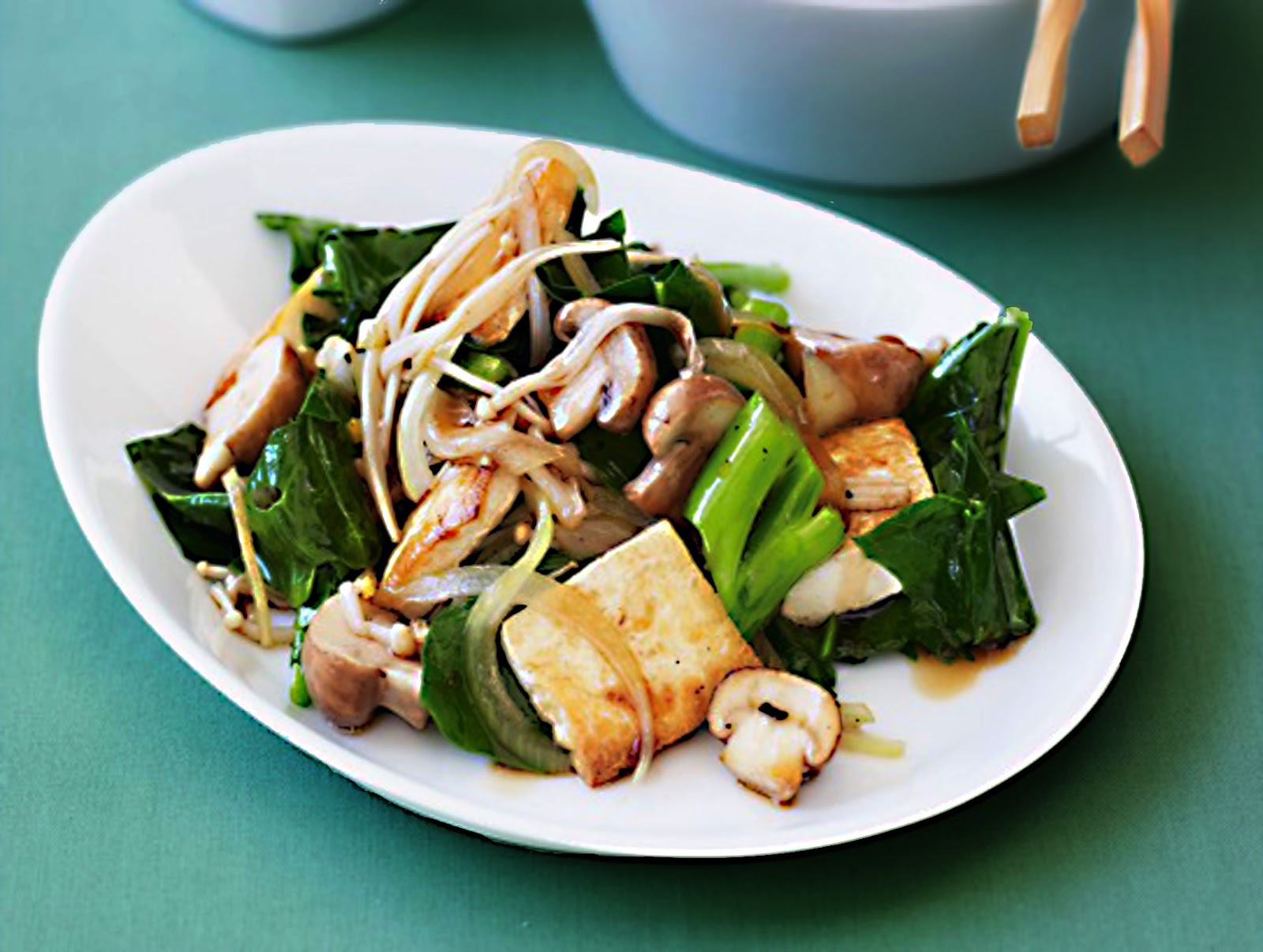
FOOD FRIDAY - TOFU & MUSHROOMS

“Asia is rich in people, rich in culture and rich in resources. It is also rich in trouble.” - Hubert H. Humphrey

I really like Asian food and often when we eat out we got to an Asian restaurant – be it Chinese, Thai, Vietnamese, Korean, Mongolian, Nepalese or Indian. Although I have tried my hand in Asian cuisine, it very seldom tastes exactly right, as it should. I find it hard to cook right. Some dishes turn out well, however, and the following stir-fry is one of the successes…

STIR-FRIED TOFU & MUSHROOMS
Ingredients
2 tbsp vegetable oil
1 onion, thinly sliced
2 garlic cloves, crushed
4 cm piece fresh ginger, peeled, cut into thin matchsticks
600g firm tofu, cut into 3 cm oblongs, about 1 cm thick
200g Swiss brown mushrooms, sliced
100g enoki mushrooms, trimmed
2 tablespoons light soy sauce
1/2 cup stir-fry sauce (see below)
1 bunch gai lan (Chinese broccoli), chopped
Cooked noodles
Stir-fry Sauce
½ cup soy sauce
½ cup vegetable broth
1 tbsp corn starch
1 tsp honey
1 tsp sesame seed oil
1 tsp rice vinegar
Whisk all ingredients together until smooth. Will keep refrigerated in an airtight container for 1 week.

Method
Heat oil in a wok over medium-high heat. Stir-fry onion for 2 to 3 minutes or until just soft and add garlic, ginger and tofu. Stir-fry for 3 minutes.
Add mushrooms, soy sauce and stir-fry sauce. Stir-fry for 2 minutes. Add gai lan. Stir-fry 1 to 2 minutes or until gai lan is just tender. Remove from heat.
Meanwhile, place cooked noodles in a heatproof bowl.
Serve noodles in individual bowls, with tofu and mushrooms in the middle to share out.

Tuesday, 2 August 2016

TRAVEL TUESDAY #38 - LHASA, TIBET

“Thousands of candles can be lighted from a single candle, and the life of the candle will not be shortened. Happiness never decreases by being shared.” – Buddha

Welcome to the Travel Tuesday meme! Join me every Tuesday and showcase your creativity in photography, painting and drawing, music, poetry, creative writing or a plain old natter about Travel!

There is only one simple rule: Link your own creative work about some aspect of travel and share it with the rest of us! Please use this meme for your creative endeavours only.

Do not use this meme to advertise your products or services as any links or comments by advertisers will be removed immediately.
Lhasa is a city and administrative capital of the Tibet Autonomous Region of China. The main urban area of Lhasa is roughly equivalent to the administrative borders of Chengguan District, which is part of the wider Lhasa prefecture-level city, an area formerly administered as a prefecture. Lhasa is the second most populous city on the Tibetan Plateau after Xining and, at an altitude of 3,490 metres, Lhasa is one of the highest cities in the world. The city has been the religious and administrative capital of Tibet since the mid-17th century. It contains many culturally significant Tibetan Buddhist sites such as the Potala Palace, Jokhang Temple and Norbulingka Palaces.

The Potala Palace (shown here) was the chief residence of the Dalai Lama until the 14th Dalai Lama fled to India during the 1959 Tibetan uprising. It is now a museum and World Heritage Site. The palace is named after Mount Potalaka, the mythical abode of the bodhisattva Avalokiteśvara. The 5th Dalai Lama started its construction in 1645 after one of his spiritual advisers, Konchog Chophel (died 1646), pointed out that the site was ideal as a seat of government, situated as it is between Drepung and Sera monasteries and the old city of Lhasa. It may overlay the remains of an earlier fortress called the White or Red Palace on the site, built by Songtsän Gampo in 637.

The building measures 400 metres east-west and 350 metres north-south, with sloping stone walls averaging 3 m thick, and 5 m thick at the base, and with copper poured into the foundations to help proof it against earthquakes. Thirteen stories of buildings (containing over 1,000 rooms, 10,000 shrines and about 200,000 statues) soar 117 metres on top of Marpo Ri, the "Red Hill", rising more than 300 m in total above the valley floor. Tradition has it that the three main hills of Lhasa represent the “Three Protectors of Tibet”: Chokpori, just to the south of the Potala, is the soul-mountain of Vajrapani; Pongwari that of Manjusri; and Marpori, the hill on which the Potala stands, represents Avalokiteśvara.

This post is part of the Our World Tuesday meme,
and also part of the Wordless Wednesday meme.

Add your own travel posts using the Linky tool below,and don't forget to be nice and leave a comment here, and link back to this page from your own post:

Thursday, 30 June 2016

ALL ABOUT STAR ANISE

“All those spices and herbs in your spice rack can do more than provide calorie-free, natural flavorings to enhance and make food delicious. They're also an incredible source of antioxidants and help rev up your metabolism and improve your health at the same time.” - Suzanne Somers

Illicium verum is a medium-sized native evergreen tree in the family Schisandraceae, native of northeast Vietnam and southwest China. A spice commonly called star anise, star anise seed, Chinese star anise or badiam that closely resembles anise in flavour is obtained from the star-shaped pericarp of the fruit of Illicium verum, which are harvested just before ripening. Star anise oil is a highly fragrant oil used in cooking, perfumery, soaps, toothpastes, mouthwashes, and skin creams. About 90% of the world’s star anise crop is used for extraction of shikimic acid, a chemical intermediate used in the synthesis of oseltamivir, which is an antiviral medication used to treat influenza A and influenza B (flu), and to prevent flu after exposure. The medication is taken orally.

Illicium comes from the Latin illicio meaning “entice”. In Persian, star anise is called بادیان bādiyān, hence its French name badiane. In India, it is called badian or phoolchakri and in Pakistan, it is called badian. Illicium species are evergreen shrubs and small trees. The leaves are alternately arranged and borne on petioles. The blades are glandular and fragrant. The flowers are solitary. They have few to many tepals in two or three rows, the inner ones like petals and the outer ones often smaller and more like bracts. A few to many stamens and pistils are at the centre. The fruit is an aggregate of follicles arranged in a star-shaped whorl. One seed is in each follicle, released when the follicle dehisces. The seed has a thick, oily endosperm.

These are plants of moist understory, adapted to shady habitat, and some species are so sensitive to light that too much sunlight causes them significant stress, manifesting in chlorosis and necrosis of the leaves. Several species are cultivated as ornamental plants for their flowers, foliage, and fragrance, leading to the development of several cultivars. Because of their ecological requirements, many taxa can only be grown in low-light situations. The essential oils of several species are used as flavourings and carminatives; however, the oils of I. anisatum and I. floridanum are toxic. I. verum, the common star anise, is used to flavour food and wine. Its fruit is a traditional Chinese medicine called pa-chio-hui-hsiang, which is used to treat abdominal pain and vomiting.

Star anise contains anethole, the same ingredient that gives the unrelated anise its flavor. Recently, star anise has come into use in the West as a less expensive substitute for anise in baking, as well as in liquor production, most distinctively in the production of the liquor Galliano. It is also used in the production of sambuca, pastis, and many types of absinthe. Star anise enhances the flavour of meat. It is used as a spice in preparation of biryani and masala chai all over the Indian subcontinent. It is widely used in Chinese cuisine, and in Indian cuisine where it is a major component of garam masala, and in Malay and Indonesian cuisines.

The tree is widely grown for commercial use in China, India, and most other countries in Asia. The tree is also grown in Southern New South Wales in Australia. Star anise is an ingredient of the traditional five-spice powder of Chinese cooking. It is also a major ingredient in the making of phở, a Vietnamese noodle soup. It is also used in the French recipe of mulled wine, called vin chaud (hot wine).

Japanese star anise (Illicium anisatum), a similar tree, is highly toxic and inedible; in Japan, it has instead been burned as incense. Cases of illness, including “serious neurological effects, such as seizures”, reported after using star anise tea, may be a result of deliberate economically motivated adulteration with this species. Japanese star anise contains anisatin, which causes severe inflammation of the kidneys, urinary tract, and digestive organs. The toxicity of I. anisatum, also known as shikimi, is caused by its potent neurotoxins anisatin, neoanisatin, and pseudoanisatin, which are noncompetitive antagonists of GABA receptors.

In the language of flowers, a blossoming branch of star anise means: “You are very enticing”. The star-shaped cartwheels of the spice mean: “Your youth is alluring”.

This post is part of the Floral Friday Fotos meme,
and also part of the Food Friday meme.

Tuesday, 31 May 2016

TRAVEL TUESDAY #29 - HANOI

“Wherever you go, go with all your heart.” – Confucius

Welcome to the Travel Tuesday meme! Join me every Tuesday and showcase your creativity in photography, painting and drawing, music, poetry, creative writing or a plain old natter about Travel!

There is only one simple rule: Link your own creative work about some aspect of travel and share it with the rest of us! Please use this meme for your creative endeavours only.

Do not use this meme to advertise your products or services as any links or comments by advertisers will be removed immediately.
Hanoi is the capital of Vietnam and the country's second largest city. Its population in 2009 was estimated at 2.6 million for urban districts, 6.5 million for the metropolitan jurisdiction. From 1010 until 1802, it was the most important political centre of Vietnam. It was eclipsed by Huế during the Nguyen dynasty as the capital of Vietnam, but Hanoi served as the capital of French Indochina from 1902 to 1954. From 1954 to 1976, it was the capital of North Vietnam. The city is located on the right bank of the Red River. Hanoi is located at 1,760 km north of Ho Chi Minh City. October 2010 officially marked 1000 years since the establishment of the city.

The Huc Bridge on Sword Lake ("Hồ Hoàn Kiếm"), one of the major scenic spots in Hanoi, serving as a focal point for its public life. The Huc Bridge (meaning Morning Sunlight Bridge) leads to Jade Island on which the Ngoc Son Temple (Jade Mountain Temple) stands. The temple was erected in the 18th century. It honours the 13-century military leader Tran Hung Dao who distinguished himself in the fight against the Yuan Dynasty, Van Xuong, a scholar, and Nguyen Van Sieu, a Confucian master and famous writer in charge of repairs made to the temple in 1864.

This post is part of the Our World Tuesday meme,
and also part of the Wordless Wednesday meme,
and part of the  Ruby Tuesday meme.

Add your own travel posts using the Linky tool below, and don't forget to be nice and leave a comment here, and link back to this page from your own post!

Thursday, 2 July 2015

ALL ABOUT OFFAL

"Hunger is the best sauce in the world." - Cervantes

If you are a vegetarian, you may like to skip this blog today as you may find it too distressing! People with heart conditions are warned not to read any further. Treehuggers and animal liberation people read no more. If you are an incurable romantic with easily bruised sensibilities, likewise, do not read this.

Humans are described as omnivores biologically, meaning that we eat a little bit of everything. That everything includes fruits and vegetables, nuts and seeds, meats and fats. Ii some cultures, the term “everything: is taken rather more literally and if an animal is slaughtered for food, each and every part of that animal is consumed or somehow used. The term “offal” is used for describing the internal organs and innards of an animal or fish, including brain, liver, kidney, tripe, and heart. It can also refer to the animal's extremities, such as head, tail, trotters and tongue. Various other bits and pieces like giblets, cockscomb, caul, lights, various glands, bone marrow, blood, etc are also included in this definition. Offal used as food is a tradition that goes back to the hunter/gatherer days of prehistory when to have killed an animal meant an awful lot of good luck. Every part of that animal was eaten as people did not know when again they would be able to feast on such a luxury.

We have come a long way since then, but our Neanderthal heritage is still to be found in our genes, and offal is still on our menu. The masters of the contemporary euphemism, the Americans, prefer to refer to offal as “variety meats” and in several chic restaurants in the States, one may now find increasing use of these delicacies. Are the foodies and epicures slumming it? The tradition of offal consumption represents a simple case of thrifty agrarian necessity. The farmer who knows what expense and resources go into the raising of a food animal, is convinced easily that if one is to be so indulgent as to slaughter an animal, one had better make use of all of it, even the “nasty bits”. Europeans rich and poor have always dined on offal, but it nevertheless has retained a certain… bucolic reputation. The Italians call it “la cucina povera”, or “poor food”, as a reminder of the farming origins of these dishes.

Recipes for offal abound and regional cuisines around the world make full use of all bits and pieces of the animal. “Waste not, want not” is still very much alive and many cultures would blanch at our wasteful society and its preoccupation with “chicken breasts” and “fillet mignon”.

Everyone has heard of the famous traditional Scottish haggis, which consists of sheep stomach stuffed with a boiled mix of liver, heart, lungs, rolled oats and other ingredients. Steak and kidney pie is traditional English fare, while in France, the Iberian peninsula and Italy, many items in the delicatessen and charcuterie displays boast delicious concoctions made from offal. Some of the top restaurants in Europe serve offal as “plats de resistance” – with prices to match! Asian cuisine makes no distinction between offal and other parts of the animal and is it very much a case of eating everything from the pig except the squeal.

In Greece, offal is consumed with great gusto and some famous Greek dishes utilise offal to great effect. Splinantero consists of liver, spleen and small intestine, roasted over an open fire. Kokoretsi is a similar dish that is usually Easter fare and comprises pieces of lamb offal (liver, heart, lungs, spleen, kidney and fat) that are pierced on a spit and covered by washed small intestine wound around in a spiral fashion. The kokoretsi is then roasted over coal fire. Another traditional Easter food is mageiritsa, a soup made with lamb or kid's offal and lettuce, dill, spring onions in a white egg-and-lemon sauce. Tzigerosarmas ("liver wrap") and gardoumba are two varieties of splinantero and kokoretsi made in different sizes and with extra spices to improve the taste.

If you want to read more, here are a couple of links: