Saturday, 7 December 2013

MUSIC SATURDAY - SCARLATTI

“We are the music makers, and we are the dreamers of dreams.” ― Arthur O’Shaughnessy
 

For Music Saturday some music by the patriarch of a musical family, Alessandro Scarlatti. Alessandro Scarlatti (2 May 1660 – 22 October 1725) was an Italian Baroque composer especially famous for his operas and chamber cantatas. He is considered the founder of the Neapolitan school of opera. He was the father of two other composers, Domenico Scarlatti and Pietro Filippo Scarlatti.
 

Scarlatti was born in Palermo, then part of the Kingdom of Sicily. He is generally said to have been a pupil of Giacomo Carissimi in Rome, and some theorise that he had some connection with northern Italy because his early works seem to show the influence of Stradella and Legrenzi. The production at Rome of his opera “Gli Equivoci nell Sembiante” (1679) gained him the support of Queen Christina of Sweden (who at the time was living in Rome), and he became her Maestro di Cappella.
 

In February 1684 he became Maestro di Cappella to the viceroy of Naples, perhaps through the influence of his sister, an opera singer, who might have been the mistress of an influential Neapolitan noble. Here he produced a long series of operas, remarkable chiefly for their fluency and expressiveness, as well as other music for state occasions.
 

In 1702 Scarlatti left Naples and did not return until the Spanish domination had been superseded by that of the Austrians. In the interval he enjoyed the patronage of Ferdinando de' Medici, for whose private theatre near Florence he composed operas, and of Cardinal Ottoboni, who made him his maestro di cappella, and procured him a similar post at the Basilica di Santa Maria Maggiore in Rome in 1703.
 

After visiting Venice and Urbino in 1707, Scarlatti took up his duties in Naples again in 1708, and remained there until 1717. By this time Naples seems to have become tired of his music; the Romans, however, appreciated it better, and it was at the Teatro Capranica in Rome that he produced some of his finest operas (“Telemaco”, 1718; “Marco Attilio Regolò”, 1719; “La Griselda”, 1721), as well as some noble specimens of church music, including a mass for chorus and orchestra, composed in honour of Saint Cecilia for Cardinal Acquaviva in 1721. His last work on a large scale appears to have been the unfinished serenata for the marriage of the prince of Stigliano in 1723. He died in Naples in 1725.
 

Here are seven concerti for various instruments (Naples, 1725):
Concerto for flute, strings and basso continuo in A major: I. Allegro - 0:05 II. Fuga - 1:00 III. Adagio - 2:54 IV. Allegro - 4:48
Concerto for flute, strings and basso continuo in D major:
I. Allegro, adagio - 6:12 II. Fuga - 8:21 III. Largo - 10:25 IV. Allegro - 12:14
Concerto for recorder, strings and basso continuo in A minor:
I. Allegro - 13:39 II. Largo - 15:39 III. Fuga - 17:17 IV. Piano - 19:23 V. Allegro - 21:11
Concerto for recorder, strings and basso continuo in C minor:
I. Moderato - 23:06 II. Fuga - 24:27 III. Largo - 26:20 IV. Allegro - 27:51 V. Andante - 29:21
Concerto for recorder, strings and basso continuo in A minor:
I. Andante - 30:15 II. Allegro - 34:27 III. Veloce, lento - 36:20 IV. Allegro - 37:33
Concerto for recorder, strings and basso continuo in C major:
I. Adagio - 39:29 II. Fuga - 41:07 III. Largo - 43:26 IV. Allegro - 44:57
Concerto for recorder, strings and basso continuo in G minor:
I. Allegro - 46:33 II. Fuga - 47:27 III. Largo - 49:38 IV. Allegro - 51:39

Alto recorder: Michael Schneider (A. Brown, after Denner)
Transverse flute: Karl Kaiser (G. Kowalewsky, after Palanca)
Violin: Sabine Lier (S. Klotz, 1760, Mittenwald) Ingeborg Scheerer (T. Eberle, 1781, Naples) Violoncello: Rainer Zipperling (V. Panarmo, 1786, Palermo)
Harpsichord and Chamber Organ: Sabine Bauer (Italian model, Griewisch / Fr. Lieb) Chamber Organ: Harald Hoeren (Fr. Lieb)

Friday, 6 December 2013

FOOD FRIDAY - PEACH PARFAIT

“You can be the ripest, juiciest peach in the world, and there's still going to be somebody who hates peaches.” - Dita Von Teese
 
For Food Friday this week, a luscious summer dessert that is easy to prepare if you cheat a little… Use some left-over sponge cake and use canned peaches rather than stewing your own peaches if time is short. Of course if you have ripe peaches on hand, you can always use them uncooked.
 
PEACH PARFAIT
 
Ingredients
  • 2 dessertspoons peach schnapps
  • 4 dessertspoons of apricot jam
  • 4 slices left-over sponge cake
  • 1 can peach halves
  • 6-7 tablespoons of peach fruit yoghurt
  • A handful of freshly roasted almonds, shaved
  • Whipped cream flavoured with almond essence and sweetened to taste (optional)

Method
Mix the peach schnapps with the apricot jam and blend until smooth, adding a little syrup from the canned peaches. The consistency should be like that of honey.
 
Put a slice of the sponge cake in each of the four dessert bowls. Pour an equal amount of the jam mixture over the sponge cake to moisten it.
 
Drain the peach halves and cut them into quarters. Arrange the peaches over the jam-coated sponge slices. Spoon some peach yoghurt over the dessert, enough to cover the peaches. Sprinkle the chopped almonds over the yoghurt and pipe some stiffly whipped cream (if desired) over the yoghurt. Refrigerate for about 2-3 hours before serving.
 
This post is part of the Food Friday meme,
and also part of the Food Trip Friday meme.

VALE, NELSON MANDELA

“I learned that courage was not the absence of fear, but the triumph over it. The brave man is not he who does not feel afraid, but he who conquers that fear.” - Nelson Mandela
 
Nelson Rolihlahla Mandela (18 July 1918 – 5 December 2013) was a South African anti-apartheid revolutionary who was imprisoned and then became a politician and philanthropist who served as President of South Africa from 1994 to 1999. He was the first black South African to hold the office, and the first elected in a fully representative election.
 
His government focussed on dismantling the legacy of apartheid through tackling institutionalised racism, poverty and inequality, and fostering racial reconciliation. Politically an African nationalist and democratic socialist, he served as the President of the African National Congress (ANC) from 1991 to 1997. Internationally, Mandela was the Secretary General of the Non-Aligned Movement from 1998 to 1999.
 
The Nobel Peace Prize laureate was one of the world’s most revered statesmen after preaching reconciliation despite being imprisoned for 27 years. He had rarely been seen in public since officially retiring in 2004. He made his last public appearance in 2010, at the football World Cup in South Africa. Mandela had been receiving intensive medical care at home for a lung infection after spending three months in hospital.
 
Mandela was an inspiration not only for the people of South Africa but for everyone around the world who believed in race equality, freedom and fair treatment of all people. His life was a shining example of how a single individual can change the course of history and positively affect the lives of millions. A sad day for the world, but also a day for celebrating his many achievements.
 
Many South Africans, who love Nelson Mandela like a father, say that their grief was tinged with uncertainty, and some fear over what their future holds without him.

Vale, Nelson Mandela

Wednesday, 4 December 2013

POETRY JAM - SINTERKLAAS

“A gift consists not in what is done or given, but in the intention of the giver or doer.” - Lucius Annaeus Seneca
 
Sinterklaas (or more formally Sint Nicolaas or Sint Nikolaas; Saint-Nicolas in French; Sankt Nikolaus in German) is a traditional winter holiday figure still celebrated in the Low Countries, including the Netherlands, Belgium and Luxembourg, as well as some parts of Germany, French Flanders, Lorraine and Artois. He is also well known in territories of the former Dutch Empire, including Aruba, Bonaire, Curaçao, Indonesia, and Suriname. He is one of the sources of the holiday figure of Santa Claus in North America.
 
Although he is usually referred to as Sinterklaas, he is also known as De Goedheiligman (The Good Holy Man), Sint Nicolaas (Saint Nicholas) or simply as De Sint (The Saint).He is celebrated annually on Saint Nicholas' eve (5 December) in the Netherlands and on the morning of 6 December in the other countries. Originally, the feast celebrates the name day of Saint Nicholas – patron saint of children, sailors, philatelists, and the city of Amsterdam, among others. Saint Nicholas being a bishop and this geographical spread make clear that the feast in this form has a Roman Catholic background, although the papacy has never officially recognised his existence.
 
Having spent some time in the Netherlands, I thoroughly enjoyed the Sinterklaas festivities where people dress up as the saint and his black helpers to give gifts to children, who are delighted with the visit from the kindly old man and the jolly helpers.
 
Poetry Jam this week is all about gifts and as a mention was made of Saint Nicholas’ Day (December 6) and since it is my Name Day, here is my Sinterklaas poem:
 
A Sinterklaas Poem
 
A funny day, a lovely day,
A zany day so full of play!
To friends, with wishes sung
A happy day to old and young.
 
As Sinterklaas comes by again,
With Zwarte Piet from Spain,
I wish to you his gifts does bring,
A toy, a book, …a golden ring!
 
We all enjoy the fun, the laughter
And lots of sweets to eat straight after.
There’s cake and chocolate, lots of candy,
But as for me, I’ll drink the brandy!
 
Seek high and low, go out and in
You’ll find your presents with a grin:
In sawdust smothered, under beds,
In socks, in wardrobes or in bread!
 
The kindly saint, he smiles and blesses,
The youngsters’ heads bends and caresses.
To all who’ve been good all year,
Old Sinterklass will give good cheer.

Tuesday, 3 December 2013

NEED TO FLY

“It is difficult to free fools from the chains they revere.” - Voltaire

A dark angel has been provided by Magpie Tales as the creative spark for all who will take up her challenge. Here is my offering:
 
Need to Fly
 
The wild flapping of feathered wings,
Caged and desperate to escape;
Cries in the night, powerless
To make the moon approach closer;
No amount of war paint can make you
Fearsome enough to overcome your foe.
 
Memories of a distant flight,
Some place in the past;
The freedom of air rushing by you,
Caressing your every fibre;
No amount of struggle can make you
Break your chains and escape.
 
The faint glimmer of sunlight
And visions of broken chips of blue sky;
Remembrances of green meadows,
Flowers: Do they still exist?
No amount of wishing can make you
Fly, liberated, untethered, free.
 
A gilded cage is still a cage,
Your every need taken care of
Is no guarantee of happiness;
A captive soul imprisons heart and flesh, too.
No amount of solid earth can make you
Forget the lightness of air…

Monday, 2 December 2013

MOVIE MONDAY - THE IMPOSSIBLE

“Altruism is innate, but it’s not instinctual. Everybody’s wired for it, but a switch has to be flipped.” - David Rakoff
 

Movies based on true stories capture the public’s imagination and contrary to biographical dramas that exult famous public figures, the scenario based on true stories of ordinary people tend to be rather more engaging and generate more interest in the movie-going public. We watched precisely such a film last weekend and we were kept glued to our seats. The added interest in this movie was the disaster theme, which unfortunately was a true horrific occurrence.
 

The movie in question was the J. A. Bayona 2012 film “The Impossible” starring Naomi Watts, Ewan McGregor and Tom Holland on a story by Sergio G. Sánchez and María Belón. It is based on the 2004 Indian Ocean tsunami, following an undersea earthquake that occurred at 00:58:53 UTC on Sunday, 26 December 2004, with an epicentre off the west coast of Sumatra, Indonesia. The quake itself is known by the scientific community as the Sumatra–Andaman earthquake. The resulting tsunami was given various names, including the 2004 Indian Ocean tsunami, South Asian tsunami, Indonesian tsunami, the Christmas tsunami and the Boxing Day tsunami.
 

The earthquake was caused when the Indian Plate was subducted by the Burma Plate and triggered a series of devastating tsunamis along the coasts of most landmasses bordering the Indian Ocean, killing over 230,000 people in fourteen countries, and inundating coastal communities with waves up to 30 meters high. It was one of the deadliest natural disasters in recorded history. Indonesia was the hardest-hit country, followed by Sri Lanka, India, and Thailand.
 

The movie is the story of a typical family, Maria the mother (Watts), Henry the father (McGregor) and their three children, Lucas (Holland), Thomas and Simon. They travel to Phuket, Thailand to spend their Christmas holidays relaxing in a brand new seaside resort. After settling in, they go to the pool, like so many other tourists. It is a perfect vacation in paradise-like surroundings, until a barely heard distant noise becomes a deafening roar. There is no time to escape from the massive tsunami that obliterates all in its path. Maria and her eldest son are swept one way, Henry and the two other children another way. The film follows the fate of all in the post-tsunami disaster zone.
 

The real family that the main characters of the film are based on is the Belón family and are in fact Spanish but were living in Japan at the time of the Tsunami. The film changes the nationality of the family to British. However, the real family were present on set during the whole shooting process. They were giving tips, especially to Naomi Watts who was portraying Maria Belon. The whole family also attended the film’s premiere at the Toronto Film Festival in 2012.
 

The film has amazing CGI effects and stunts, great cinematography and solid acting. These good points tend to work with the interesting story to balance out some lapses and one is temporarily restrained from asking too many ethical questions – these come out later, on reflection. The devastation and tragedy of such an epic destruction can only be sketched out by a film that concentrates on one family’s experience. The toll on the native population is hardly hinted at and the victims we see are mainly white and privileged. There is even an element of white-washing, in terms of converting the real Hispanic family’s origins to an upper class British family. This is puzzling as the film was produced in Spain, but perhaps it was aiming at the sympathies of the Anglocentric world, where most of the box-office profits would be made.
 

The film is poignant and heart-warming, because it focusses the immense tragedy on the experiences of one family. While their plight is personal and intense, it raises a more universal sympathy, especially as the family is both the recipient as well as the giver of kindness in the face of adversity. In fact, altruism is one of the main themes of the movie. The young Tom Holland, playing Lucas, the eldest son steals many of the scenes, while Naomi Watts does a great job of the severely injured Maria, the mother. A harrowing film in many respects, but nevertheless well worth seeing.

Sunday, 1 December 2013

ART SUNDAY - KARL SCHMIDT-ROTTLUFF

“You can understand nothing about art, particularly modern art, if you do not understand that imagination is a value in itself.” - Milan Kundera
 
Karl Schmidt-Rottluff (born Rottluff bei Chemnitz 1884 – died Berlin 1976) The painter, print-maker and sculptor Karl Schmidt was born at Rottluff near Chemnitz in 1884. His father was a miller. In 1905 he enrolled to study architecture at Dresden Technical University. The year he met Ernst Ludwig Kirchner, Erich Heckel and Fritz Bleyl there, he co-founded with them the group of artists known as “Die Brücke”. Their first joint portfolio of prints appeared in 1906.
 
He outdid his colleagues in insisting on pure primary colours and his expressionist paintings were dominated by forceful handling of the medium to achieve intensity and brilliance. Until 1912 he often stayed for quite some time in the Dangastermoor near Varel in Oldenburg, where he found a wealth of motifs for his landscape paintings. After moving to Berlin in 1911, he addressed problems of form, developing an increasingly reductive geometric formal language, a development that was interrupted by the outbreak of war.
 
While serving on the Eastern Front, he did a cycle of religious woodcuts in which he tried to come to terms with the horrors of war. These are regarded as his graphic masterpiece. In 1918 he returned to Berlin. During the 1920s he reverted to the work rhythm of travelling to paint during the summers and working in his studio during the winters. Stays in Pomerania, at Lake Leba in Ticino and in the Taunus Mountains as well as a stint in Rome to study at the German Academy in the Villa Massimo (1930) inspired his mature still lifes and landscapes.
 
In 1937 his work was declared degenerate at the notorious Munich exhibition of “Degenerate Art”. By 1941 he was forbidden to paint and was expelled from the painters’ guild. After World War II he was appointed to a chair at the (West) Berlin Hochschule für bildende Künste. His late work links up, as far as motifs are concerned, with his Expressionist phase although his palette was by then more subtle and less intense.
 
In 1956 this renewer of art, who had been an arch revolutionary in his youth, was awarded the highest (West) German distinction, the “Pour le Mérite” order, and was honoured as a classic. The Brücke Museum, which he had endowed with a collection of his works, was inaugurated in 1967. Numerous retrospectives in the Federal Republic paid tribute to this artist, who, as art historians unanimously agree, was one of the most important German Expressionists.
 
In his painting “Village Square”, circa 1919 (National Gallery – Prague, Czech Republic; Height: 119 cm - Width: 137 cm), we see the strong colours and rich patterns of the strongly geometric style he was developing around the time of World War I. There is an almost primitive feel to the work, reminiscent of Africa.

Saturday, 30 November 2013

MUSIC SATURDAY - ALBINONI

“A composition is always more than the sum of its parts. In other words, a really good piece of music is more than itself. It's sort of like a prism, which you can see from each facet a single totality.” - Yo-Yo Ma
 
Tomaso Giovanni Albinoni (8 June 1671 - 17 January 1751) was a Venetian Baroque composer. While famous in his day as an opera composer, he is mainly remembered today for his instrumental music, such as the concertos, many of which are regularly recorded. Here are some of his oboe concertos, containing a wealth of wonderful music.
 
Albinoni was particularly fond of the oboe, a relatively new introduction in Italy, and is credited with being the first Italian to compose oboe concertos (Op. 7, 1715). Prior to Op.7, Albinoni had not published any compositions with parts for wind instruments. The concerto, in particular, had been regarded as the province of stringed instruments. It is likely that the first concertos featuring a solo oboe appeared from German composers such as Telemann or Handel. Nevertheless, the four concertos with one oboe (Nos. 3, 6, 9 and 12) and the four with two oboes (Nos. 2, 5, 8 and 11) in Albinoni’s Op.7 were the first of their kind to be published, and proved so successful that the composer repeated the formula in Op.9 (1722) – which are to be heard below.
 
The video accompanying the soundtracks contains some gorgeous video and photos from Venice, Murano and Burano, many sights of which would certainly have been familiar to Albinoni. The video has been uploaded by Hollandsk Gjestehus, a guesthouse in Vinstra, Norway, which looks absolutely delightful. No doubt the owners recorded their trip to Venice and what better music for a soundtrack than Albinoni’s?


BELATED FOOD FRIDAY

“Everything you see I owe to spaghetti.” - Sophia Loren
 

It’s been a very busy time for me these past few days, so I am running behind in all things. Hence the belated Food Friday post. Nevertheless, having enjoyed this dish lately, here is the recipe:
 

SPAGHETTINI AI FUNGHI
 

Ingredients
150 g butter, tablespoon or two of olive oil
300 g of Swiss brown mushrooms
100 g champignons
1 coffee cup of cream (≈ 50 mL)
Tablespoon or two of sherry
100 g grated parmesan
Parsley, freshly ground nutmeg
Deep plate full of uncooked spaghettini (8 minute cook variety, snap pasta into two pieces to fit into plate before boiling, makes eating it easier too!)
 

Method
Heat oil and butter in frying pan until hot.  Sauté the sliced mushrooms and champignons.  Add the cream and the sherry and simmer until mushrooms are cooked and the cream has been reduced.  Stir often to prevent nasty accidents involving burnt sauces.  Add the chopped truffle and stir well to flavour through.  Remove from heat and put aside.  Cook the spaghetti for the specified time plus one minute more.  Rinse with cold water and drain.  Reheat the mushroom cream sauce until it is boiling, stirring thoroughly all the while.  Add the drained spaghetti and mix well so that it is well wrapped in the sauce.  Remove from heat and add the grated cheese, seasoning with the nutmeg and parsley.  Serve immediately and drink with icy cold Chardonnay or white burgundy.  A fresh seasonal green salad complements this dish well.
 

This post is part of the Food Friday meme,
and also part of the Food Trip Friday meme.

Thursday, 28 November 2013

STEPHEN & CATHERINE GATHERING GORSE

“God enters by a private door into every individual.” - Ralph Waldo Emerson
 
Today, the Greek Orthodox faith celebrates the feast day of St Stephen the Latter, who was born on this day in Constantinople in 715 AD. He became an ascetic monk and during the reign of Constantine V (741-775), the iconoclast, he was apprehended and brought before the Emperor for worshipping icons of Christ and the Saints. Constantine condemned him to eleven months in bonds and imprisonment. As he failed to give up worshipping icons, he was dragged over the earth and was stoned, like Stephen the First Martyr; wherefore he is called Stephen the Latter. Finally, he was struck with a wooden club on the temple and his head was shattered, and thus he died in the year 767.
 
The Catholic faith celebrates today, St Catherine Laboure, virgin, who was born on May 2, 1806. At an early age she entered the community of the Daughters of Charity, in Paris, France. Three times in 1830 the Virgin Mary appeared to St. Catherine Laboure, who then was a twenty-four year old novice. Forty-five years later, St. Catherine spoke fully of the apparitions to one of her superiors. She died on December 31, 1876, and was canonised on July 27, 1947. Her feast day is November 28.
 
On this day, it is the anniversary of the birthdays of:
John Bunyan, writer (1628);
Jean Baptiste Lully, Italo-French composer (1632);
William Blake, writer/artist (1757);
Friedrich Engels, philosopher (1820);
Anton Rubinstein, composer (1829);
Stefan Zweig, Austrian writer (1881);
Claude Lévi-Strauss, Belgian social anthropologist (1908);
Hope Lange, actress (1933);
Randy Newman, musician (1943):
Rita Mae Brown, writer (1944);
Alexander Godunov, composer (1949);

The gorse bush, Ulex europaeus, is today’s birthday plant. It is symbolic of anger (probably in reference to the plant’s spines) and also of enduring affection and love for all seasons (due most likely to the plant’s habit of producing a few blooms almost throughout the whole year).  The astrologers assign the gorse to Mars.

Today is also Albania’s Independence Day; Burundi’s Republic Day; Chad’s Republic Day; Mauritania’s National Day (since 1960) and Panama’s Independence Day.

Wednesday, 27 November 2013

POETRY JAM - GRATITUDE LISTS

“As we express our gratitude, we must never forget that the highest appreciation is not to utter words, but to live by them.” - John F. Kennedy
 

For Poetry Jam this week, Laurie would like participants to make a gratitude list with at least 12 items. Then the list should be used to create a poem. The catch is that any form of the words “grateful, gratitude, thankful or thankfulness” cannot be used in the piece composed.

I have recently have had to be especially grateful to all my family for their support and love – especially so to my mother, who has always been my rock and my support in all of the vicissitudes of my life. My list of twelve things to be grateful for are:
1)    Mother
2)    Partner
3)    Family
4)    Home
5)    Work
6)    Country
7)    Education
8)    Affluence
9)    Friends
10) Music
11) Books
12) Nature

My Mother


My mother is what I am made of –
Her blood has nourished me,
Her breath awakened mine.
My mother is the soil I have sprung from –
Her flesh begat my own,
Her heart still beats in syntony with mine.
 

Mother, I speak your tongue,
I think in ways that you have taught me,
I love as you have loved,
I speak with words I’ve heard you using.
 

My mother wanes that I may wax,
Her gentle quietude, my own advantage;
Her touch forever light, caressing.
My mother loves, most constantly
Her thoughts to me ever running,
Her words a song, a sweet consoling.
 

Mother, I take all you give,
I cherish all your caring,
I accept your nurture kindly,
I rejoice in your constant presence.
 

The painting above, 'Hawaiian Mother and Child' 1920, is by Charles W. Bartlett, (watercolour and pastel on art board).
 

Happy Thanksgiving to all who celebrate it!

Tuesday, 26 November 2013

AUTUMN EVENING

“Autumn wins you best by this its mute appeal to sympathy for its decay.” - Robert Browning
 
An 1889 painting, “Autumn on the river “by John Singer Sargent is this week’s stimulus for the weekly creative writing challenge organised by Magpie Tales. Here is my contribution, with apologies to the artist for the creative cropping and other image manipulations:
 
Autumn Evening
 
As evening falls so softly, cold
Memory’s scent I follow,
And life grows dark and old.
 
Leaves die, as they turn to gold
The sound of voices hollow.
As evening falls so softly, cold
 
I try to break its stranglehold;
My spirits fall and ebb, so low –
And life grows dark and old.
 
I try to be so resolute and bold
To make my song again to flow
As evening falls so softly, cold…
 
The wood attacked, consumed by mould
Decay eats into it so slow,
And life grows dark and old.
 
My dreams to highest bidder sold
Love’s ghosts in sadness wallow:
As evening falls so softly, cold
And life grows dark and old.

Monday, 25 November 2013

MOVIE MONDAY - FROM PRADA TO NADA

“There is no charm equal to tenderness of heart.” - Jane Austen
 

We watched a chick flick at the weekend, which I was dragged in front of the TV to see, but in the end it wasn’t too bad considering it was an Angeleno adaptation of a Jane Austen novel – Beverley Hills style. It was the 2011 Angel Gracia film “From Prada to Nada”, starring Camilla Belle, Alexa Vega, Kuno Becker, Adriana Barraza and Nicholas D’Agosto. Fina Torres, Luis Alfaro and Craig Fernandez wrote the screenplay based on Jane Austen’s novel “Sense and Sensibility”.
 

Two wealthy Beverley Hills sisters, Mary (Vega) and Nora (Belle) not only have to cope with their father’s death on his 55th birthday, but also must survive when they find themselves destitute, seeing their father was bankrupt. They discover they have a half-brother (Pablo Cruz) and are forced by a grasping sister-in-law to move in with their aunt Aurelia (Barrazza) in East L.A.
 

Mary, the younger sister, is the most spoiled, she speaks no Spanish, and is scared of the vatos. Nora, her sister convinces her to finish college, while she goes off to work in a law firm. Mary decides that one of her wealthy and good-looking teachers will be her ticket back to Beverley Hills. Nora discovers that in her job as a legal intern, Edward (D’Agosto), her supervisor, is the brother of the grasping sister-in-law. Nora and Edward fall in love but Nora wishes to finish her education and progress her career rather than concentrate on matters of the heart. While they live in the barrio, they discover the true meaning of love, family and priorities in life. Needless to say a happy end is in store for all concerned.
 

This was a lightweight romantic comedy with no pretensions whatsoever, treading solid familiar ground, which perhaps made me more kindly disposed to it. Jane Austen doesn’t always translate well to modern times, but the Latino twist on this adaptation worked. The concept of marriage and its importance may have been paramount to Jane Austen and her contemporaries, but no as much today. However, the Latino expectations regarding marriage and family suit the Austen premise well and the screenplay has been well-adapted to a contemporary Mexican/American reality.
 

The acting is good enough for the subject matter – this is no Shakespeare play. The director handles the material well and manages most of the time to control the actors tendency to overact. Some of the best acting comes from the supporting roles, Barrazza doing a splendid job as Aunt Aurelia, even though hers is a minor role. The others in the Barrio also provide some enjoyable moments. There is a tendency to typecast in the movie and the grasping sister-in-law is almost pantomime material. Wilmer Valderrama as Bruno, the love interest in the Barrio does a good enough job as the strong silent type.
 

The soundtrack was very well suited to the action, with well-accented contrasts between Beverley Hills pop and traditional Mexican sounds in the Barrio (music by Heitor Pereira). The soundtrack contains one of the best renditions of “Cielito Lindo” I have ever heard – it’s quite magical and it's a pity I couldn't track who the female singer was.
 

This is a very light and frothy romantic comedy and although very L.A. in terms of cultural references, we as Australians enjoyed it and understood the point of all references. It’s one of the advantages of living in a multicultural city like Melbourne. The film was savaged by the critics, but was much better received by the viewing public. If you set your expectation a notch or two down you will certainly enjoy the film for what it is – as I said, it’s not self-important, nor pretentious (which is always a good thing).

Sunday, 24 November 2013

ART SUNDAY - MODIGLIANI

“I recall my thrilled first exposure, as a teenager, to one of his [Modigliani’s] long-necked women, with their piquantly tipped heads and mask-like faces. The rakish stylisation and the succulent color were easy to enjoy, and the payoff was sanguinely erotic in a way that endorsed my personal wishes to be bold and tender and noble, overcoming the wimp that I was. In that moment, I used up Modigliani’s value for my life. But in museums ever since I have been happy to salute his pictures with residually grateful, quick looks.” - Peter Schjeldahl
 
Amedeo Modigliani was born on July 12, 1884 to a Sephardic Jewish family living in reduced circumstances in Livorno, Italy. He began his formal art training in 1898, and in 1902 and 1903 he studied in Florence and Venice. In 1906 he moved to Paris, with the help of a small allowance from his mother.
 
He first settled in Montmarte along with his closest friends Soutine and Lipchitz, who were also expatriate artists. He immersed himself in café and nightlife, developing a dissolute life-style that enhanced his reputation as a bohemian but eventually ruined his life.  Modigliani worked as wildly as he had lived. Alcohol and hashish never diminished his great desire to work. Neither did the numerous affairs with all kinds of women. It seems his whole life was a series of protests: Against the bourgeois smugness of his family of businessmen, against all that his art teacher Micheli represented, and against a society that failed to recognize and reward his talent.
 
Desperately poor, he scavenged stone from building sites around Paris. His sculpture, like his paintings emphasised elongated, simplified forms. He lost many of his works because he could not pay his rent and had to move a lot. He also never kept a record of his works. As his health began to fail around 1914 he turned to painting almost exclusively. Leopold Zborowski became his exclusive representative and moved Modigliani to the south of France in early 1918. Paris had become too unstable because of the fighting during World War I. It was here that he met Jeanne Hebuterne who became his mistress. By spring, they were back in Paris.
 
Jeanne gave birth to a daughter in the Autumn and his works were beginning to sell. But, his health took a turn for the worse. He died on January 24, 1920, of tubercular meningitis. The following day Jeanne, nine months pregnant with her second child, threw herself from a window of her parents’ home and died instantly.
 
Had the artist lived a few more years, he would have witnessed a growing interest in his work. In 1921 there was a memorial exhibition organized by Zborowski that received great acclaim. A foreign collector named Dr. Albert Barnes, in 1922 bought a large number of his works. Modigliani’s work still has to be studied thoroughly, but he is certainly one of the most recognised and well-known modern artists today.
 
More than anything, Modigliani was a portraitist and if one examines his work, one can see much that was assimilated by Picasso to develop his own style. Picasso’s style is a synthesis of many of the important styles in modern art, in which he took from many of his contemporaries, and in Modigliani’s case Picasso was borrowing from a man who had initially borrowed from him.
 
The art of Amedeo Modigliani cannot be classified as a specific “-ism.” His work is a part of “The School of Paris”, which refers to a group of international artists that lived and worked in France during the pre-WWII period. Because a definition of the School of Paris is rather vague, it is difficult to give an exact number of how many artists belonged to it, but it probably is close to one hundred.
 
The core of the School of Paris was formed by Jewish artists from Central and Eastern Europe who had left their native countries, sometimes due to ethnic persecution, but also because of artistic reasons: The Jewish Faith didn’t tolerate figurative images, so Jewish abstract artists were forced to look for an environment that tolerated figurative art. Their relationship with France is interesting. On the one hand they admired the French culture, on the other hand the French restraint was at odds with their Jewish and Slav temperament.
 
Although Paris is the cradle of expressionism (Van Gogh), the mentality of expressionism goes against the French sense of restraint, and there are few, if any, true French expressionists. However, the School of Paris lived and breathed expressionism, partly because of the influence of Van Gogh, as well as the German expressionists, but first and foremost because of the Jewish background of many artists of the School of Paris.
 
The “Reclining Nude” of 1917 above is characteristic of the artist’s work. He frequently painted nudes, which in some cases got him trouble with the authorities, especially given his licentiousness and rather dissolute lifestyle. The sleek, limber elongated figures and faces lend an air of grace to his subjects, but at the same time, the eyes without pupils lend a certain classicism to his work, reminiscent of ancient sculptures. The figure, which is cropped lies in a tense, uncomfortable pose lending the work a dynamism and tension which is attractive to the viewer.

Saturday, 23 November 2013

MUSIC SATURDAY - HÄNDEL VIOLIN SONATAS

“You affect the world by what you browse.” - Tim Berners-Lee
 
The change in YouTube policy that allows one to upload longer clips has meant that very quickly, a huge number of larger classical works have been uploaded in their entirety. This is a boon for classical music lovers, allowing one to perform a quick search and be able to enjoy the absolute best of the veritable treasure trove of Western classical music at will.
 
For Music Saturday today, here is such a gem. Georg Frideric Händel’s “Complete Violin Sonatas”, played by Andrew Manze (violin) and Richard Egarr (harpsichord).
 
Sonata in D major, Op.1/13, HWV 371 0:00
Sonata in F, Op.1/12, HWV 370 12:12
Sonata in D minor, HWV 359a 26:02
Sonata in A major, Op.1/3, HWV 361 33:42
Sonata in G minor, Op.1/6, HWV 364a 41:40
Sonata in A major ('Roger'), Op.1/10 48:58
Sonata in E major ('Roger'), Op.1/12 57:02
Sonata in G major, HWV 358 1:06:12


The painting above is Orazio Gentileschi’s (1563–1639) “Young Woman Playing a Violin”.

Friday, 22 November 2013

FOOD FRIDAY - RICE PUDDING

“Rice is great if you're really hungry and want to eat two thousand of something.” - Mitch Hedberg
 

For Food Friday, a classic dessert recipe popular in many parts of the world. This version is from Greece.
 

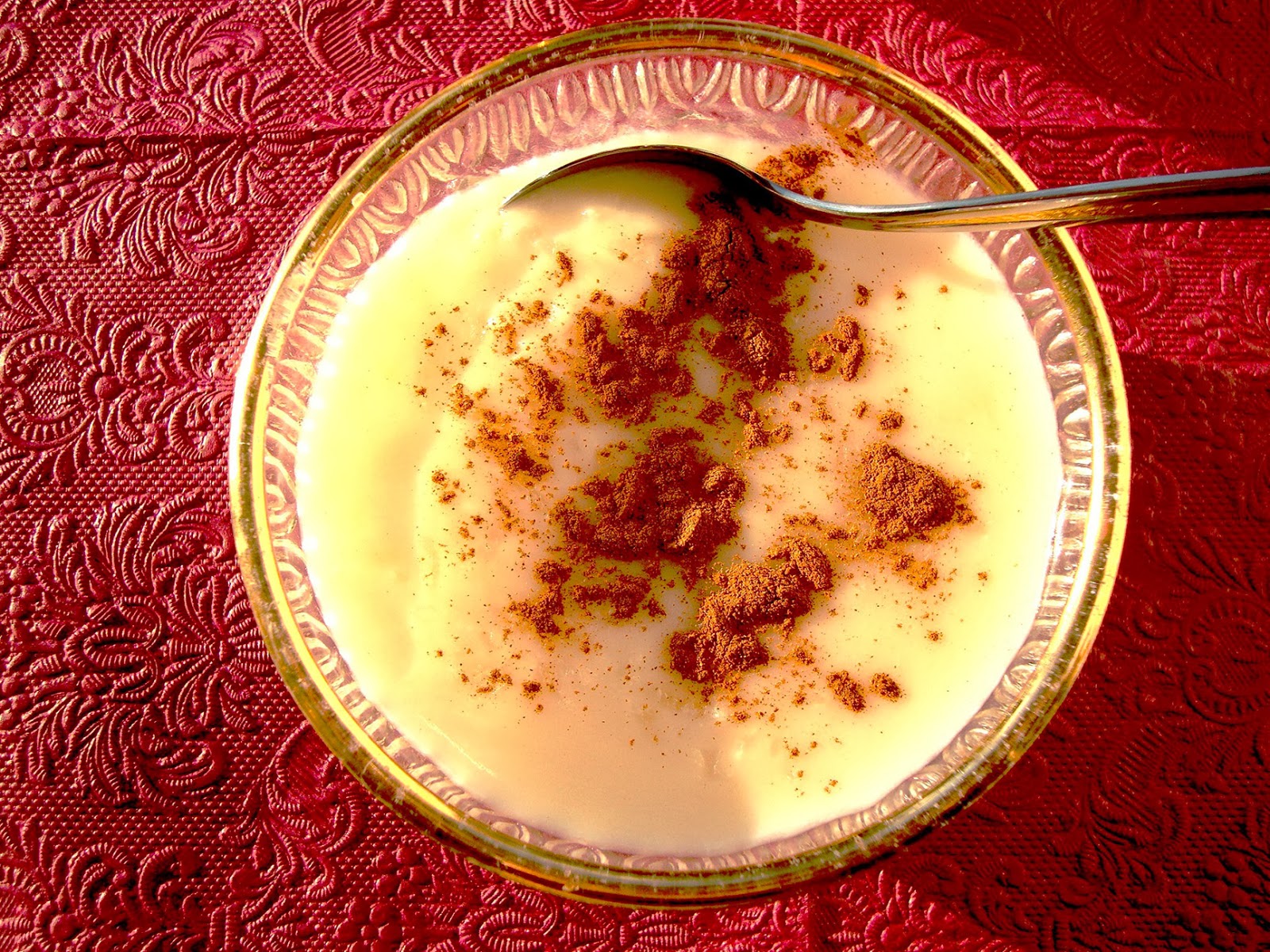
RICE PUDDING (RYZOGHALO)
 

Ingredients
3 and 1/2 cups milk
1/2 cup sugar
1/2 cup short grain rice (high in starch)
2 strips orange peel (peel of half an orange)
1 cinnamon stick
1/2 tsp. vanilla extract
Ground cinnamon for garnish
 

Method
1) In a medium saucepan combine the sugar, milk, cinnamon stick, and orange peel.
2) Bring to the boil on high heat stirring all the while.
3) Add the rice and simmer covered for about 20 minutes. Remove cover and continue to simmer for a further 20-25 minutes, or until rice is very tender and pudding begins to thicken. Stir occasionally.
4) Remove rind and cinnamon stick and add vanilla. Stir and divide mixture into four bowls.
5) Sprinkle with cinnamon generously and let cool in refrigerator for at least 2 hours.
 

This post is part of the Food Friday meme,
and also part of the Food Trip Friday meme.

Thursday, 21 November 2013

WORLD TELEVISION DAY 2013

“Television is chewing gum for the eyes.” - Frank Lloyd Wright
 

UNESCO is celebrating World Television Day today. This was proclaimed by the United Nations General Assembly in 1996 to encourage global exchanges of television programmes focusing on peace, security, economic and social development and the enhancement of cultural exchange. This commemorates the date on which the first World Television Forum was held in 1996.
 

Television is still one of the most influential forms of media presently. It is the arena where images, forms, styles and ideas surrounding the human existence are mobilised. Television makes its mark as the most popular medium for communication and information because of the considerable convenience it offers to its audience of all ages, nationalities and social status worldwide. Television does not require literacy and presents information in audiovisual form requiring no extra skills for comprehension.
 

Television and the significance of broadcasting as a fundamental means of communication and a standard gateway of information for the masses, most importantly in least-developed countries cannot be stressed enough. Television plays an effective role in disseminating information and knowledge and serves a powerful tool for reflecting and shaping human conditions and aspirations. Fostering freedom of expression and increasing cultural diversity in the media, particularly by improving the endogenous production capacities and supporting the distribution of quality audio-visual programmes are all suited for implementation using television.
 

The position of television as the means of primary entertainment in the home is accepted widely. Mainstream professional television in Australia was launched on 16 September 1956 in Sydney, launched in time to cover the 1956 Melbourne Olympics. The new medium was introduced by Bruce Gyngell with the words “Good evening, and welcome to television”, and has since seen the introduction of colour, and digital television, and the planned shutdown of analogue broadcasts set to take place between 2010 to 2013 (depending on the area). Local programs, over the years, have included a broad range of comedy, sport, and in particular drama series, in addition to news and current affairs. The industry is regulated by the Australian Communications and Media Authority.
 

As television technology developed throughout the 1960s, the medium dominated as the entertainment form of choice for most Australians. By 1965, it was estimated that 9 out of 10 Australian families owned a TV set. Nowadays of course, while all households have a television set, most have several.

Wednesday, 20 November 2013

POETRY JAM - LIGHTNING

“A poet is a man who manages, in a lifetime of standing out in thunderstorms, to be struck by lightning five or six times.” - Randall Jarrell
 

The theme of  “Lightning” is this week’s Poetry Jam stimulus for literary offerings by those who accept the challenge. Here is my contribution, rather apt as one considers the wild weather with horrific consequences that many places around the world have experienced.
 

The Watery Grave
 

And as the clouds gathered,
And as the lightning flashed,
As thunder roared,
The rains came…
 

The watery curtains cascaded down,
The rivers flowed and overflowed,
Became torrents; creeks turned to rivers
And the floods came…
 

And as the waters rushed,
And as the dams gushed,
The deluge broke the barriers
And the spate came…
 

The water covered all
In dirty brown slough;
Making lake of land
But the rains still came…
 

The might of surging waters
Overwhelmed man and beast,
Dragged down buildings, destroyed;
And death came…
 

Now as the waters still swell,
As displaced people shiver
From shock, fear, frustration,
Grim realisation came…
 

Silent, sunken, submerged,
What once was dry land and
Homes, cars, gardens, dreams,
All lie under a watery grave.

Tuesday, 19 November 2013

REMEMBERED SONG

“The power of a handwritten letter is greater than ever. It’s personal and deliberate and means more than an e-mail or text ever will. It has a unique scent. It requires deciphering. But, most important, it’s flawed.” - Ashton Kutcher

An old letter is this week’s stimulus for the weekly creative writing challenge organised by Magpie Tales . Here is my contribution:
 
Remembered Song, After the Fact
 
“And then you left me
Like a broken toy in a deserted playground
That no child will claim as its own.
And if I sit and write to you now,
It is all because I’ve loved you so.
Take care that you dress well,
The cold weather is still ahead.
And put your mind at ease,
I have not told anyone about us...
 
And then you abandoned me,
Like a stray kitten none wanted,
Preferring me to die slowly rather than dealing the death blow yourself.
And if I still persist in seeking you out,
It is all because I’ve loved so much.
Look after yourself, mind that you dress well,
The worse of the cold weather is still ahead.
And you know it well,
I tell none about the two of us...
 
And then you turned away from me,
As if I were a mistake
That nobody admits to having made.
And if I still remember you and cry
It is all because I’ve loved you so much.
Tell her to take good care of you,
The cold weather is still to come.
And put your mind at ease,
Nobody will ever find out about us...
 
And now I am alone, forgotten,
Like a lost letter
None wants to claim.
And if I still care about you
It is all because I’ve loved you so.
Mind that you dress well, you are so weak
The coldest weather is still to come.
And you know full well,
I shall not tell anyone about us...”

Monday, 18 November 2013

MOVIE MONDAY - SHUTTER ISLAND

“I became insane, with long intervals of horrible sanity.” - Edgar Allan Poe
 
You sometimes watch a movie and while it keeps you interested and engaged, when it finishes you cannot really say whether you really liked it or not. These types of movies are perhaps the most unsatisfying as they are in a somewhat gray zone, not eliciting intense antipathy or a fervent liking for. We watched such a movie at the weekend, enjoying a great deal it on the one level, but feeling somewhat deflated and unsatisfied at its conclusion…
 
It was the 2010 Martin Scorsese film “Shutter Island” starring Leonardo DiCaprio, Ben Kingsley, Mark Ruffalo, Max von Sydow, Michelle Williams and Emily Mortimer. It is a period drama with a thriller-type premise, touching upon the theme of insanity and what drives criminally insane people to commit acts that are beyond our morality and sense of humanity.
 
Scorsese is a master film-maker and his direction is faultless, the cinematography of the bleak setting highly evocative, and the acting top class. In this respect, the film satisfies greatly. But somehow one feels cheated at the end – the desire to have a twist in the story line being greater than the desire to tell a good story, pure and simple. Perhaps our own desire for enjoyment as story listeners depends to a certain extent on our ability to predict the twists of the story. Or perhaps in our desire to identify with some of the characters and like them to a certain extent. And there are a lot of unlikeable characters in the film, whom we were supposed to like (or so it turns out in the end).
 
The plot takes place in 1954, when the World War II atrocities are still fresh in the minds of people, especially so for the US soldiers that took part in the storming of the Nazi concentration camps (and yes, there are some graphic scenes there). A US marshal, Teddy Daniels (Di Caprio) is assigned to investigate the disappearance of a patient from Boston's Shutter Island Ashecliffe Hospital for the criminally insane. Daniels has personal reasons for wanting to be assigned on the island, but once there he begins to think that he has been brought to the island as part of a twisted plot by hospital doctors whose radical treatments are unethical and illegal, or even quite sinister.
 
Daniels’ investigating skills soon provide a promising lead, but the hospital refuses him access to records he suspects would break the case wide open. As a hurricane cuts off communication with the mainland, more dangerous criminals escape in the confusion, and the puzzling, improbable clues multiply, Daniels begins to doubt everything - his memory, his partner, and his own sanity.
 
I am beginning to wonder whether a second viewing of the film may work better with me, and certainly this is a film that invites a revisit after some time. There is a lot of violence in the movie and some quite confronting issues and images that convey a sense of horror and highlight the depth of inhumanity that human beings are capable of. One is led to question the concept of “sanity” and how fragile our balanced mental state is. The film is worth watching, but be aware of its graphic and violent content.