Showing posts with label indonesia. Show all posts

Tuesday, 24 June 2025

TRAVEL TUESDAY 503 - MT AGUNG, BALI, INDONESIA

“If your heart is a volcano, how shall you expect flowers to bloom?” -  Khalil Gibran
Welcome to the Travel Tuesday meme! Join me every Tuesday and showcase your creativity in photography, painting and drawing, music, poetry, creative writing or a plain old natter about Travel.
There is only one simple rule: Link your own creative work about some aspect of travel and share it with the rest of us. Please use this meme for your creative endeavours only.
Do not use this meme to advertise your products or services as any links or comments by advertisers will be removed immediately.
Mount Agung (Balinese: ᬕᬸᬦᬸᬂ​ᬅᬕᬸᬂ, romanized: gunung āgung, Indonesian: Gunung Agung) is an active volcano in Karangasem Regency, Bali, Indonesia. It is located southeast of Mount Batur volcano, also in Bali. It is the highest point on Bali, and dominates the surrounding area, influencing the climate, especially rainfall patterns. From a distance, the mountain appears to be perfectly conical. From the peak of the mountain, it is possible to see the peak of Mount Rinjani on the nearby island of Lombok, to the east, although both mountains are frequently covered in clouds. Agung is a stratovolcano, with a large and deep crater. Its most recent eruptions occurred from 2017–2019.
Balinese people believe that Mt Agung is a replica of Mt Meru, the central axis of the universe. The most important temple on Bali, Pura Besakih, is high on the slopes of Gunung Agung. Pura Besakih is a complex made up of 23 temples that sit on parallel ridges. It has stepped terraces and flights of stairs that ascend to several courtyards and brick gateways that lead up to the main spire or Meru structure, which is called Pura Penataran Agung. All this is aligned along a single axis and designed to lead the spiritual person upward and closer to the mountain which is considered sacred.
Each year, there are at least 70 festivals held at the complex since almost every shrine celebrates a yearly anniversary. This cycle is based on the 210-day Balinese Pawukon calendar year.

You are invited to the Inlinkz link party!

Click here to enter

Tuesday, 9 August 2022

TRAVEL TUESDAY 351 - JAKARTA, INDONESIA

“Never, ever forget history.” – Sukarno

Welcome to the Travel Tuesday meme! Join me every Tuesday and showcase your creativity in photography, painting and drawing, music, poetry, creative writing or a plain old natter about Travel.
There is only one simple rule: Link your own creative work about some aspect of travel and share it with the rest of us.
Please use this meme for your creative endeavours only. Do not use this meme to advertise your products or services as any links or comments by advertisers will be removed immediately.
Java is an island of Indonesia. At about 139,000 square kilometres, the island is comparable in size to England, the U.S. State of North Carolina, or Omsk Oblast. With a population of over 141 million (the island itself) or 145 million (the administrative region), Java is home to 56.7% of the Indonesian population and is the world's most populous island.

The Indonesian capital city, Jakarta (photo above), is located on western Java. Much of Indonesian history took place on Java. It was the centre of powerful Hindu-Buddhist empires, the Islamic sultanates, and the core of the colonial Dutch East Indies. Java was also the centre of the Indonesian struggle for independence during the 1930s and 1940s. Java dominates Indonesia politically, economically and culturally. Four of Indonesia's eight UNESCO world heritage sites are located in Java: 1) Ujung Kulon National Park, 2) Borobudur Temple, 3) Prambanan Temple, and 4) Sangiran Early Man Site.

You are invited to the Inlinkz link party!

Click here to enter

Tuesday, 12 April 2022

TRAVEL TUESDAY 335 - PURA BRATAN, BALI

“Aim at heaven and you will get earth thrown in. Aim at earth and you get neither.” -  C. S. Lewis

Welcome to the Travel Tuesday meme! Join me every Tuesday and showcase your creativity in photography, painting and drawing, music, poetry, creative writing or a plain old natter about Travel.
There is only one simple rule: Link your own creative work about some aspect of travel and share it with the rest of us. Please use this meme for your creative endeavours only.
Do not use this meme to advertise your products or services as any links or comments by advertisers shall be removed immediately.
Pura Ulun Danu Bratan, or Pura Bratan, is a major Shivaite and water temple on Bali, Indonesia. The temple complex is located on the shores of Lake Bratan in the mountains near Bedugul. Water temples serve the entire region in the outflow area; downstream there are many smaller water temples that are specific to each irrigation association (subak).

Built in 1633, this temple is used for offerings ceremony to the Balinese water, lake and river goddess Dewi Danu, due to the importance of Lake Bratan as a main source of irrigation in central Bali. The 11 stories of pelinggih meru dedicated for Shiva and his consort Parvathi. Buddha statue also present inside this temple.

Lake Bratan is known as the Lake of Holy Mountain due to the fertility of this area. Located 1200 m above sea level, it has a cold tropical climate. Every Tuesday, the piodalan ceremony takes place at the temple, to ensure good water supply to all the rice farmers in Bali. As the day progresses, the lake and its surroundings become crowded with tourists and paddle boats, so if you want to experience the temple in all its glory, start early in the morning, or stay back during the sunset, to capture the beauty in a relatively uncluttered milieu.

You are invited to the Inlinkz link party!

Click here to enter

Tuesday, 8 March 2022

TRAVEL TUESDAY 330 - PRAMBANAN, INDONESIA

“The essence of Hinduism is the same essence of all true religions: Bhakti or pure love for God and genuine compassion for all beings.” - Radhanath Swami

Welcome to the Travel Tuesday meme! Join me every Tuesday and showcase your creativity in photography, painting and drawing, music, poetry, creative writing or a plain old natter about Travel.
There is only one simple rule: Link your own creative work about some aspect of travel and share it with the rest of us. Please use this meme for your creative endeavours only.
Do not use this meme to advertise your products or services as any links or comments by advertisers shall be removed immediately.
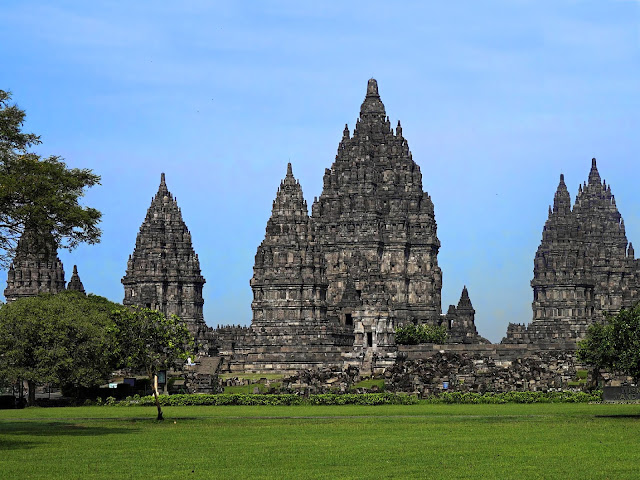
Prambanan (Indonesian: Candi Prambanan, Javanese: Rara Jonggrang) is an 8th-century Hindu temple compound in Special Region of Yogyakarta, Indonesia, dedicated to the Trimūrti, the expression of God as the Creator (Brahma), the Preserver (Vishnu) and the Destroyer (Shiva). The temple compound is located approximately 17 kilometres northeast of the city of Yogyakarta on the boundary between Central Java and Yogyakarta provinces.
The temple compound, a UNESCO World Heritage Site, is the largest Hindu temple site in Indonesia and the second-largest in Southeast Asia after Angkor Wat. It is characterised by its tall and pointed structures, typical of Hindu architecture, and by the towering 47-metre-high central building inside a large complex of individual temples.
Prambanan temple compounds originally consists of 240 temple structures; which represents the grandeur of ancient Java's Hindu art and architecture, also considered as a masterpiece of the classical period in Indonesia. Prambanan attracts many visitors from around the world.

This post is also part of the Wordless Wednesday meme.

You are invited to the Inlinkz link party!

Click here to enter

Tuesday, 1 June 2021

TRAVEL TUESDAY 290 - MT BROMO, INDONESIA

“The paradox of volcanoes was that they were symbols of destruction but also life. Once the lava slows and cools, it solidifies and then breaks down over time to become soil – rich, fertile soil.” ― Matt Haig

Welcome to the Travel Tuesday meme! Join me every Tuesday and showcase your creativity in photography, painting and drawing, music, poetry, creative writing or a plain old natter about Travel.
There is only one simple rule: Link your own creative work about some aspect of travel and share it with the rest of us. Please use this meme for your creative endeavours only.
Do not use this meme to advertise your products or services as any links or comments by advertisers shall be removed immediately.
Mount Bromo (Indonesian and Javanese: Gunung Bromo) is an active somma volcano and part of the Tengger mountains, in East Java, Indonesia. At 2,329 meters (7,641 feet) it is not the highest peak of the massif, but the most famous. The area is one of the most visited tourist destinations in East Java, and the volcano is included in the Bromo Tengger Semeru National Park.

The name Bromo comes from the Javanese pronunciation of Brahma, the Hindu god of creation. Mount Bromo is located in the middle of a plain called “Sea of Sand” (Javanese: Segara Wedi or Indonesian: Lautan Pasir), a nature reserve that has been protected since 1919. A typical way to visit Mount Bromo is from the nearby mountain village of Cemoro Lawang. From there it is possible to walk to the volcano in about 45 minutes, but it is also possible to take an organized jeep tour, including stops at the viewpoint of Mount Penanjakan (2,770 m or 9,088 ft) (Indonesian: Gunung Penanjakan).

The sights on Mount Penanjakan can also be reached on foot in about two hours. Depending on the level of volcanic activity, the Indonesian Center for Volcanology and Disaster Mitigation sometimes issues a warning not to visit Mount Bromo.

This post is part of the Our World Tuesday meme,
and also part of the Ruby Tuesday meme,
and also part of the Wordless Wednesday meme.

You are invited to the Inlinkz link party!

Click here to enter

Tuesday, 27 February 2018

TRAVEL TUESDAY #120 - BOROBUDUR, INDONESIA

“It is better to travel well than to arrive.” - Buddha 

Welcome to the Travel Tuesday meme! Join me every Tuesday and showcase your creativity in photography, painting and drawing, music, poetry, creative writing or a plain old natter about Travel.

There is only one simple rule: Link your own creative work about some aspect of travel and share it with the rest of us. Please use this meme for your creative endeavours only.

Do not use this meme to advertise your products or services as any links or comments by advertisers will be removed immediately. 
Borobudur, or Barabudur (Indonesian: Candi Borobudur) is a 9th-century Mahayana Buddhist temple in Magelang, Central Java, Indonesia, and the world’s largest Buddhist temple. The temple consists of nine stacked platforms, six square and three circular, topped by a central dome. It is decorated with 2,672 relief panels and 504 Buddha statues. The central dome is surrounded by 72 Buddha statues, each seated inside a perforated stupa.

Built in the 9th century during the reign of the Sailendra Dynasty, the temple design follows Javanese Buddhist architecture, which blends the Indonesian indigenous cult of ancestor worship and the Buddhist concept of attaining Nirvana. The temple demonstrates the influences of Gupta art that reflects India’s influence on the region, yet there are enough indigenous scenes and elements incorporated to make Borobudur uniquely Indonesian.

The monument is a shrine to the Lord Buddha and a place for Buddhist pilgrimage. The pilgrim journey begins at the base of the monument and follows a path around the monument, ascending to the top through three levels symbolic of Buddhist cosmology: Kāmadhātu (the world of desire), Rupadhatu (the world of forms) and Arupadhatu (the world of formlessness). The monument guides pilgrims through an extensive system of stairways and corridors with 1,460 narrative relief panels on the walls and the balustrades.

Borobudur has the largest and most complete ensemble of Buddhist reliefs in the world. Evidence suggests Borobudur was constructed in the 9th century and abandoned following the 14th-century decline of Hindu kingdoms in Java and the Javanese conversion to Islam. Worldwide knowledge of its existence was sparked in 1814 by Sir Thomas Stamford Raffles, then the British ruler of Java, who was advised of its location by native Indonesians.

Borobudur has since been preserved through several restorations. The largest restoration project was undertaken between 1975 and 1982 by the Indonesian government and UNESCO, followed by the monument’s listing as a UNESCO World Heritage Site. Borobudur remains popular for pilgrimage. Once a year, Buddhists in Indonesia celebrate Vesak at the monument, and Borobudur is Indonesia's single most visited tourist attraction.

This post is part of the Our World Tuesday meme,
and also part of the Wordless Wednesday meme.

Sunday, 24 January 2016

ART SUNDAY - JAN TOOROP

“While I recognise the necessity for a basis of observed reality... true art lies in a reality that is felt.” - Odilon Redon

Johannes Theodorus ‘Jan’ Toorop (20 December 1858 – 3 March 1928) was a Dutch-Indonesian painter, who worked in various styles, including Symbolism, Art Nouveau, and Pointilism. His early work was influenced by the Amsterdam Impressionism movement.

Jan Toorop was born in Purworejo on the island of Java in the Dutch East Indies (present-day Indonesia). His father was Christoffel Theodorus Toorop, a civil servant, and his mother was Maria Magdalena Cooke. He was the third of five children and lived on the island of Bangka near Sumatra until he was nine years old. He was then sent to school in Batavia on Java.

In 1869 he left Indonesia for the Netherlands, where he studied in Delft and Amsterdam. In 1880 he became a student at the Rijksakademie in Amsterdam. From 1882 to 1886 he lived in Brussels where he joined Les XX (Les Vingts), a group of artists centred on James Ensor. Toorop worked in various styles during these years, such as Realism, Impressionism Neo-Impressionism and Post-Impressionism.

After his marriage to an Annie Hall, a British woman, in 1886, Toorop alternated his time between The Hague, England and Brussels, and after 1890 also the Dutch seaside town of Katwijk aan Zee. During this period he developed his unique Symbolist style, with dynamic, unpredictable lines based on Javanese motifs, highly stylised willowy figures, and curvilinear designs.

In the late 19th century (in 1897) Toorop lived for 20 years in a small house on the market in the seaside town Domburg, Walcheren, Zeeland. He worked with a group of fellow artists, including Marinus Zwart and Piet Mondrian. There was no joint endeavour or common style among them. Each followed his individual personality, but they sought their inspiration in “the Zeeland light”, in the dunes, forests, beaches and the characteristic Zeeland population. Toorop was the centre of this group.

Thereafter he turned to Art Nouveau styles, in which a similar play of lines is used for decorative purposes, without any apparent symbolic meaning. In 1905, he converted to Catholicism and began producing religious works. He also created book illustrations, posters, and stained glass designs. Throughout his life Toorop also produced portraits, in sketch format and as paintings, which range in style from highly realistic to impressionistic. Toorop died on 3 March 1928 in The Hague in the Netherlands. His daughter Charley Toorop (1891–1955) was also a painter, as was his grandson Edgar Fernhout.

The image shown above is “The Vagabonds”, of 1891. It is executed in pencil, crayons and ink on cardboard, 65 x 76 cm and exhibited in the Kröller-Müller museum, Otterlo. There is a strong graphic, illustrative element in the work, and one can easily imagine it as a book illustration. The brilliant colours – particularly the blues and greens – draw the viewer’s eyes into the work and one is mesmerised by the syncopated rhythm of the lines, before one registers the faces of the two women and the ‘vagabonds’ of the title.

The lugubrious graveyard setting and the menacing faces of the men contrast with the dead (sleeping?) woman and the anxious mourning woman in black on the right. This is a fascinating work and it seems that it could have quite a story attached to it. The death of the artist’s first daughter shortly after her birth may have influenced his vision, perhaps, but also the artist’s contraction of venereal disease and his temporary blindness in 1887 could have left him with some psychological baggage that may be seen in his work.

Friday, 15 March 2013

FOOD FRIDAY: GADO-GADO

“The wish for healing has always been half of health." - Lucius Annaeus Seneca
 

Gado-Gado is an Indonesian vegetable dish, which means “mixtures”. The exact composition of the vegetable mixture varies, but usually comprises seasonal vegetable that are locally available. Typically, authentic gado-gado does not have carrot and tomatoes. Depending on your greengrocer’s stocks and how well Asian vegetable are represented you may use the following (vegetarians may omit the objectionable ingredients):
 

Gado-Gado (Jakarta Style)
Ingredients


Blanched: Shredded, chopped, or sliced green vegetables such as cabbage, kang-kung, young boiled jack fruit, string beans, bitter melon, and corn
Uncooked: Sliced cucumber, bean sprouts and lettuce
Fried: Tofu and/or tempeh
Sliced boiled potatoes
Boiled eggs, sliced
 

Peanut sauce dressing is the characteristic feature of the dish, and this is poured on top of the vegetable salad before serving. The composition of this peanut sauce varies also, but it is warmed before mixing and serving.
Ground fried peanuts (kidney beans may be substituted for a richer taste)
Coconut sugar/palm sugar (can substitute brown sugar)
Chillies (according to taste)
Lime juice
Terasi (dried shrimp paste)
Tamarind water to dilute
 

Method
Assemble the cold vegetables and eggs in a pleasing arrangement on lettuce leaves. Pour on the warm peanut sauce and serve immediately. This is a complete meal in itself. Gado-gado is always served with krupuk (kind of crackers, usually tapioca crackers), or also with emping (Indonesian style fried crackers, which are made from melinjo). In Indonesia, Gado-gado is usually served with rice or lontong (rice cake wrapped in banana leaf).
 

This post is part of the Food Friday meme,
and also part of the Food Trip Friday meme.

Monday, 14 March 2011

MOVIE MONDAY - EAT PRAY LOVE


“Selfishness is not living as one wishes to live, it is asking others to live as one wishes to live.” - Oscar Wilde

It was a public holiday in Melbourne today, Labour Day. The day was sunny and fine and we started it by taking a long walk to the Darebin Parklands. It seems that many other people had the same idea as us, with the place was full of families, cyclists, children and adults, people walking dogs and many others like us. Yesterday it had rained fairly heavily and the creek was full of water, the rushing water flowing rapidly and carrying now and then debris. Twigs, broken branches. On the banks there some uprooted saplings and one could see on the banks that yesterday the water level was much higher.

We came back home rather tired and seeing how I still haven’t recovered from my cold, we sat down and watched a movie. We saw the Ryan Murphy 2010 film “Eat Pray Love”, the screen adaptation of Elizabeth Gilbert’s best seller. We had got this film yesterday at the Latrobe University Sunday market and seeing how we had heard so much about it, we decided to watch it today. It was really quite disappointing…

First, let me say that we haven’t read the book and most of the good things I have heard concern the book. Yes, yes, I know, don’t judge a book by its film, but this is a book I have now not been inspired to read. However good the book is, the film has ruined it pre-emptively for me. This was a movie that went on and on for two-and-a-half hours and the only relief was the scenery in Italy, in India and in Bali. But it was no travel documentary, but a “deep-and-meaningful voyage of self-discovery by a woman who is going through a mid-life crisis”. Yawn… Wake me up when it’s over, please.

Julia Roberts plays Liz Gilbert who has achieved success as an author, has a husband, friends, a house, a career she likes, and lives the good life in New York. Yet like so many others in her shoes (those who have not experienced real misfortune, or need, or poverty, or deep tragedy), she finds herself lost, confused, and unsatisfied with all the wonderful things that life has offered her. She decides to start searching for what she really wants in life. She gets a divorce (and presumably with quite a lot of cash in hand), embarks on a journey around the world that becomes a quest for self-discovery. In her travels, she discovers eating in Italy; praying in India, and, finally loving in Bali. Her character comes out as selfish, ungrateful and mawkish in a self-pitying sort of way. She whines a lot…

The travels of Liz are inward-looking and her whole wide-world is an insulated water-coloured one untouched by economic crises, wars, terrorism, natural disasters, poverty, uncertainty, climate change, religious intolerance, or any other major issues of philosophical importance. The world inhabited by Liz is Lizocentric and everything revolves around her paying homage to her shallow existence and short-sighted view of the narrowest perspective.

She visits Italy and her Italy is a caricature of some 50s and 60s films of the type “Gidget Goes to Rome” or “Three Coins in the Fountain”. She goes to Italy for the food, not the art nor the literature; not the history nor the philosophy. Even her attempts at learning the language are pathetically related to the food… She goes to India next and her India is some mystical fun-fair that reeks of supermarket-shelf religion: “On Special Today – Guru Meditation at Ashram”. Nothing deep and meaningful, no insight, no true enlightenment, no involvement in Indian society and its multitudinous current-day problems. No involvement in the religious issues posited by the coexistence of Islam and Hinduism. She is not touched by the real India. Her interaction with other inmates of the Ashram is self-serving and her brand of Indian spirituality is that which she could have found easily in New York. She flies to Bali and Liz’s Bali is shallow and comfortable. Her interaction with the medicine man is trite. Her only selfless act is her charitable gesture towards a traditional healer in need. But is it really selfless or does she do it as a moral catharsis that makes her feel better? She finds love in Bali and she scorns it because she doesn’t need it, or so she says. She has no compunction in telling the man that offers her his love: “I don’t have to love you to love myself!” Amazing self-obsession!

This is an extraordinary story of a woman who is so selfish for the most part, that all she wants out of life and people is to take, take, take. There is no natural selfless giving, no gracious sharing, no acceptance of the bounty of good fortune, but always a quest for ever more things and people according to what she feels she needs at that moment. This is a spoilt brat all grown up, an egotistical woman, a mediocre human being (not really evil, but at the same time not really good or virtuous or gracious), a boring person, a shallow existence. Poor Julia Roberts does her best to give the role all she can, but this is individualistic and selfish bilge dressed up as a philosophical-religious-mystical-emotional homily. Is this heroine what modern women aspire to?

I may sound a trifle acerbic, but the film was quite annoying in many ways. It was a fantasyland of platitudinous, facile and superficial tediousness. It was presented in such a didactic, life-changing, aggrandising way that one was immediately distanced by it. I did not want to do anything with this Liz woman, as shown by the movie. This was not a human being that I felt had made the world a better place to be in. Liz had striven hard to make Liz feel better, more comfortable, more loved, more spoilt, more content. And of course for Liz and every other Liz, “Après moi, le déluge”…