Showing posts with label UNESCO. Show all posts

Tuesday, 24 February 2026

TRAVEL TUESDAY 538 - DELHI, INDIA

“If there is one place on the face of earth where all the dreams of living men have found a home from the very earliest days when man began the dream of existence, it is India.” - Romain Rolland

Welcome to the Travel Tuesday meme! Join me every Tuesday and showcase your creativity in photography, painting and drawing, music, poetry, creative writing or a plain old natter about Travel.
There is only one simple rule: Link your own creative work about some aspect of travel and then share it with the rest of us.
Please use this meme for your creative endeavours only. Do not use this meme to advertise your products or services as any links or comments by advertisers will be removed immediately.
Delhi, officially the National Capital Territory (NCT) of Delhi, is a megacity and a union territory of India containing New Delhi, the capital of India. Straddling the Yamuna river, but spread chiefly to the west, or beyond its right bank, Delhi shares borders with the state of Uttar Pradesh in the east and with the state of Haryana in the remaining directions. Delhi became a union territory on 1 November 1956 and the NCT in 1995. The NCT covers an area of 1,484 square kilometres. According to the 2011 census, Delhi's city proper population was over 11 million, while the NCT's population was about 16.8 million.

The topography of the medieval fort Purana Qila on the banks of the river Yamuna matches the literary description of the citadel Indraprastha in the Sanskrit epic Mahabharata; however, excavations in the area have revealed no signs of an ancient built environment. From the early 13th century until the mid-19th century, Delhi was the capital of two major empires, the Delhi Sultanate and the Mughal Empire, which covered large parts of South Asia. All three UNESCO World Heritage Sites in the city, the Qutub Minar, Humayun's Tomb, and the Red Fort, belong to this period.

Delhi was the early centre of Sufism and Qawwali music. The names of Nizamuddin Auliya and Amir Khusrau are prominently associated with it. The Khariboli dialect of Delhi was part of a linguistic development that gave rise to the literature of Urdu and later Modern Standard Hindi. Major Urdu poets from Delhi include Mir Taqi Mir and Mirza Ghalib. Delhi was a notable centre of the Indian Rebellion of 1857. In 1911, New Delhi, a southern region within Delhi, became the capital of the British Indian Empire.

During the Partition of India in 1947, Delhi was transformed from a Mughal city to a Punjabi one, losing two-thirds of its Muslim residents, in part due to the pressure brought to bear by arriving Hindu and Sikh refugees from western Punjab. After independence in 1947, New Delhi continued as the capital of the Dominion of India, and after 1950 of the Republic of India.

You are invited to the Inlinkz link party!

Click here to enter

Tuesday, 10 February 2026

TRAVEL TUESDAY 536 - SIGHISOARA, ROMANIA

“In much knowledge there is also much grief.” - Marie of Romania
Sighișoara is a city on the Târnava Mare River in Mureș County, central Romania. Located in the historic region of Transylvania, Sighișoara had a population of 23,927 according to the 2021 census. It is a popular tourist destination for its well-preserved old town, which is listed by UNESCO as a World Heritage Site since 1999. The town administers seven villages: Angofa, Aurel Vlaicu, Hetiur, Rora, Șoromiclea, Venchi, and Viilor.
Notable attractions are: The Clock Tower (Turnul cu Ceas) is the town's iconic landmark, standing 64 metres tall. It features a clock with wooden figurines that change at midnight and offers a 360-degree panoramic view from its top. Vlad Dracul House: The birthplace of Vlad the Impaler (the historical inspiration for Dracula). It is the oldest civil stone building in the city, now housing a museum and restaurant. The Covered Stairway: A 17th-century wooden staircase with 176 steps leading up to the Church on the Hill. Church on the Hill (Biserica din Deal): A Gothic church located at the citadel's highest point, known for its well-preserved 500-year-old frescoes.
Guild Towers: Nine of the original 14 defensive towers survive, each named after the craft guild responsible for it (e.g., Tailors’ Tower, Tinsmiths’ Tower).  The Sighișoara Medieval Festival in late July transforms the town filling it with knights, people in period costumes, live music, and markets.

You are invited to the Inlinkz link party!

Click here to enter

Tuesday, 16 December 2025

TRAVEL TUESDAY 528 - OLD JEDDAH, SAUDI ARABIA

“The hajj is one of the five essential practices of Islam; when they make the pilgrimage to Mecca, Muslims ritually act out the central principles of their faith.” - Karen Armstrong

Jeddah is a governorate and the largest city in Mecca Province, Saudi Arabia, and the country's second largest city after Riyadh, located along the Red Sea coast in the Hejaz region. Jeddah is the commercial centre of the country. It is not known when Jeddah was founded, but Jeddah's prominence grew in 647 when the Caliph Uthman made it a travel hub serving Muslim travelers going to the holy city of Mecca for Islamic pilgrimage.

Since those times, Jeddah has served as a gateway for millions of pilgrims who have arrived in Saudi Arabia. With a population of about 3,751,722 people as of 2022, Jeddah is the largest city in Mecca Province, the largest city in Hejaz, the second-largest city in Saudi Arabia (after the capital Riyadh), and the ninth-largest in the Middle East. It also serves as the administrative centre of the OIC. Jeddah Islamic Port, on the Red Sea, is the thirty-sixth largest seaport in the world and the second-largest and second-busiest seaport in the Middle East (after Dubai's Port of Jebel Ali).

Historic Jeddah, or al-Balad, is a world cultural heritage site, a central archaeological, commercial, and tourist area, in downtown Jeddah on the western coast of the Kingdom of Saudi Arabia. It consists of the Jeddah neighbourhoods within the old wall, gates, alleys, mosques, houses, markets, buildings, government headquarters, neighbourhood empty areas between houses (barha), landmarks, public squares, personal museums, and ancient mosques.

Historic Jeddah is one of six Saudi archaeological sites listed in the UNESCO’s World Heritage List. Historic Jeddah is surrounded by a wall that was first built in the fifteenth century. Within it, Historic Jeddah was divided into four main neighbourhoods (Harat): Harat al-Sham (the Levant), Harat al-Yemen, Harat al-Mazloum, and Harat al-Bahr (the sea).

These neighbourhoods contained landmarks that influenced modern Saudi history, most notably: Bait Nassif (House of Nassif), in which the founding King Abdulaziz Bin Abdulrahman Al Saud resided for about ten years, as well as four hundred buildings; the oldest of which dates back to the seventh century, and the most recent to the twentieth century.

You are invited to the Inlinkz link party!

Click here to enter

Tuesday, 21 October 2025

TRAVEL TUESDAY 520 - SIBIU, ROMANIA

“Nothing’s far when one wants to get there.” - Marie of Romania

Sibiu, German: Hermannstadt, Hungarian: Nagyszeben, Latin: Cibinium, is a city in central Romania, situated in the historical region of Transylvania, with a population of 134,309. Located some 275 km north-west of Bucharest, the city straddles the Cibin River, a tributary of the Olt River. Now the seat of Sibiu County, between 1692 and 1791 and 1849–65 Sibiu was the capital of the Principality of Transylvania. Until 1876, the Hecht house in Sibiu served as the seat of the Transylvanian Saxon University.

Nicknamed 'The Town with Eyes' for the eyebrow dormers on many old buildings, the town is a popular tourist destination. It is known for its culture, history, cuisine, and architecture. Several fortified villages near Sibiu, such as Biertan and Valea Viilor, were inscribed as a UNESCO World Heritage Site in 1993 under the collective listing "Villages with Fortified Churches in Transylvania". Separately, in 2004, the historical centre of Sibiu was added to Romania's tentative list of UNESCO World Heritage Sites, but has not yet been officially inscribed.

It was later designated the European Capital of Culture in 2007, alongside Luxembourg City. In 2008, Forbes ranked Sibiu as "Europe's 8th-most idyllic place to live". In 2019, Sibiu was named the European Region of Gastronomy and hosted a European Union summit. In 2021, it also hosted the European Wandering Capital event, the continent’s most prominent hiking and eco-tourism gathering.

Sibiu is also known nationally and internationally for its Christmas market. Renowned local personalities include Transylvanian Saxon scientists Conrad Haas and Hermann Oberth, who were both pioneers of rocketry. The company Elrond, which created the eGold cryptocurrency (among the biggest in the world), was founded by people from Sibiu.

You are invited to the Inlinkz link party!

Click here to enter

Tuesday, 12 August 2025

TRAVEL TUESDAY 510 - BADAIN JARAN DESERT, CHINA

“I had to live in the desert before I could understand the full value of grass in a green ditch.” - Ella Maillart

Welcome to the Travel Tuesday meme! Join me every Tuesday and showcase your creativity in photography, painting and drawing, music, poetry, creative writing or a plain old natter about Travel.
There is only one simple rule: Link your own creative work about some aspect of travel and share it with the rest of us. Please use this meme for your creative endeavours only.
Do not use this meme to advertise your products or services as any links or comments by advertisers will be removed immediately.
The
Badain Jaran Desert (Chinese: 巴丹吉林沙漠; pinyin: Bādānjílín Shāmò) is a desert in China which spans the provinces of Gansu, Ningxia and Inner Mongolia. It covers an area of 49,000 square kilometers. By size it is the third largest desert in China. This desert is home to some of the tallest stationary dunes on Earth, with some reaching a height of more than 500 meters, although most average at around 200 meters. Its tallest dune is also measured, from base to peak, as the world's third tallest dune and highest stationary dune in the world.
The desert also features over 100 spring-fed lakes that lie between the dunes, some of which are fresh water while others are extremely saline. These lakes give the desert its name which is Mongolian for "mysterious lakes". These lakes are not completely studied and high pH lakes harbour extremely interesting animal communities. It is also crossed by one river, the Ruo Shui ("weak water"), which has formed an alluvial plain in the desert.
The Badain Jaran megadunes is one of the few places where the singing sand phenomenon occurs, in which the sand emits a sharp, loud noise that can be maintained for more than a minute. Although it is not fully understood, it is believed that it is caused by an electrostatic charge that is generated as wind pulls the top layers of sand down a dune slope. This will produce a low pitched rumble that can reach over 105 decibels. The "singing" starts with an avalanche of sand down the leeward face of a large dune.
On July 27 2025 China's Badain Jaran Desert - Towers of Sand and Lakes, successfully passed the review process to be included on the World Heritage List by the United Nations Educational, Scientific and Cultural Organization (UNESCO).

You are invited to the Inlinkz link party!

Click here to enter

Tuesday, 4 March 2025

TRAVEL TUESDAY 486 - TALINN, ESTONIA

“Small nations have no time for small goals - they have to think big in order to become contributors.” - Kersti Kaljulaid

https://en.wikipedia.org/wiki/Kersti_Kaljulaid


Welcome to the Travel Tuesday meme! Join me every Tuesday and showcase your creativity in photography, painting and drawing, music, poetry, creative writing or a plain old natter about Travel.

There is only one simple rule: Link your own creative work about some aspect of travel and share it with the rest of us. Please use this meme for your creative endeavours only.

Do not use this meme to advertise your products or services as any links or comments by advertisers will be removed immediately.

Tallinn is the capital and most populous city of Estonia. Situated on a bay in north Estonia, on the shore of the Gulf of Finland of the Baltic Sea, Tallinn has a population of about 461,000 (as of 2025) and administratively lies in the Harju maakond (county). Tallinn is the main governmental, financial, industrial, and cultural centre of Estonia. It is located 187 km northwest of the country's second largest city, Tartu; however, only 80 km south of Helsinki, Finland, also 320 km west of Saint Petersburg, Russia, 300 km north of Riga, Latvia, and 380 km east of Stockholm, Sweden. From the 13th century until the first half of the 20th century, Tallinn was known in most of the world by variants of its other historical name Reval.


Due to the strategic location by the sea, its medieval port became a significant trade hub, especially in the 14–16th centuries, when Tallinn grew in importance as the northernmost member city of the Hanseatic League. Tallinn Old Town is one of the best-preserved medieval cities in Europe and is listed as a UNESCO World Heritage Site. In 2012, Tallinn had the highest number of startup companies per person among all capitals and larger cities in Europe. Tallinn is the birthplace of many international high-technology companies, including Skype and Wise. The city is home to the headquarters of the European Union's IT agency, and to the NATO Cyber Defence Centre of Excellence. In 2007, Tallinn was listed among the top-10 digital cities in the world, and in 2022, Tallinn was listed among the top-10 "medium-sized European cities of the future”.


You are invited to the Inlinkz link party!

Click here to enter

Tuesday, 28 January 2025

TRAVEL TUESDAY 481 - AJANTA CAVES, INDIA

“Conquer the angry one by not getting angry; conquer the wicked by goodness; conquer the stingy by generosity, and the liar by speaking the truth.” - The Buddha


Welcome to the Travel Tuesday meme! Join me every Tuesday and showcase your creativity in photography, painting and drawing, music, poetry, creative writing or a plain old natter about Travel.

There is only one simple rule: Link your own creative work about some aspect of travel and share it with the rest of us. Please use this meme for your creative endeavours only.

Do not use this meme to advertise your products or services as any links or comments by advertisers will be removed immediately.

The Ajanta Caves are 30 rock-cut Buddhist cave monuments dating from the second century BCE to about 480 CE in Aurangabad district of Maharashtra state in India. Ajanta Caves are a UNESCO World Heritage Site. Universally regarded as masterpieces of Buddhist religious art, the caves include paintings and rock-cut sculptures described as among the finest surviving examples of ancient Indian art, particularly expressive paintings that present emotions through gesture, pose and form.

The caves were built in two phases, the first starting around the second century BCE and the second occurring from 400 to 650 CE, according to older accounts, or in a brief period of 460–480 CE according to later scholarship. The Ajanta Caves constitute ancient monasteries (Viharas) and worship-halls (Chaityas) of different Buddhist traditions carved into a 75-metre wall of rock.


The caves also present paintings depicting the past lives and rebirths of the Buddha, pictorial tales from Aryasura's Jatakamala, and rock-cut sculptures of Buddhist deities. Textual records suggest that these caves served as a monsoon retreat for monks, as well as a resting site for merchants and pilgrims in ancient India. While vivid colours and mural wall paintings were abundant in Indian history as evidenced by historical records, Caves 1, 2, 16 and 17 of Ajanta form the largest corpus of surviving ancient Indian wall-paintings.


Shown in the photo above is the interior of Ajanta chaitya hall, in Cave 26. The inscriptions include a vision statement and the aim to make: “A memorial on the mountain that will endure for as long as the moon and the sun continue to shine.” The sculptures in Cave 26 are elaborate and more intricate than those in other caves. It is among the last caves excavated, and an inscription suggests it was built in the late 5th or early 6th century.


The Ajanta Caves are threatened by a number of factors, including water damage, biological effects, and human activity. These factors have caused significant deterioration to the cave paintings and sculptures, and have compromised structural integrity of the caves.

You are invited to the Inlinkz link party!

Click here to enter

Tuesday, 7 January 2025

TRAVEL TUESDAY 478 - BOSRA, SYRIA

“The age in which we live can only be characterised as one of barbarism. Our civilisation is in the process not only of being militarised, but also being brutalised. Alva Myrdal

Welcome to the Travel Tuesday meme! Join me every Tuesday and showcase your creativity in photography, painting and drawing, music, poetry, creative writing or a plain old natter about Travel.
There is only one simple rule: Link your own creative work about some aspect of travel and share it with the rest of us. Please use this meme for your creative endeavours only.
Do not use this meme to advertise your products or services as any links or comments by advertisers will be removed immediately.
The Roman Theatre at Bosra (Arabic: المسرح الروماني ببصرى) is a large Roman theatre in Bosra, in the district of Dar'a in south-western Syria. It was built in either the second quarter or the second half of the second century AD, and is constructed of black basalt.  It is likely that the theatre was built during the reign of Trajan. The theatre was originally built outside the walls of the town, but was later completely enclosed by an Ayyūbid fortress. The city of Bosra had its fortifications expanded between 481 and 1251. When later integrated into the fortifications, its role was to serve as a citadel and to guard a road leading to Damascus.
The theatre is 102 metres across and has seating for about 17,000 people; it is thus among the largest of the Ancient Roman civilisation.  It served a city that once had 80,000 inhabitants. It is also one of the best preserved both in Syria and across the Roman empire. It was substantially restored between 1947 and 1970, before which it contained large quantities of sand, which may have helped to protect the interior.
Palmyra, a UNESCO world heritage site that once linked Persia, India and China with the Roman empire and the Mediterranean area, has already seen destruction at the hands of the Islamic State group. The ancient town first fell to IS militants in May 2015, when they held it for 10 months. During that time, IS damaged a number of its relics and eventually emptied it of most of its residents, causing an international outcry. 
In 2017, Islamic State militants destroyed parts of the amphitheatre, as well as an iconic monument known as the Tetrapylon in Syria's historic town of Palmyra. It was another of the group's latest attack on world heritage, an act that the UN cultural agency called a "war crime.” As of July 2018, the site is still on the UNESCO's list of World Heritage in Danger. The theatre was added to the list in 2013.

You are invited to the Inlinkz link party!

Click here to enter

Tuesday, 16 April 2024

TRAVEL TUESDAY 440 - TALLINN, ESTONIA

“I hope one day when I say I'm from Estonia, people don't say: 'What? Where's that?'” Carmen Kass

Welcome to the Travel Tuesday meme! Join me every Tuesday and showcase your creativity in photography, painting and drawing, music, poetry, creative writing or a plain old natter about Travel.
There is only one simple rule: Link your own creative work about some aspect of travel and share it with the rest of us.
Please use this meme for your creative endeavours only. Do not use this meme to advertise your products or services as any links or comments by advertisers will be removed immediately.
Tallinn is the capital and most populous city of Estonia. Situated on a bay in north Estonia, on the shore of the Gulf of Finland of the Baltic Sea, Tallinn has a population of about 461,000 (as of 2024) and administratively lies in the Harju maakond (county). Tallinn is the main governmental, financial, industrial, and cultural centre of Estonia. It is located 187 km northwest of the country's second largest city, Tartu; however, only 80 km south of Helsinki, Finland, also 320 km west of Saint Petersburg, Russia, 300 km north of Riga, Latvia, and 380 km east of Stockholm, Sweden.

From the 13th century until the first half of the 20th century, Tallinn was known in most of the world by variants of its other historical name Reval. Tallinn received Lübeck city rights in 1248; however, the earliest evidence of human population in the area dates back nearly 5,000 years. The medieval indigenous population of what is now Tallinn and north Estonia was one of the last "pagan" civilisations in Europe to adopt Christianity following the Papal-sanctioned Livonian Crusade in the 13th century.

The first recorded claim over the place was laid by Denmark after a successful raid in 1219 led by King Valdemar II, followed by a period of alternating Scandinavian and Teutonic rulers. Due to the strategic location by the sea, its medieval port became a significant trade hub, especially in the 14–16th centuries, when Tallinn grew in importance as the northernmost member city of the Hanseatic League. Tallinn Old Town is one of the best-preserved medieval cities in Europe and is listed as a UNESCO World Heritage Site.

Tallinn has the highest number of startup companies per person among all capitals and larger cities in Europe and is the birthplace of many international high-technology companies, including Skype and Wise. The city is home to the headquarters of the European Union's IT agency, and to the NATO Cyber Defence Centre of Excellence. In 2007, Tallinn was listed among the top-10 digital cities in the world, and in 2022, Tallinn was listed among the top-10 "medium-sized European cities of the future".

You are invited to the Inlinkz link party!

Click here to enter

Tuesday, 5 September 2023

TRAVEL TUESDAY 407 - THE ALHAMBRA, SPAIN

“Perhaps there never was a monument more characteristic of an age and people than the Alhambra; a rugged fortress without, a voluptuous palace within; war frowning from its battlements; poetry breathing throughout the fairy architecture of its halls.” ― Washington Irving

Welcome to the Travel Tuesday meme! Join me every Tuesday and showcase your creativity in photography, painting and drawing, music, poetry, creative writing or a plain old natter about Travel. There is only one simple rule: Link your own creative work about some aspect of travel and share it with the rest of us. Please use this meme for your creative endeavours only. Do not use this meme to advertise your products or services as any links or comments by advertisers will be removed immediately.

The Alhambra (Arabic: الْحَمْرَاء‎‎  Al-Ḥamrā, lit. "The Red One"), the complete Arabic form of which was Qalat Al-Hamra, is a palace and fortress complex located in Granada, Andalusia, Spain. It was originally constructed as a small fortress in AD 889 on the remains of Roman fortifications and then largely ignored until its ruins were renovated and rebuilt in the mid-13th century by the Moorish emir Mohammed ben Al-Ahmar of the Emirate of Granada, who built its current palace and walls.

The complex was begun in 1238 by Muhammad I Ibn al-Ahmar, the first Nasrid emir and founder of the Emirate of Granada, the last Muslim state of Al-Andalus. It was built on the Sabika hill, an outcrop of the Sierra Nevada which had been the site of earlier fortresses and of the 11th-century palace of Samuel ibn Naghrillah. Later Nasrid rulers continuously modified the site. The most significant construction campaigns, which gave the royal palaces much of their definitive character, took place in the 14th century during the reigns of Yusuf I and Muhammad V.

After the conclusion of the Christian Reconquista in 1492, the site became the Royal Court of Ferdinand and Isabella (where Christopher Columbus received royal endorsement for his expedition), and the palaces were partially altered. In 1526, Charles V commissioned a new Renaissance-style palace in direct juxtaposition with the Nasrid palaces, but it was left uncompleted in the early 17th century. After being allowed to fall into disrepair for centuries, with its buildings occupied by squatters, the Alhambra was rediscovered following the defeat of Napoleon I, whose troops destroyed parts of the site.

The rediscoverers were first British intellectuals and then other American and Northern European Romantic travellers. The most influential of them was Washington Irving, whose Tales of the Alhambra (1832) brought international attention to the site. The Alhambra was one of the first Islamic monuments to become the object of modern scientific study and has been the subject of numerous restorations since the 19th century. It is now one of Spain's major tourist attractions and a UNESCO World Heritage Site.

You are invited to the Inlinkz link party!

Click here to enter

Tuesday, 8 March 2022

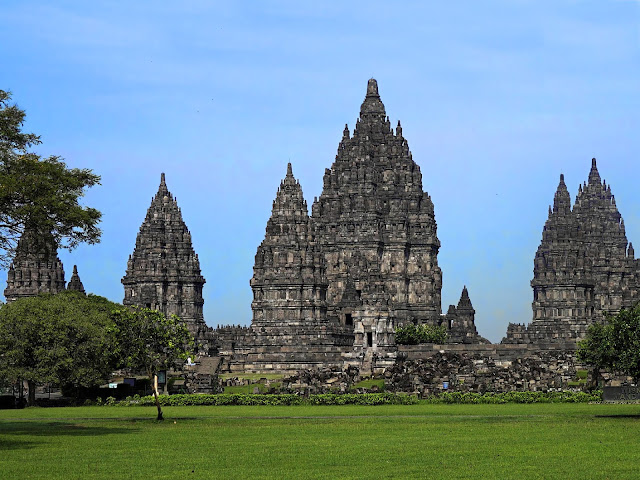
TRAVEL TUESDAY 330 - PRAMBANAN, INDONESIA

“The essence of Hinduism is the same essence of all true religions: Bhakti or pure love for God and genuine compassion for all beings.” - Radhanath Swami

Welcome to the Travel Tuesday meme! Join me every Tuesday and showcase your creativity in photography, painting and drawing, music, poetry, creative writing or a plain old natter about Travel.
There is only one simple rule: Link your own creative work about some aspect of travel and share it with the rest of us. Please use this meme for your creative endeavours only.
Do not use this meme to advertise your products or services as any links or comments by advertisers shall be removed immediately.
Prambanan (Indonesian: Candi Prambanan, Javanese: Rara Jonggrang) is an 8th-century Hindu temple compound in Special Region of Yogyakarta, Indonesia, dedicated to the Trimūrti, the expression of God as the Creator (Brahma), the Preserver (Vishnu) and the Destroyer (Shiva). The temple compound is located approximately 17 kilometres northeast of the city of Yogyakarta on the boundary between Central Java and Yogyakarta provinces.
The temple compound, a UNESCO World Heritage Site, is the largest Hindu temple site in Indonesia and the second-largest in Southeast Asia after Angkor Wat. It is characterised by its tall and pointed structures, typical of Hindu architecture, and by the towering 47-metre-high central building inside a large complex of individual temples.
Prambanan temple compounds originally consists of 240 temple structures; which represents the grandeur of ancient Java's Hindu art and architecture, also considered as a masterpiece of the classical period in Indonesia. Prambanan attracts many visitors from around the world.

This post is also part of the Wordless Wednesday meme.

You are invited to the Inlinkz link party!

Click here to enter

Tuesday, 26 January 2021

TRAVEL TUESDAY 272 - SEGOVIA

“In Spain, the dead are more alive than the dead of any other country in the world.” – Federico Garcia Lorca

Welcome to the Travel Tuesday meme! Join me every Tuesday and showcase your creativity in photography, painting and drawing, music, poetry, creative writing or a plain old natter about Travel.
There is only one simple rule: Link your own creative work about some aspect of travel and share it with the rest of us. Please use this meme for your creative endeavours only
Do not use this meme to advertise your products or services as any links or comments by advertisers shall be removed immediately.
Segovia is a city in the autonomous region of Castile and León, Spain. The city is famous for its historical buildings and for three main landmarks: Its magnificent Roman aqueduct, its cathedral, one of the last Gothic temples to be built in Europe, and the castle, which was an influence for Walt Disney’s Cinderella Castle. The city centre of Segovia was declared World Heritage by the Unesco in 1985. It is the capital of the Province of Segovia.

Segovia’s position on trading routes made it an important centre of trade in wool and textiles. The end of the Middle Ages saw something of a golden age for Segovia, with a growing Jewish population and the creation of a foundation for a powerful cloth industry. Several splendid works of Gothic architecture were also completed during this period. Notably, Isabella I was proclaimed queen of Castile in the church of San Miguel de Segovia on December 13, 1474.

The population growth that the city experienced during the nineteenth century accelerated steadily beginning around 1920: 16,013 inhabitants that year, 33,360 in 1960, 53,237 in 1981. Since the 1980s growth has slowed markedly: 55,586 in 2004 and 56,047 in 2007.

This post is part of the Our World Tuesday meme,
and also part of the Ruby Tuesday meme,
and also part of the Wordless Wednesday meme.

You are invited to the Inlinkz link party!

Click here to enter

Tuesday, 1 September 2020

TRAVEL TUESDAY 251 - ISTANBUL, TURKEY

  
“ ‘Life can’t be all that bad’, I’d think from time to time. ‘Whatever happens, I can always take a long walk along the Bosphorus.’ ” ― Orhan Pamuk 

Welcome to the Travel Tuesday meme! Join me every Tuesday and showcase your creativity in photography, painting and drawing, music, poetry, creative writing or a plain old natter about Travel.

There is only one simple rule: Link your own creative work about some aspect of travel and share it with the rest of us. Please use this meme for your creative endeavours only.

Do not use this meme to advertise your products or services as any links or comments by advertisers shall be removed immediately.  
Istanbul, formerly known as Byzantium and Constantinople, is the most populous city in Turkey and the country's economic, cultural and historic center. Istanbul is a transcontinental city in Eurasia, straddling the Bosporus strait (which separates Europe and Asia) between the Sea of Marmara and the Black Sea. Its commercial and historical center lies on the European side and about a third of its population lives in suburbs on the Asian side of the Bosporus.

With a total population of around fifteen million residents in its metropolitan area, Istanbul is one of the world's largest cities by population, ranking as the world's fifteenth-largest city and the largest city in Europe. The city is the administrative centre of the Istanbul Metropolitan Municipality (coterminous with Istanbul Province).

Founded under the name of Byzantion (Βυζάντιον) on the Sarayburnu promontory around 660 BCE, the city grew in size and influence, becoming one of the most important cities in history. After its reestablishment as Constantinople in 330 CE, it served as an imperial capital for almost sixteen centuries, during the Roman/Byzantine (330–1204), Latin (1204–1261), Byzantine (1261–1453) and Ottoman (1453–1922) empires. It was instrumental in the advancement of Christianity during Roman and Byzantine times, before the Ottomans conquered the city in 1453 CE and transformed it into an Islamic stronghold and the seat of the Ottoman Caliphate.

Under the name Constantinople it was the Ottoman capital until 1923. The capital was then moved to Ankara and the city was renamed Istanbul. The city held the strategic position between the Black Sea and the Mediterranean. It was also on the historic Silk Road. It controlled rail networks between the Balkans and the Middle East and was the only sea route between the Black Sea and the Mediterranean. In 1923, after the Turkish War of Independence, Ankara was chosen as the new Turkish capital, and the city's name was changed to Istanbul. Nevertheless, the city maintained its prominence in geopolitical and cultural affairs.

The population of the city has increased tenfold since the 1950s, as migrants from across Anatolia have moved in and city limits have expanded to accommodate them. Arts, music, film, and cultural festivals were established towards the end of the 20th century and continue to be hosted by the city today. Infrastructure improvements have produced a complex transportation network in the city.

Over 12 million foreign visitors came to Istanbul in 2015, five years after it was named a European Capital of Culture, making the city the world's fifth-most popular tourist destination. The city's biggest attraction is its historic center, partially listed as a UNESCO World Heritage Site, and its cultural and entertainment hub is across the city's natural harbor, the Golden Horn, in the Beyoğlu district. Considered an Alpha - global city by the Globalization and World Cities Research Network, it hosts the headquarters of many Turkish companies and media outlets and accounts for more than a quarter of the country's gross domestic product. Hoping to capitalize on its revitalization and rapid expansion, Istanbul has bid (unsuccessfully) for the Summer Olympics five times in twenty years.

This post is part of the Our World Tuesday meme,
and also part of the Wordless Wednesday meme.

You are invited to the Inlinkz link party!
Click here to enter

Tuesday, 14 April 2020

TRAVEL TUESDAY 231 - TAJ MAHAL, INDIA

“India has always had a strange way with her conquerors. In defeat, she beckons them in, then slowly seduces, assimilates and transforms them.” ― William Dalrymple

Welcome to the Travel Tuesday meme! Join me every Tuesday and showcase your creativity in photography, painting and drawing, music, poetry, creative writing or a plain old natter about Travel.

There is only one simple rule: Link your own creative work about some aspect of travel and share it with the rest of us. Please use this meme for your creative endeavours only.

Do not use this meme to advertise your products or services as any links or comments by advertisers shall be removed immediately.
The Taj Mahal (Persian for ‘Crown of Palaces’) is an ivory-white marble mausoleum on the south bank of the Yamuna river in the Indian city of Agra. It was commissioned in 1632 by the Mughal emperor, Shah Jahan (reigned 1628–1658), to house the tomb of his favorite wife, Mumtaz Mahal. The tomb is the centrepiece of a 42-acre complex, which includes a mosque and a guest house, and is set in formal gardens bounded on three sides by a crenellated wall.

Construction of the mausoleum was essentially completed in 1643 but work continued on other phases of the project for another 10 years. The Taj Mahal complex is believed to have been completed in its entirety in 1653 at a cost estimated at the time to be around 32 million rupees, which in 2015 would be approximately 52.8 billion rupees (US$827 million). The construction project employed some 20,000 artisans under the guidance of a board of architects led by the court architect to the emperor, Ustad Ahmad Lahauri.

The Taj Mahal was designated as a UNESCO World Heritage Site in 1983 for being “the jewel of Muslim art in India and one of the universally admired masterpieces of the world’s heritage”. Described by Nobel laureate Rabindranath Tagore as “the tear-drop on the cheek of time”, it is regarded by many as the best example of Mughal architecture and a symbol of India's rich history. The Taj Mahal attracts 7–8 million visitors a year. In 2007, it was declared a winner of the ‘New 7 Wonders of the World’ (2000–2007) initiative.

This post is part of the Our World Tuesday,
and also part of the Wordless Wednesday meme.


You are invited to the Inlinkz link party!

Click here to enter

Tuesday, 19 March 2019

TRAVEL TUESDAY #175 - PONT-DU-GARD, FRANCE

“Nothing requires the architect's care more than the due proportions of buildings.” - Vitruvius 

Welcome to the Travel Tuesday meme! Join me every Tuesday and showcase your creativity in photography, painting and drawing, music, poetry, creative writing or a plain old natter about Travel.

There is only one simple rule: Link your own creative work about some aspect of travel and share it with the rest of us. Please use this meme for your creative endeavours only.

Do not use this meme to advertise your products or services as any links or comments by advertisers will be removed immediately.
The Pont du Gard is an ancient Roman aqueduct that crosses the Gardon River near the town of Vers-Pont-du-Gard in southern France. The Pont du Gard is the highest of all elevated Roman aqueducts, and, along with the Aqueduct of Segovia, one of the best preserved. It was added to UNESCO’s list of World Heritage Sites in 1985 because of its historical importance. The aqueduct bridge is part of the Nîmes aqueduct, a 50-kilometre system built in the first century AD to carry water from a spring at Uzès to the Roman colony of Nemausus (Nîmes). Because of the uneven terrain between the two points, the mostly underground aqueduct followed a long, winding route that called for a bridge across the gorge of the Gardon River.

The bridge has three tiers of arches, stands 48.8 m high, and descends a mere 2.5 centimetres – a gradient of only 1 in 18,241 – while the whole aqueduct descends in height by only 17 m over its entire length, which is indicative of the great precision that Roman engineers were able to achieve, using simple technology. The aqueduct formerly carried an estimated 200,000 m3 of water a day to the fountains, baths and homes of the citizens of Nîmes. It may have been in use as late as the 6th century, with some parts used for significantly longer, but a lack of maintenance after the 4th century led to clogging by mineral deposits and debris that eventually choked off the flow of water.

After the Roman Empire collapsed and the aqueduct fell into disuse, the Pont du Gard remained largely intact, due to the importance of its secondary function, as a toll bridge. For centuries the local lords and bishops were responsible for its upkeep, in exchange for the right to levy tolls on travellers using it to cross the river, although some of its stones were looted and serious damage was inflicted on it in the 17th century.

It attracted increasing attention starting in the 18th century, and became an important tourist destination. It underwent a series of renovations between the 18th and 21st centuries, commissioned by the local authorities and the French state, that culminated in 2000 with the opening of a new visitor centre and the removal of traffic and buildings from the bridge and the area immediately around it. Today it is one of France's most popular tourist attractions, and has attracted the attention of a succession of literary and artistic visitors.

This post is part of the Our World Tuesday meme,
and also part of the Wordless Wednesday meme.

Tuesday, 16 October 2018

TRAVEL TUESDAY #153 - VALENCIA, SPAIN

“I would sooner be a foreigner in Spain than in most countries. How easy it is to make friends in Spain!” – George Orwell 

Welcome to the Travel Tuesday meme! Join me every Tuesday and showcase your creativity in photography, painting and drawing, music, poetry, creative writing or a plain old natter about Travel.

There is only one simple rule: Link your own creative work about some aspect of travel and share it with the rest of us. Please use this meme for your creative endeavours only.

Do not use this meme to advertise your products or services as any links or comments by advertisers will be removed immediately.
Valencia on the east coast of Spain, is the capital of the autonomous community of Valencia and the third-largest city in Spain after Madrid and Barcelona, with around 800,000 inhabitants in the administrative centre. Valencia is Spain’s third largest metropolitan area, with a population ranging from 1.7 to 2.5 million depending on how the metropolitan area is defined.

The Port of Valencia is the 5th busiest container port in Europe and the busiest container port on the Mediterranean Sea. The city is ranked at Gamma+ in the Globalization and World Cities Research Network. Valencia is integrated into an industrial area on the Costa del Azahar (Orange Blossom Coast).

Valencia was founded as a Roman colony by the consul Decimus Junius Brutus Callaicus in 138 BC, and called Valentia Edetanorum. In 714 Moroccan and Arab Moors occupied the city, introducing their language, religion and customs; they implemented improved irrigation systems and the cultivation of new crops as well, being capital of the Taifa of Valencia.

In 1238 the Christian king James I of Aragon reconquered the city and divided the land among the nobles who helped him conquer it, as witnessed in the Llibre del Repartiment. He also created a new law for the city, the Furs of Valencia, which were extended to the rest of the Kingdom of Valencia. In the 18th century Philip V of Spain abolished the privileges as punishment to the kingdom of Valencia for aligning with the Habsburg side in the War of the Spanish Succession.

Valencia was the capital of Spain when Joseph Bonaparte moved the Court there in the summer of 1812. It also served as capital between 1936 and 1937, during the Second Spanish Republic. The city is situated on the banks of the Turia, on the east coast of the Iberian Peninsula, fronting the Gulf of Valencia on the Mediterranean Sea. Its historic centre is one of the largest in Spain, with approximately 169 ha (420 acres); this heritage of ancient monuments, views and cultural attractions makes Valencia one of the country's most popular tourist destinations.

Due to its long history, this is a city with numerous popular celebrations and traditions, such as the Fallas (when you can taste the traditional Spanish dish paella), which were declared as Fiestas of National Tourist Interest of Spain in 1965 and Intangible cultural heritage by UNESCO in November 2016. In 2015, Joan Ribó, from Coalició Compromís, became mayor.

This post is part of the Our World Tuesday meme,
and also part of the Wordless Wednesday meme.