Showing posts with label byzantine. Show all posts

Tuesday, 5 September 2017

TRAVEL TUESDAY #95 - MYSTRAS, GREECE

“The possession of knowledge does not kill the sense of wonder and mystery. There is always more mystery.” ― Anaïs Nin

Welcome to the Travel Tuesday meme! Join me every Tuesday and showcase your creativity in photography, painting and drawing, music, poetry, creative writing or a plain old natter about Travel.

There is only one simple rule: Link your own creative work about some aspect of travel and share it with the rest of us. Please use this meme for your creative endeavours only.

Do not use this meme to advertise your products or services as any links or comments by advertisers will be removed immediately.
Mystras (Greek: Μυστράς, or Μυζηθράς, [Myzithras] in the Chronicle of the Morea) is a fortified town and a former municipality in Laconia, Peloponnese, Greece. Situated on Mt. Taygetos, near ancient Sparta, it served as the capital of the Byzantine Despotate of the Morea in the 14th and 15th centuries, experiencing a period of prosperity and cultural flowering.

In late 1248, William II of Villehardouin, ruler of the Frankish Principality of Achaea, captured Monemvasia, the last remaining Byzantine outpost on the Morea. This success was soon followed by the submission of the restive Tsakones on Mount Parnon, the Slavic Melingoi tribe of Mount Taygetos, and the inhabitants of the Mani peninsula, thereby extending his sway over all of Laconia and completing the conquest of the peninsula, which had begun in 1205, in the aftermath of the Fourth Crusade.

Laconia was incorporated into the princely domain, and the young prince passed the winter of 1248–49 there, touring the country and selecting sites for new fortifications such as Grand Magne and Leuktron; finally, near his residence of Lacedaemon (ancient Sparta), on a spur of Mount Taygetos, he built the fortress that came to be known as Mystras.

The site remained inhabited throughout the Ottoman period, when it was mistaken by Western travellers for ancient Sparta. In the 1830s, it was abandoned and the new town of Sparti was built, approximately eight kilometres to the east. In 1989 the ruins, including the fortress, palace, churches, and monasteries, were named a UNESCO World Heritage Site. 

The photo shows Pantanassa’s monastery, (Greek: Μονή Παντανάσσης), which was founded by a chief minister of the late Byzantine Despotate of the Morea, John Frankopoulos, and was dedicated in September 1428. It is the only monastery on the site still permanently inhabited. Today it is inhabited by nuns providing hospitality. Its “beautifully ornate stone-carved façade” is of architectural note.

Above the monastery one can see the fortress of William II of Villehardouin. Mystras constitutes a monumental late-Byzantine complex with distinct and well-preserved elements such as land-planning, street planning, secular and ecclesiastical architecture, and artistic production. Its authentic urban character, which has not been affected by human interventions, has been preserved through the centuries. The most important monuments on the site give the visitor the chance to perceive various aspects of the Byzantine culture.

This post is part of the Our World Tuesday meme,
and also part of the Ruby Tuesday meme,
and also part of the Wordless Wednesday meme. 

Add your own travel posts using the Linky tool below, and don't forget to be nice and leave a comment here, and link back to this page from your own post:

Sunday, 9 August 2015

ART SUNDAY - GEORGE KORDIS

“One life is all we have and we live it as we believe in living it. But to sacrifice what you are and to live without belief, that is a fate more terrible than dying.” - Joan of Arc

George Kordis (Γεώργιος Κορδής) is a modern Greek artist who has been trained to paint icons in the Byzantine tradition and has achieved great fame in Orthodox iconography. He uses traditional techniques and style, choosing to paint in the difficult medium of egg tempera on specially prepared board or wood. As well as painting in the traditional religious icon genre, he has also chosen to paint large works in the same style but of secular, mythological and folk themes. He is very prolific, all the more amazing given the large canvases he paints and his meticulous work with the difficult medium he uses.

George Kordis was born in Greece in Makryracchi of Phthiotis in1956, and grew up in Athens. He studied theology in the Theological School of the University of Athens and concurrently studied Byzantine iconography under the tutelage of Cypriot hagiographer Symeon Symeou. He obtained a Master of Theology at the Holy Cross Seminary in Boston and also studied art at the School of Art of the Boston Museum.

When he returned to Athens he continued his art studies in painting and engraving under Fotis Mastichiadis. He has become an expert in theology and the aesthetics of Byzantine painting. In 1991 he obtained a Doctorate of Theology and since 2003 he is a lecturer in the Theological School of the University of Athens. His painting style owes much to the Byzantine tradition. He uses examples of Byzantine lay painting to set the stage for his subjects, which are often indebted to the West for their iconographic references and technique.

He has exhibited his work widely, in more than 25 personal exhibitions and even more collective ones. His works are in many public and private collections. As a hagiographer, he has an intimate knowledge of the past Byzantine riches of the icon, but he does not simply copy old works, he creates his own personal style, which although is traditional and builds on solid historical foundations, is fresh and startlingly original. He has painted many icons, but also has created the mural decorations of many churches in both Greece and abroad.

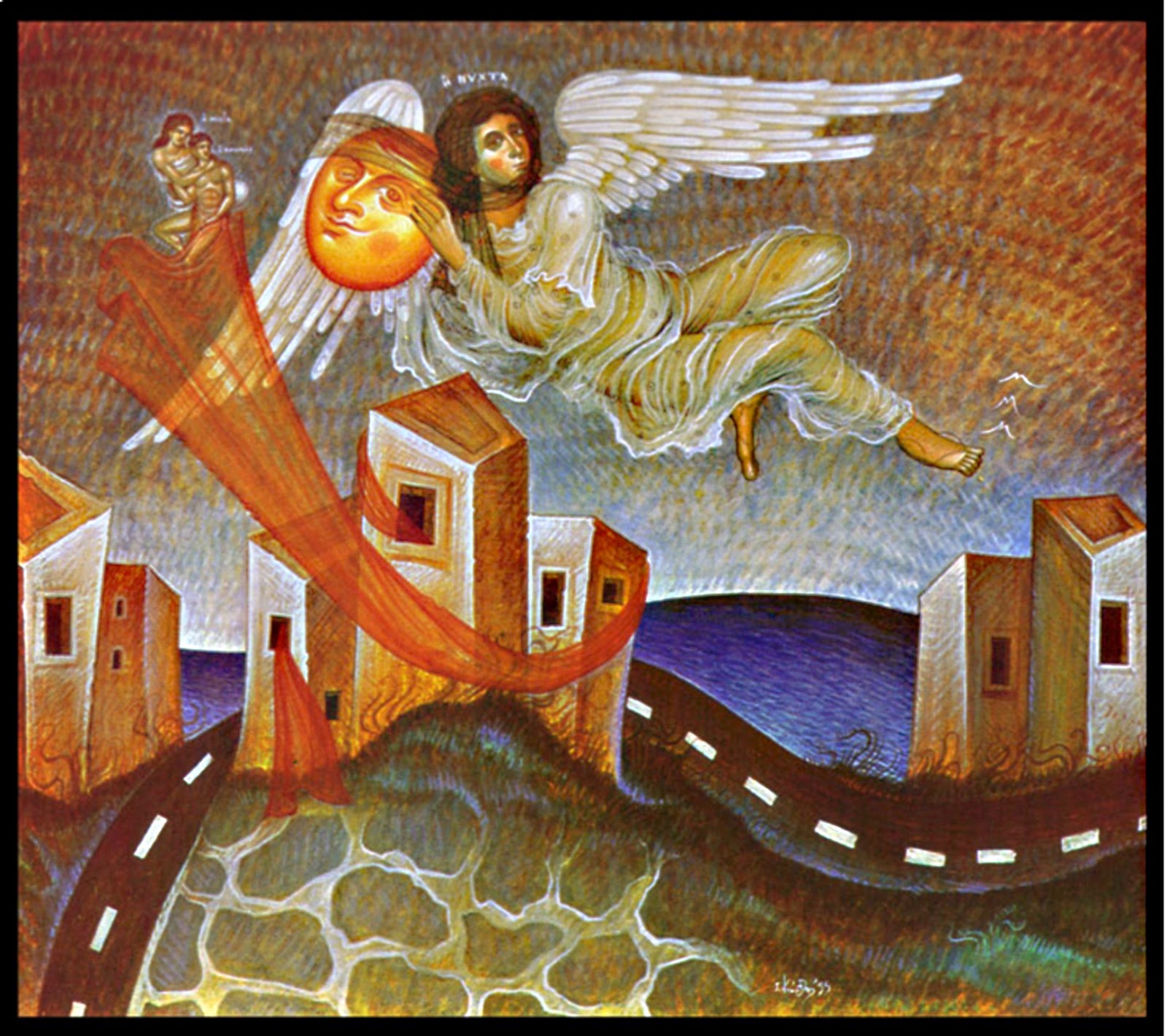
The painting above is his “Night” of 1995. The style is byzantine, but the subject matter is reminiscent of an ancient Greek myth, while the setting seems to be modern. It this juxtaposition of anachronistic elements that adds interest to the painting and despite the disparate components, it is a unified, satisfying whole.

Sunday, 14 June 2015

ART SUNDAY - CIMABUE

“The aim of art is to represent not the outward appearance of things, but their inward significance.” - Aristotle

Cimabue (1240-1302) was a master Florentine painter and mosaicist, who was a pioneer in the artistic movement towards naturalism in his time. Cimabue introduced three-dimensional designs using the Romanesque approach, with Byzantine models and medieval techniques to create his own style. Cimabue built on existing styles of painting to create more life-like and proportional figures, making subjects more realistic to the viewer. Cimabue may not have received credit for many of the changes in art style at this time, but he was a great contributor and major force of naturalism in art and the realist movement.

There is very little documentation about Cimabue’s early life and training in art. It is thought that Cimabue was born in Florence and died in Pisa, Italy. There are a number of works attributed to Cimabue, however, only one was dated with certainty and that is the mosaic of St. John the Evangelist, created in 1301-1302 in the Pisa Duomo. His first attributed work, the Crucifixion, in the church of San Dominico in Arezzo, was thought to have been created in 1270. In 1280, it is said that he painted the Maesta, now displayed at the Louvre Museum. Cimabue is said to have been a nickname, meaning “bull-headed”. His real name is thought to have been Cenni di Pepi, but he was also known as Bencivieni di Pepo, or Benvenuto di Giuseppe. Because his works were not dated or signed, and many were destroyed by time or natural disaster, Cimabue may not have received the credit which he so deserved. Many of his artworks are still disputed today because of the lack of documentation.

Cimabue was strongly influenced by the Greek Byzantine style, but he introduced his own more natural treatment of these traditional subjects and formal Byzantine style. He was one of the first artists of his time to leave the traditional, somewhat stiff Byzantine style of art, opting to find more beauty in the reality of nature and life. He used soft and natural outlines, with finer portrayal of muscles and bones. These three-dimensional designs exhibited his dramatic and sentimental approach to art. Cimabue worked with egg tempera on panel to create his paintings, but also worked in fresco and mosaic. His subjects were of the crucifixion, saints and apostles, and scenes from the Apocalypse. He used linear perspective, which was later more refined by his pupil Giotto. It is thought that although the Florentine school was attributed to Giotto, it was Cimabue’s style that inspired this movement. Members of the later formed Florentine School, were masters such as Michelangelo, Raphael, and Leonardo da Vinci.

Although Cimabue is a somewhat forgotten artist, he set a new direction for art of his time period. Life-like figures, with realistic traits and proportions, were a radical departure from the European artistic tradition of the time. Remaining true to the theme of religious icons, Cimabue introduced realism to his art, anticipating the naturalist movement to come. Cimabue’s Madonna, in the Church of Santa Maria, has been regarded as a marvel of art. Cimabue’s last work, the Large Mosaic of St. John in Pisa Cathedral, was started in 1302, but he died that same year, leaving the altarpiece to be completed by his student Giotto. Cimabue’s style was respected and admired by other artists such as Giotto and Duccio, but was also was a catalyst for the realism movement.

The work above is the fresco “Madonna Enthroned with the Christ Child, St. Francis and Four Angels”, painted about 1280 and found in the Lower Church of St Francis in Assisi. In this large scale (320 × 340 cm) work, one can see Cimabue’s artistry patently. The figures of the Madonna, Christ and saints are beautifully modeled and one appreciates the three-dimensional rendition of the faces and limbs. The poses are more natural and less formal than in the Byzantine icons and even the colours are beginning to assume a more realistic approach so that the eye of the viewer is led into thinking this is a true rendition of a real scene.

Thursday, 29 May 2014

BYZANTINE MUSIC


“For in the end, we will conserve only what we love. We will love only what we understand. We will understand only what we are taught.”  - Baba Dioum

Have you ever heard Greek, Turkish or Middle Eastern music? Do you immediately appreciate a different sound, highly characteristic of these countries? Exotic, lilting, plangent, melancholy, melismatic? Have you ever wondered why this type of music sounds so different and yet so specifically exotic? You may like to hear an example of this type of music:

This is a Greek Orthodox church traditional melody, sung by Petros Gaitanos. It is from the Second Ode to the Virgin Mary in the Plagal A sound (see below):
Αγνή Παρθένε Δέσποινα
Άχραντε Θεοτόκε
Χαίρε Νυμφή Ανύμφευτε
Παρθένε Μήτηρ Άνασσα…

Pure Virgin Mistress,

Blessed Mother of God,
Hail Bride, unblesmished,
Virgin Mother, Queen…

Well if the answer to all of these questions is yes, read on. I thought I would copy here a piece I wrote for a music composition and discussion group I belong to and which discusses Byzantine scales. These scales are direct descendant of the ancient Greek scales, from which stem the traditions of the Greek orthodox church chants, traditional Greek music and much of the Near Eastern and Middle Eastern music.


Each of the Byzantine musical collections of notes used in constructing a melody are called a "sound" [ήχος - eechos] and correspond to our concept of a scale. There are eight different "sounds" [ήχοι - eechoi]:
Principal A, Principal B, Principal C, Principal D, (these are the “main” ones [κύριοι - kyrioi]) and
Plagal A, Plagal B, Plagal C = “Heavy”  [βαρύς - barys], and Plagal D (these are the “oblique” ones [πλάγιοι - plagioi]).

Tetrachords (four-note groups) are used to construct the Byzantine “scales’ as they were used to construct the ancient Greek modes and some of the Byzantine scales are identical or very similar to the ancient Greek modes, while others are the same as diatonic scales.


There are different constructions of tetrachords and the emotional impact of the tetrachord will depend on the interrelationship of intervals in it. Some of the tetrachords are identical or very similar in construction in the different scales, and the groups of tetrachords that are thus similar are each called a “genus” [γένος - genos].

There are three genera:
1)    Diatonic: Principal and Plagal A and D
2)    Chromatic: Principal and Plagal B
3)    Enharmonic: Principal and Plagal C (= heavy)

Characteristically melodies in the diatonic genus are described as being of the following disposition [ήθος - eethos]: “joyful, imposing, festive”.  Melodies in the chromatic genus are described as being “sweet, melancholy, pensive, gloomy”. While melodies constructed in the enharmonic genus are described as being “pleasant, enthusiastic, masculine”.


The names of the notes in Byzantine music are:

C = Ni (νι)
D = Pa (πα)
E = Vou (βου)
F = Ga (γα)
G = Di (δι)
A = Ke (κε)
B = Zo (ζο)

Principal A and Plagal A  =  D, E, F, G, A, B, C, D’, C, B flat, A, G, F, E, D

Principal B = G, A flat, B, C, B, A flat, G.  But! G, F, E, D, E, F, G and G, F, E, D flat, C
Plagal B = D, E flat, F sharp, G, A, B, C, D, C, B flat, A, G, F sharp, E flat, D
Principal C and Plagal C = F major scale (F, G, A, B flat, C, D, E, F)
Principal D = E, F, G, A, B, C, D, E, D, C, B, A, G, F sharp,/G, F/ E, D sharp, E
Plagal D = C major scale (C, D, E, F, G, A, B, C)

Note that these are approximations as the sharps and flats are not exactly so sounded, often an intermediate tempering used, rather than the equal tempering of diatonic scales. The notation of Byzantine music is in neumes (νεύματα - as in illustration above).

Understanding of these scales contributes positively to the listening experience of Orthodox Church chants as well as to the understanding of much Balkan folk music, and of Near and Middle Eastern music.

Sunday, 20 April 2014

ART SUNDAY - ST MARK, VENICE


“If the Resurrection is resurrection from the dead, all hope and freedom are in spite of death.” - Paul Ricoeur

The Patriarchal Cathedral Basilica of Saint Mark (officially known in Italian as the Basilica Cattedrale Patriarcale di San Marco and commonly known as Saint Mark's Basilica) is the cathedral church of the Roman Catholic Archdiocese of Venice, northern Italy. It is the most famous of the city's churches and one of the best-known examples of Italo-Byzantine architecture. It lies at the eastern end of the Piazza San Marco, adjacent and connected to the Doge's Palace. Originally it was the chapel of the Doge, and has only been the city's cathedral since 1807, when it became the seat of the Patriarch of Venice, archbishop of the Roman Catholic Archdiocese of Venice, formerly at San Pietro di Castello. For its opulent design, gold ground mosaics, and its status as a symbol of Venetian wealth and power, from the 11th century on the building has been known by the nickname Chiesa d'Oro (Church of gold).


The upper levels of the interior are completely covered with bright mosaics covering an area of about 8000 square metres. Most of these mosaics use the traditional background of gold glass tesserae, creating the shimmering overall effect. Unfortunately, the Doge retained a workshop of mosaicists until the late 18th century, and in the 19th century contracted a mosaic workshop run by the Salviati glassmaking firm, and the majority of the medieval mosaics have been “restored” by removing and resetting, usually with a considerable loss of quality, so that only about one-third of the mosaic surface can be regarded as original.


The earliest surviving work, in the main porch, perhaps dates to as early as 1070, and was probably by a workshop that had left Constantinople in the mid-11th century and worked at Torcello Cathedral. They are in a fairly pure Byzantine style but in succeeding phases of work Byzantine influence reflecting the latest style of the capital was reduced by stages, disappearing altogether by about the 1130s, after which the style was Italian in essentials, reflecting a change from a colonial to a local art. The main period of decoration was the 12th century, a period of deteriorating relations between Venice and Byzantium, but very little is known about the process or how it was affected by politics.


The mosaics in the interior recount the events of the New Testament, with the great message of Christian salvation. The mosaics in the atrium, carried out afterwards, during the 13th century, are a meditation on the Old Testament, in particular the books of Genesis and Exodus, and are well located as precursor of and preparation for the interior. Interwoven with this main plan one identifies many others: The story of the Virgin, the martyrdoms of St. Peter and St. Clement, the events of St. John the Evangelist's life and those of John the Baptist and St. Isidore, the great pantheon of saints worshipped by the Venetians and, most important of all, the cycles with the legend of St. Mark. The gold background of the mosaics does not only give unity to the mosaics themselves but, in accordance with the oriental conception, has a precise symbolic value as the colour of the Divine, the image of that light which, for the theologians and Fathers of the mediaeval church, was God himself.


In the centre of the basilica, at the intersection with the transept, the dome celebrates the concluding mystery of the life of Jesus: His Resurrection and Ascension to heaven. The decoration of the Ascension cupola, dating to the second half of the 12th century, is the mosaic masterpiece of St. Mark's and the heart of the church's spiritual message. It is considered to be the best mosaic expression in the whole church for structure, quality and preservation.  The Greek master who, with his assistants, created this cycle has been defined as the “agitato style” master. There could be no more suitable definition of this mosaicist who, in the creation of these scenes of the Death, Resurrection and Ascent, expresses all the dramatic tension and renewal of humanity and the universe. He manipulates the line in a myriad of curves that delineate the faces and create highly complicated folds that wind in broad spirals, spreading out into elegant fan-shaped drapery and extending in an extremely harmonious fluttering that recalls Hellenic solutions. (For another post on Byzantine mosaic, see here).


Above is the mosaic of the Resurrection, quite apt for Easter Sunday. I hope you have had a peaceful Easter/ Pascha/ Passover with your loved ones.

Wednesday, 29 May 2013

THE FALL OF CONSTANTINOPLE

“Civilisation has ever accompanied emigration and conquest - the conflict of opinion, of religion, or of race.” - Alfred Russel Wallace
 
On this day, in 1453 AD, the Fall of Constantinople (the capital of the Byzantine Empire) occurred, after a siege by the Ottoman Empire, led by 21-year-old Ottoman Turk Sultan Mehmed II. The defending army inside the city was commanded by Byzantine Greek Emperor Constantine XI Palaiologos. The siege lasted from Friday, 6 April 1453 until Tuesday, 29 May 1453 (according to the Julian calendar), when the city was conquered by the Ottomans.
 
The capture of Constantinople marked the end of the last remnant of the Roman Empire, an imperial state whose reign and influence had lasted for nearly 1,500 years. It was a massive blow to Christendom, and the Moslem Ottomans thereafter were free to advance into Europe without an adversary to their rear. After the conquest, Mehmed made Constantinople the Ottoman Empire’s new capital. Several Greek and non-Greek intellectuals fled the city before and after the siege, migrating particularly to Italy. It is argued that they helped fuel the Renaissance. Some mark the end of the Middle Ages by the fall of the city and empire.
 
Constantinople was one of the most heavily fortified cities in the world, and was defended by, at most, 10,000 men. The Ottomans had between 100,000 and 150,000 men on their side. During the 50-day siege, the Turks employed various important war tactics in taking over the city. They used huge cannon to destroy the walls and warships were used to counter the city’s sea defences. They also used an extensive infantry to engulf the city.
 
For seven weeks Mehmed’s massive cannon fired on the walls, but it was unable to sufficiently penetrate them, and due to its extremely slow rate of reloading the Greeks were able to repair most of the damage after each shot. Meanwhile, Mehmed’s fleet could not enter the Golden Horn due to the large chain the Byzantines had laid across the entrance. To circumvent this he built a road of greased logs across Galata on the north side of the Golden Horn, and rolled his ships across. This succeeded in stopping the flow of supplies from Genoan ships and demoralising the Byzantine defenders, but did not help in breaching the land walls.
 
Mehmed offered to raise the siege for an astronomical tribute that he knew the city would be unable to pay. When this was declined, Mehmed planned to overpower the walls by sheer force, knowing that the Byzantine defenders would be worn out before he ran out of troops. On the morning of May 29 the attack began. The first wave of attackers, the Bashi-bazouks, were poorly trained and equipped, and were meant only to kill as many Byzantine defenders as possible. The second assault focused on a section of the Blachernae walls in the northwest part of the city, which had been partially damaged by the cannon; the attackers managed to break through, but were just as quickly pushed back out by the Byzantines.
 
The Byzantines also managed to hold off an attack by the more disciplined and highly skilled Ottoman Janissary army, but the Genoan general in charge of the defense, Giovanni Giustiniani, was wounded in the attack, and the Greek troops began to panic. Unfortunately, the Kerkoporta gate in the Blachernae section of the walls had been left unlocked (some say this was the act of some traitor), and the Ottomans soon discovered this. The Ottomans rushed in, and Constantine XI himself led the last defence of the city, dying in the ensuing battle in the streets. The city was looted for three days, in accordance with the traditional punishment allotted on a city that had resisted a siege, but Mehmed restrained his troops out of respect for the ancient but now conquered empire. Mehmed was subsequently nicknamed “The Conqueror”.
 
Mehmed renamed the city Istanbul. To further glorify the city he built mosques, palaces, monuments and a system of aqueducts. The city was now officially claimed for Islam. New rules and regulations came about for the conquered. The Greeks were to form communities within the empire called milets. The Christians were still allowed to practice their religion, but had to dress in distinguishing attire and could not bear arms. Those who stayed were mostly confined to the Phanari and Galata districts. The Phanariotes, as the Greeks were called, often provided capable advisors to the Ottoman sultans, and were just as often seen as traitors by other Greeks. Even to this day, the Greek Orthodox Patriarchate of Constantinople in Phanari, Istanbul, is considered to be the chief seat of the Greek Church.

Saturday, 4 May 2013

HAPPY EASTER!

“This is the day which the Lord hath made; we will rejoice and be glad in it.” - Psalm 118:24
 

Easter Saturday and the day was devoted to going to church. We visited two Orthodox churches, one Russian and one Greek. Orthodox Easter is full of traditions and the liturgies of the Holy Week are quite moving.
 

Here is the Resurrection troparion (hymn), “Christos Anesti” – Christ is Risen. The troparion is first sung during the Paschal Vigil at the end of the procession around the church, which takes place at the beginning of Matins. When all are gathered before the church’s closed front door, the clergy and faithful take turns chanting the troparion.


The troparion in the original Greek:
Χριστὸς ἀνέστη ἐκ νεκρῶν,
θανάτῳ θάνατον πατήσας,
καὶ τοῖς ἐν τοῖς μνήμασι,
ζωὴν χαρισάμενος!
 

Transliteration:
Christós anésti ek nekrón,
thanáto thánaton patísas,
ké tís en tís mnímasi,
zoín charisámenos!
 

A typical translation in English runs:
Christ is risen from the dead,
Trampling down death by death,
And upon those in the tombs
Bestowing life!
Happy Easter! Καλή Ανάσταση!

Sunday, 6 May 2012

ART SUNDAY - BYZANTINE MOSAIC


“It is the neglect of timely repair that makes rebuilding necessary.” - Richard Whately

Hagia Sofia (Aya Sofya) is the legendary Church of Holy Wisdom in Istanbul, Western Turkey. Dedicated on December 26th, 537 AD by the emperor Justinian, the great church of Haghia Sophia was the religious centre of the Byzantine Empire for nine hundred years, in what was then the capital of the Empire, Constantinople (now Istanbul). After the Turkish conquest of Constantinople in 1453, The Hagia Sophia served as an imperial mosque of the Ottoman Empire. After the foundation of the Turkish Republic, it was turned into a museum in 1935.

The present structure dates from the reign of Justinian (527-565 AD), and was built by his architects Anthemius of Tralles and Isidorus of Miletus. Isidorus the Younger, nephew of Isidorus of Miletus, supervised significant restoration after an earthquake in Justinian’s time. Buttresses were erected much later by Emperor Andronicus Palaeologus in 1317 and minarets were added by Sultan Mehmet II (the Conqueror), Beyazit II, and Murat III.

The church was sumptuously built with rich carvings, marble facings, semiprecious stones, a solid silver iconostasis, and richly decorated with frescoes and mosaics throughout the centuries. The mosaics either depicted the Virgin Mother, Jesus, saints, or emperors and empresses. Other parts were decorated in a purely decorative style with geometric patterns. During the Sack of Constantinople in 1204, the Latin Crusaders vandalised valuable items in every important Byzantine structure of the city, including the golden mosaics of the Hagia Sophia. Many of these items were shipped to Venice, whose Doge, Enrico Dandolo, had organized the invasion and sack of Constantinople.

Following the building’s conversion into a mosque in 1453, many of its mosaics were covered with plaster, due to Islam’s ban on representational imagery. This process was not completed at once, and reports exist from the 17th century in which travellers note that they could still see Christian images in the former church. In 1847–49, the building was restored by two Swiss Italian brothers, Gaspare and Giuseppe Fossati, and Sultan Abdülmecid allowed them to also document any mosaics they might discover during this process. This work did not include repairing the mosaics and after recording the details about an image, the Fossatis painted it over again. In some cases, the Fossatis recreated damaged decorative mosaic patterns in paint, sometimes redesigning them in the process.

The Fossati records are the primary sources about a number of mosaic images now believed to have been completely or partially destroyed in an earthquake in 1894. These include a great mosaic of Christ Pantocrator in the dome, a mosaic over a now-unidentified Door of the Poor, a large image of a jewel-encrusted cross, and a large number of images of angels, saints, patriarchs, and church fathers. Most of the missing images were located in the building’s two tympana. The Fossatis also added a pulpit (minbar) and the four large medallions on the walls of the nave bearing the names of Muhammad and Islam’s first caliphs.

Illustrated here is a particularly fine 12th Century mosaic (most likely from 1118 AD) of the Virgin Mary and the infant Christ flanked by Emperor John II Comnenus and the Empress Irene (Eirene). The inscription above the emperor reads: “John, in Christ the Lord faithful Emperor, Porphyrogenitus and Autocrat of the Romans, Comnenus”. The term porphyrogenitus means “born in the purple”, i.e. a legitimate son of the reigning emperor. Keep in mind that the first son of the preceding emperor did not always live long enough to be crowned himself (in fact, John’s two eldest sons died before him).  Also known as Kaloiannis (John the Beautiful), he was apparently quite ugly (the term beautiful apparently referring to his pious character). He married the daughter (later to be the Empress Eirene) of King Ladislaus I of Hungary. The inscription above her head reads: “Eirene, the most pious Augusta”.

This mosaic exemplifies the high art and technical expertise reached by the mosaic artists of the Byzantine era, who created shimmering, sparkling works with vivid and fresh colours. Mosaics have a high degree of permanency and that these mosaics survived for centuries and numerous attempts at defacement is a credit to the skill of the artists and craftsmen, as well as the permanency of the medium of mosaic.

With the Greek Election occurring today it is perhaps appropriate that one considers the persistence of the Greek people and the ever-recurring resurrection of a country and people that has been conquered, enslaved, subjugated, razed and humiliated on numerous occasions. The recent economic crisis and its numerous attendant misfortunes is yet another of these obstacles that will be overcome and Greece will rise from its ashes once again. It will be like a mosaic obscured by time, neglect, daubing with plaster, which is revealed by loving restoration.

Sunday, 25 December 2011

PSALM SUNDAY - KONTAKION FOR THE NATIVITY


“Christmas is most truly Christmas when we celebrate it by giving the light of love to those who need it most.” - Ruth Carter Stapleton

Merry Christmas!

For Psalm Sunday today, a Greek Orthodox Kontakion that celebrates the Nativity of Jesus Christ.

A Kontakion is a type of thematic hymn in the Orthodox Church and other Eastern Christian churches. Originally, the kontakion was an extended homily in verse consisting of one or two proemia (preliminary stanzas) followed by several strophes called oikoi (singular oikos), usually between 18 and 24. The kontakia were so long that the text was rolled up on a pole for use in the services - the origin of the name kontakion, which means “from the pole” in Greek.

It is typical of the form that each of the proemia and strophes end with the same refrain. Acrostics are also a hallmark of this hymnographic form.  In current practice, the kontakion has been greatly abbreviated. Only the (first) proemium and first strophe are sung or read after the sixth ode of the canon at orthros. The proemium alone is sung at the Divine Liturgy, following the troparia, and most other services of the daily cycle. The kontakion is not sung at vespers.

According to tradition, Saint Romanos the Melodist wrote the first kontakion, the Kontakion for the Birth of Our Lord, by divine inspiration. Legend aside, Romanos established the kontakion in the form it retained for centuries, and he is the most famous composer of kontakia.

Kontakion for Christmas
By Romanos the Melodist

Today the Virgin gives birth to the Transcendent One,
And the earth offers a cave to the Unapproachable One!
Angels with shepherds glorify Him,
The wise men journey with a star to guide them
For our sake the Eternal God was born as a Little Child!


It is illustrated by a neo-Byzantine fresco of the Nativity.
I hope your Christmas was peaceful, restful, contented and well-spent beside those you love.

Monday, 1 November 2010

BYZANTINE MEATBALLS


“Time in its irresistible and ceaseless flow carries along on its flood all created things and drowns them in the depths of obscurity.” - Anna Komnené

The Byzantine Empire succeeded the Roman Empire and officially began when Constantine the Great (St Constantine - 272-337 AD) moved his capital in 330 AD from Rome to Byzantium, renaming it Constantinople (now Istanbul). Constantine had chosen the site for his new capital with care. He placed Constantinople on the frontier of Europe and Asia, dominating the waterway connecting the Mediterranean and Black seas. It was a crossroads of trade, of cultures and with a great tradition going back to prehistory. From 330 AD to 1453 AD Byzantium reigned supreme, and while Western Europe languished in the dark ages, Byzantium flourished.

The most salient aspect of Greek Byzantium was the transmission of classical culture. While classical studies, science, and philosophy largely dissipated in the Latin west, Byzantine education and philosophy still zealously pursued these intellectual traditions. It was in Byzantium that Plato and Aristotle continued to be studied and were eventually transmitted first into the Islamic world and then back into Western Europe. A basic education in Byzantium consisted first of the mastery of classical Greek literature, such as Homer (largely unknown in the West during this period) and almost all of the Greek literature we have today was only preserved by the Byzantines.

The Byzantine emperors reigned over a vast empire of fabulous wealth. Life in Constantinople was extremely civilised and the emperor’s court and his nobles lived a lavish existence, dressed in silks, adorned with gold and precious stones and eating the best and freshest foods spiced with the richest condiments the Orient had to offer.

Nicholas Tselementes (1878 - 1958) the most distinguished Greek chef of modern times, traced back to Byzantine times such dishes as Keftedes (fried meatballs), Dolmades (grain and/or meat stuffed into vegetables or plant leaves and cooked), Moussaka (a layered dish of meat, cheese and pasta or grain), Yuvarlakia (meat and/or grain dumplings cooked in broth), and Kakavia, the Greek version of Bouillabaise (mixed fish soup). He also traced back to the ancient Greeks the making of white sauce - using flour and fat to thicken a broth or milk mixture.

Although some of these dishes are now known to the world by Turkish or European names (even the Greeks call white sauce “béchamel”), their origins are Greek. We know that Byzantine Greeks ate three meals a day - breakfast, lunch and supper. They had many fast days that coincided with the church year cycle, similar to what modern Orthodox Greeks observe now. While the lower classes made do with what they could get, the upper classes were served three courses at their midday and supper meals consisting of hors d’ oeuvres, a main course of fish or meat and a sweet course.

The Byzantines ate all kinds of meats including pork, and numerous types of fowl. They ate large amounts of fresh fish and seafood. There were many types of soups and stews and salads were popular. They liked a variety of cheeses and fruits were eaten both fresh and cooked. Fruits included apples, melons, dates, figs, grapes and pomegranates. Almonds, walnuts, and pistachios were used in many dishes as well as being eaten by themselves.

Here is a Byzantine dish that would have been enjoyed by the middle classes of merchants and shopkeepers, but which in its modern Greek version is still staple fare:

KEFTÉDHES (BYZANTINE MEATBALLS)
Ingredients

  • 500 g lean beef or veal, ground
  • 1 large onion, grated
  • 2 cloves garlic, crushed
  • 1 egg, beaten lightly
  • 3 slices of bread, crusts removed, soaked in water and squeezed lightly
  • 3 tablespoonfuls finely chopped parsley
  • 2 sprigs fresh mint
  • 3 tablespoonfuls red wine
  • 2-3 tablespoonfuls water, if necessary
  • Freshly ground cinnamon (pinch)
  • Freshly ground pepper (to taste)
  • Freshly ground nutmeg (pinch)
  • Freshly ground allspice (pimento - pinch)
  • Salt to taste
  • 1 cup of barley, powdered in the blender
  • Olive oil, enough for a frying depth of 2 cm

Method
In the authentic recipe, the meat would probably be pounded or finely minced with a knife instead of ground.
Mix all ingredients except barley and olive oil, and refrigerate for an hour.
Pinch off small pieces of the mixture, the size of walnuts, form into a ball and dredge in the barley flour.
Heat the oil to a smoking point and fry the meatballs until crisp, turning constantly. Remove and drain on absorbent paper.
Serve with a green salad and crispy bread, accompanied by a gutsy red wine.

Sunday, 6 June 2010

ART SUNDAY - GEORGE KORDIS


“Certain thoughts are prayers.  There are moments when, whatever be the attitude of the body, the soul is on its knees.” - Victor Hugo

For Art Sunday, a contemporary Greek artist, George Kordis (Γεώργιος Κορδής). George Kordis was born in Greece in Makryracchi of Phthiotis in1956, and grew up in Athens. He studied theology in the Theological School of the University of Athens and concurrently studied Byzantine iconography under the tutelage of Cypriot hagiographer Symeon Symeou. He obtained a Master of Theology at the Holy Cross Seminary in Boston and also studied art at the School of Art of the Boston Museum. When he returned to Athens he continued his art studies in painting and engraving under Fotis Mastichiadis. He has become an expert in theology and the aesthetics of Byzantine painting. In 1991 he obtained a Doctorate of Theology and since 2003 he is a lecturer in the Theological School of the University of Athens.

His painting style owes much to the Byzantine tradition. He uses examples of Byzantine lay painting to set the stage for his subjects, which are often indebted to the West for their iconographic references and technique. He has exhibited his work widely, in more than 25 personal exhibitions and even more collective ones. His works are in many public and private collections.

As a hagiographer, he has an intimate knowledge of the past Byzantine riches of the icon, but he does not simply copy old works, he creates his own personal style, which although is traditional and builds on solid historical foundations, is fresh and startlingly original. He has painted many icons, but also has created the mural decorations of many churches in both Greece and abroad.

The painting above is his personal interpretation of the seasons personified. First comes Autumn losing a page of manuscript in the rising wind. Then pensive ageing Winter, playing with his worry beads. A youthful Spring rejoices in the flower-filled meadow at the feet and the flying kite of the beginning of Lent. Summer s a young fisherman, grasping the sun and ready to set sail with his nets in the green sea. A beautiful tableau of the year’s cycle.

Saturday, 26 April 2008

GREEK EASTER 2008


HAPPY EASTER! CHRIST IS RISEN! – ΚΑΛΟ ΠΑΣΧΑ! ΧΡΙΣΤΟΣ ΑΝΕΣΤΗ!

The icon of the Anastasis – the Descent of Christ into Hell and His Resurrection – is a sacred image that was created and developed by Christian artists of the Orthodox Byzantine Church. It is one of the favourite themes in Eastern Christian Art and the traditional Byzantine icon for the Resurrection. The Anastasis image was created in the late seventh century and continued to evolve until it reached its final form in the eleventh century.

The Liturgy of the Hours, evolved over the whole lifetime of the Orthodox Church is a source of the iconography of the Resurrection. It is rather difficult to ascertain which came first, the Liturgy of the Hours prayers, or the awareness of the Anastasis event. What is certain however is that there are many references to the Anastasis event in the Liturgies of Great and Holy Saturday of both the Western Latin Church and the Eastern Orthodox Churches.

In the Matins of Great and Holy Saturday,
the priest chants:
“O Messiah, Jesus, Whom are you seeking in the depths of hell? Hell’s foundations quaked and trembled, seeing You Opening the graves of mortal men. When devouring Hades Engulfed the Rock of Life, In great pain he burst asunder, And the dead, held captive from all ages Were released.”

Epiphanius of Salamis, writes this piece, now forming art of the Vespers for Holy Saturday:
“Yesterday he was stricken, Today, he strikes the abode of Hades, With the lightning of his divinity; Yesterday he was bound up, Today, he ties down the tyrant in indissoluble bonds; Yesterday he was condemned, Today, he presents freedom to the condemned.”

Christ, standing on the broken gates of hell and the scattered symbols of sin’s enslavement, takes both Adam by the hand and hauls him out of his tomb, with Eve watching awe-struck behind him. It is a very dynamic image. Christ’s knees are bent but he is not walking in either direction. Rather, the sense of movement is up. The action is all Christ’s. Adam and Eve are being pulled from their tombs towards Christ and towards redemption.

John the Baptist and King David (left) as well as angels and other figures from the Scriptures watch the miracle of the resurrection in acknowledgement of Christ’s divinity, their gestures an affirmation of the miracle they are witnessing.

HAVE A PEACEFUL AND HAPPY EASTER!
ΚΑΛΟ ΠΑΣΧΑ! ΧΡΙΣΤΟΣ ΑΝΕΣΤΗ!