Saturday, 26 April 2008

GREEK EASTER 2008


HAPPY EASTER! CHRIST IS RISEN! – ΚΑΛΟ ΠΑΣΧΑ! ΧΡΙΣΤΟΣ ΑΝΕΣΤΗ!

The icon of the Anastasis – the Descent of Christ into Hell and His Resurrection – is a sacred image that was created and developed by Christian artists of the Orthodox Byzantine Church. It is one of the favourite themes in Eastern Christian Art and the traditional Byzantine icon for the Resurrection. The Anastasis image was created in the late seventh century and continued to evolve until it reached its final form in the eleventh century.

The Liturgy of the Hours, evolved over the whole lifetime of the Orthodox Church is a source of the iconography of the Resurrection. It is rather difficult to ascertain which came first, the Liturgy of the Hours prayers, or the awareness of the Anastasis event. What is certain however is that there are many references to the Anastasis event in the Liturgies of Great and Holy Saturday of both the Western Latin Church and the Eastern Orthodox Churches.

In the Matins of Great and Holy Saturday,
the priest chants:
“O Messiah, Jesus, Whom are you seeking in the depths of hell? Hell’s foundations quaked and trembled, seeing You Opening the graves of mortal men. When devouring Hades Engulfed the Rock of Life, In great pain he burst asunder, And the dead, held captive from all ages Were released.”

Epiphanius of Salamis, writes this piece, now forming art of the Vespers for Holy Saturday:
“Yesterday he was stricken, Today, he strikes the abode of Hades, With the lightning of his divinity; Yesterday he was bound up, Today, he ties down the tyrant in indissoluble bonds; Yesterday he was condemned, Today, he presents freedom to the condemned.”

Christ, standing on the broken gates of hell and the scattered symbols of sin’s enslavement, takes both Adam by the hand and hauls him out of his tomb, with Eve watching awe-struck behind him. It is a very dynamic image. Christ’s knees are bent but he is not walking in either direction. Rather, the sense of movement is up. The action is all Christ’s. Adam and Eve are being pulled from their tombs towards Christ and towards redemption.

John the Baptist and King David (left) as well as angels and other figures from the Scriptures watch the miracle of the resurrection in acknowledgement of Christ’s divinity, their gestures an affirmation of the miracle they are witnessing.

HAVE A PEACEFUL AND HAPPY EASTER!
ΚΑΛΟ ΠΑΣΧΑ! ΧΡΙΣΤΟΣ ΑΝΕΣΤΗ!

BACH'S EASTER


“A song will outlive all sermons in the memory.” - Henry Giles

Johann Sebastian Bach is one of my favourite composers and his music is as close to perfection as we humans can get. In his music one can hear all of the emotions, all of the human condition, all of our joys and sorrows. This cantata that I have selected today is one of consummate artistry and genuine feeling.

It is Johann Sebastian Bach’s "Christ lag in Todes Banden" (BWV 4 – Christ Lay in Death’s Bonds) and is very apt for this Easter Eve.


1. Sinfonia.

2. Choral.

Christ lag in Todesbanden
Für unsre Sünd gegeben,
Er ist wieder erstanden
Und hat uns bracht das Leben;
Des wir sollen fröhlich sein,
Gott loben und ihm dankbar sein
Und singen halleluja,
Halleluja!
Christ lay in death's bonds
given over for our sins,
He has risen again
and brought us life;
therefore we should be joyful,
praise God and be thankful to Him
and sing Hallelujah,
Hallelujah!

3. Duett.

Den Tod niemand zwingen kunnt
Bei allen Menschenkindern,
Das macht' alles unsre Sünd,
Kein Unschuld war zu finden.
Davon kam der Tod so bald
Und nahm über uns Gewalt,
Hielt uns in seinem Reich gefangen.
Halleluja!

No one could defeat death
among all humanity,
this was all because of our sins,
no innocence was to be found.
Therefore death came so soon
and took power over us,
held us captive in his kingdom.
Hallelujah!

4. Choral.

Jesus Christus, Gottes Sohn,
An unser Statt ist kommen
Und hat die Sünde weggetan,
Damit dem Tod genommen
All sein Recht und sein Gewalt,
Da bleibet nichts denn Tods Gestalt,
Den Stach'l hat er verloren.
Halleluja!

Jesus Christ, God's son,
has come in our place,
and has done away with sin,
thereby taking from death
all his rights and power,
nothing remains but death's form;
he has lost his sting.
Hallelujah!

Cantus Cölln.
Dir. Konrad Junghänel.


1. Choral.

Es war ein wunderlicher Krieg,
Da Tod und Leben rungen,
Das Leben behielt den Sieg,
Es hat den Tod verschlungen.
Die Schrift hat verkündigt das,
Wie ein Tod den andern fraß,
Ein Spott aus dem Tod ist worden.
Halleluja!

It was a strange battle,
that death and life waged,
life claimed the victory,
it devoured death.
The scripture had prophesied this,
how one death gobbled up the other,
a mockery has been made out of death.
Hallelujah!

2. Arie.

Hier ist das rechte Osterlamm,
Davon Gott hat geboten,
Das ist hoch an des Kreuzes Stamm
In heißer Lieb gebraten,
Das Blut zeichnet unsre Tür,
Das hält der Glaub dem Tode für,
Der Würger kann uns nicht mehr schaden.
Halleluja!

Here is the true Easter-lamb,
offered up by God,
which was, high on the cross' stalk
roasted in hot love,
the blood marks our door,
faith holds it against death,
the strangler can no longer harm us.
Hallelujah!

3. Duett.

So feiern wir das hohe Fest
Mit Herzensfreud und Wonne,
Das uns der Herre scheinen läßt,
Er ist selber die Sonne,
Der durch seiner Gnade Glanz
Erleuchtet unsre Herzen ganz,
Der Sünden Nacht ist verschwunden.
Halleluja!

So we celebrate the high festival
with joy of heart and delight,
which the Lord radiates upon us,
He himself is the sun,
that through the splendor of his grace
illuminates our hearts completely,
the night of sin has disappeared.
Hallelujah!

4. Choral.

Wir essen und leben wohl
In rechten Osterfladen,
Der alte Sauerteig nicht soll
Sein bei dem Wort der Gnaden,
Christus will die Koste sein
Und speisen die Seel allein,
Der Glaub will keins andern leben.
Halleluja!

We eat and live well
on the true Easter bread,
the old leaven shall not
exist next to the word of grace,
Christ will be our food
and nourish the soul alone,
faith will live in no other way.
Hallelujah!

Cantus Cölln.
Dir. Konrad Junghänel.

Friday, 25 April 2008

ANZAC DAY; GOOD FRIDAY; PESACH


“We understand death for the first time when he puts his hand upon one whom we love.” - Madame de Staël

A solemn day today on many counts. On 25 April every year, Anzac Day is a special commemorative day for Australians and New Zealanders. It commemorates the landing of Australian and New Zealand troops at Gallipoli on 25 April 1915. The date, 25 April, was officially named ANZAC Day in 1916.

ANZAC stands for Australian and New Zealand Army Corps. In 1917, the word ANZAC meant someone who fought at Gallipoli and later it came to mean any Australian or New Zealander who fought or served in the First World War. During the Second World War, ANZAC Day became a day on which the lives of all Australians lost in war time were remembered. The spirit of ANZAC recognises the qualities of courage, mateship and sacrifice which were demonstrated at the Gallipoli landing.

Commemorative services are held at dawn on 25 April, the time of the original landing, across the nation, usually at war memorials. This was initiated by returned soldiers after the First World War in the 1920s as a common form of remembrance. The first official dawn service was held at the Sydney Cenotaph in 1927, which was also the first year that all states recognised a public holiday on the day. Initially dawn services were only attended by veterans who followed the ritual of 'standing to' before two minutes of silence was observed, broken by the sound of a lone piper playing the 'Last Post'. Later in the day, there were marches in all the major cities and many smaller towns for families and other well wishers.

Today it is a day when Australians reflect on the many different meanings of war. Gatherings are held at war memorials across the country.


For Greek Orthodoxy, today is Good Friday, the most solemn and melancholy day in the Church calendar. On Good Friday morning, at the service of the Royal Hours, we remember all the Old Testament prophesies that foretold the coming, teaching, suffering, and death of Christ. In the afternoon, the wooden icon representing Christ’s dead body is taken down from the Cross, and wrapped in a white sheet for burial. A cloth icon of the deceased body of Christ, called the Epitaphion, is carried in a procession around the Church and placed on the flower bedecked and canopied Bier called the Kouvouklion. We have prepared Christ’s body for the wake or the viewing.

On Good Friday evening we gather to mourn the Service of the Lamentations. We sing three lamentation hymns with many verses. The great paradox is that Christ, who is the Son of God and the source of all life, is now seen dead before us. We sing “E Zoe en tafo”, that is, “O Christ, you, who are Life, You are now laid in the tomb, and ranks of angels were amazed, glorifying your condescension.” Then the funeral procession takes place. The Bier/Kouvouklion is carried in sacred procession and, upon its return to church, the icon of the dead Christ is placed on the Altar.


Today is also St Mark’s Feast Day. Most of what we know about Mark the Evangelist, comes directly from the New Testament. He is usually identified with the Mark of Acts 12:12. (When Peter escaped from prison, he went to the home of Mark's mother.) Paul and Barnabas took him along on the first missionary journey, but for some reason Mark returned alone to Jerusalem. It is evident, from Paul's refusal to let Mark accompany him on the second journey despite Barnabas's insistence, that Mark had displeased Paul. Later, Paul asks Mark to visit him in prison so we may assume the trouble did not last long.

The oldest and the shortest of the four Gospels, the Gospel of Mark emphasizes Jesus' rejection by humanity while being God's triumphant envoy. Probably written for Gentile converts in Rome—after the death of Peter and Paul sometime between A.D. 60 and 70—Mark's Gospel is the gradual manifestation of a "scandal", that is, a crucified Messiah.

This is also Pesach, or Passover, for the Jews. This springtime holiday always begins on the 15th day of the Jewish month of Nissan. The basic theme of the holiday is the exodus from slavery in Egypt; the various rituals and texts associated with Pesach help to establish and understand this crucial narrative of Jewish communal memory. The basic story is found in the book of Exodus, chapters 1-15. Chapters 12-15 contain details of the observance of the holiday itself.

The name Pesach comes from a Hebrew word meaning "to pass through" or "to pass over". It refers to the story of how God "passed over" the houses of the Jews during the plague of the Death of the First Born. "Pesach" is also the name of the sacrificial offering (a lamb) that was made in the Temple on this holiday. Pesach is also sometimes called the Chag Ha-Aviv "Holiday of the Springtime," or Zman Cherutenu "the Season of our Freedom."

On the first night of Pesach (first two nights for many traditional Jews outside Israel), there is a special meal filled with ritual to teach the significance of the holiday. This meal is called a Seder, from a Hebrew word meaning "order." There is a set of texts that are to be discussed in a specific order. The Seder also includes rituals of eating matzah and bitter herbs, singing holiday songs, and asking questions. It is a multi-media Jewish ritual event! The texts, prayers and instructions for the evening are found in a volume called the Hagaddah, which means 'telling.' The point of the evening is not to read the Hagaddah, but to use it as a springboard to 'jump off the page.'

The most well-known observances of Pesach are the holding of the Seder meal on the first night (or nights) and the prohibitions against the eating of Hametz - leavened foods. Leavened foods include anything made from five basic grains: wheat, barley, spelt, rye, and oats. This includes anything made from these products, including beer and grain alcohols. The only acceptable way to eat these grain products is in the form of Matzah, or unleavened bread, which is baked very quickly so that the dough does not rise. This helps to remember the speed with which the Israelites left Egypt. The Bible says that they did not have time for their bread to rise. Other kinds of foods can be made from ground-up matzah, including cakes and confections, but these are prepared especially for Pesach.

Jews of Ashkenazic (European) descent often also refrain from eating a category of food called kitniyot. These are products made from seeds and beans, including rice, corn, and legumes. The concern is that the prohibited foods may be confused with these items in processed form. Many Sephardic Jews will eat kitniyot, but customs vary widely. Biblically, Pesach lasts for seven days, but, since Rabbinic times, many communities observe eight days. The prohibition against eating leavened foods lasts until sundown after the final day of the holiday. Today is the sixth day of Pesach.

Enjoy your weekend, and if Orthodox, Happy Easter! If Jewish, Happy Passover!

Thursday, 24 April 2008

MAUNDY THUSRDAY 2008


“To forgive is to set a prisoner free and discover that the prisoner was you.” - Lewis B. Smedes

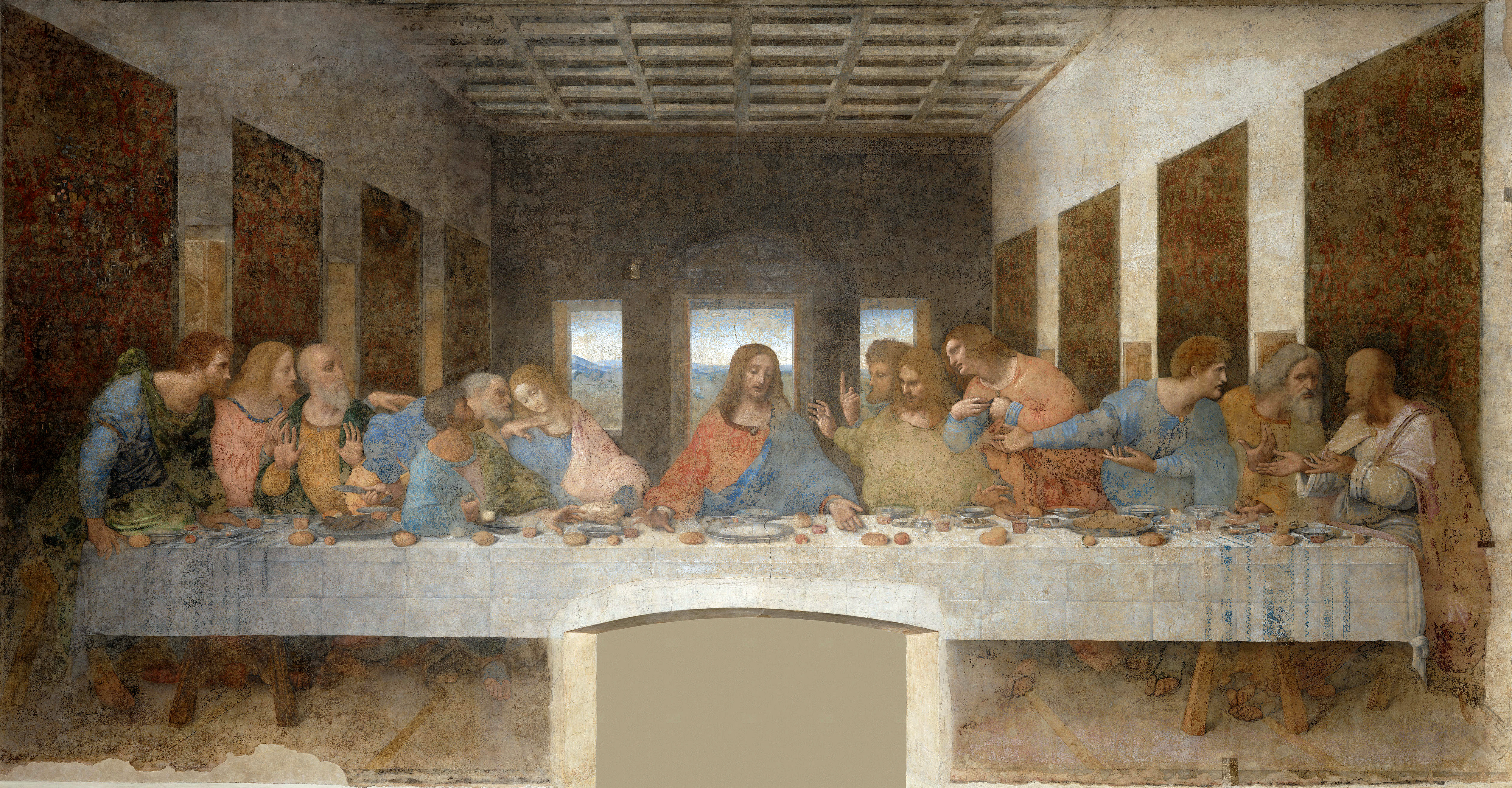
This week is Holy Week for the Orthodox people and Orthodox Easter is this Sunday. Today is Maundy Thursday or Holy Thursday, which is the Thursday before Easter Sunday, observed by Christians in commemoration of Christ's Last Supper. The name Maundy is derived from mandatum (Latin, "commandment"), the first word of an anthem sung in the liturgical ceremony on that day. Another derivation is from the Latin mundo, "I ritually cleanse," referring to Christ's washing the feet of the apostles.

In many churches, the Eucharist is celebrated in a liturgy that includes Holy Communion. During the Roman Catholic liturgy, the ceremony of the washing of the feet, or pedilavium, is performed: the celebrant washes the feet of 12 people to commemorate Christ's washing of his disciples' feet. In England a custom survives of giving alms ("maundy pennies") to the poor; this recalls an earlier practice in which the sovereign washed the feet of the poor on Maundy Thursday. In most European countries, the day is known as Holy Thursday.

The feast of Maundy (or Holy) Thursday solemnly commemorates the institution of the Eucharist, where Christ blesses bread and wine which miraculously transubstantiate .This is the oldest of the observances peculiar to Holy Week.

Eucharist |ˈyoōkərist| noun
The Christian ceremony commemorating the Last Supper, in which bread and wine are consecrated and consumed.
• the consecrated elements, esp. the bread.
The bread and wine are referred to as the body and blood of Christ, though much theological controversy has focused on how substantially or symbolically this is to be interpreted. The service of worship is also called Holy Communion or (chiefly in the Protestant tradition) the Lord's Supper or (chiefly in the Catholic tradition) the Mass. See also consubstantiation , transubstantiation .
DERIVATIVES
Eucharistic |ˌyoōkəˈristik| |ˈˈjukəˈrɪstɪk| |-ˈrɪstɪk| adjective
Eucharistical |ˌyoōkəˈristikəl| |ˈˈjukəˈrɪstəkəl| |-ˈrɪstɪk(ə)l| adjective
ORIGIN late Middle English : from Old French eucariste, based on ecclesiastical Greek eukharistia ‘thanksgiving,’ from Greek eukharistos ‘grateful,’ from eu ‘well’ + ‘offer graciously’ (from kharizesthaikharis ‘grace’ ).

Salvador Dalí’s 1955 painting of “The Last Supper” is shown above.

Wednesday, 23 April 2008

EVASION


“In a separation it is the one who is not really in love who says the more tender things.” – Marcel Proust

A poem written many years ago when I was coping with a parting of ways, an ending and a separation that was predestined even from before the union that begat it. “Evasion” seems an odd title on first reading, but think about it…

Evasion

My emotions leave me
Deserting the confines of the walls of my heart;
In single file they abandon me
Responding to your wily invitation.
And I – I feel empty, deluded and betrayed.

My every thought scatters,
Escaping from the cramped prison of my mind
In heterogenous gangs they escape, run
Behind you, flying, following you.
And I – I’m arid, solitary, desolate.

My few joys disappear,
Away from my life they vanish;
They fade like the few luminous gleams
Of the last firework.
And I – I’m in the darkness, sad, dejected, melancholy.

My hopes run away from me,
They fly like delicate, blue butterflies.
My soul, a bare little box
Containing only the emptiness of despair,
A zero, a null void, a barren waste;
And I – I can feel nothing now.

Without you, in my torment,
I’m only a carcass
Without hopes, joys, thoughts or feelings.

Tuesday, 22 April 2008

EARTH DAY 2008


“The ultimate test of a moral society is the kind of world that it leaves to its children.” -Dietrich Bonhoeffer

Today is Earth Day, and it is on this day that we make a point of taking heed of the planet’s cries for help. Environment groups all around the world organise demonstrations, special events, lectures, and increase awareness about issues that we should be thinking about every day of the year, not just n Earth Day.

In 1969, as a U.S. Senator from Wisconsin, Gaylord Nelson (1916-2005) came up with one of the most powerful ideas of his time: Earth Day. Inspired by the teach-ins dealing with the Vietnam War, Earth Day was an instant success, drawing 20 million participants the first year (1970). American Heritage Magazine called the first Earth Day "one of the most remarkable happenings in the history of democracy." Each year since, Earth Day has been celebrated around the world.

When Senator Nelson received the Presidential Medal of Freedom in 1995, President Clinton noted, “as the founder of Earth Day, he is the grandfather of all that grew out of that event— the Environmental Protection Act, the Clean Air Act, the Clean Water Act, the Safe Drinking Water Act. He also set a standard for people in public service to care about the environment and try to do something about it.”

Quite aptly today, an Australian group promoting environmentally-friendly tourism has won an international award. Ecotourism Australia was named winner of the World Travel and Tourism Council (WTTC) Conservation Award at the eighth Global Travel and Tourism Summit in Dubai. Ecotourism Australia was formed in 1991 as a not-for-profit organisation made up largely of private sector tourism businesses.

The group won praise for its ECO Certification Program, which encourages best practice among tourism providers in ecological sustainability, natural area management and quality of ecotourism experiences. Earlier this month, they declared Queensland's Hidden Valley Cabins and Tours, in the Paluma Range north-west of Townsville, Australia's first fully carbon neutral tourism operator. For the WTTC awards, recognising best practice in sustainable tourism development, 11 international judges chose three finalists in each category before visiting those on the short-list.

I planted a tree today. What did you do for Earth Day 2008?

“In the end, we conserve only what we love. We will love only what we understand. We will understand only what we are taught.” - Baba Dioum, Senegalese poet.

Monday, 21 April 2008

MOVIE MONDAY - AN OPERA


“Any subject is good for opera if the composer feels it so intently he must sing it out.” - Gian Carlo Menotti

We watched an opera on DVD yesterday and it proved to be quite a good production. The medium of the DVD certainly lends itself well to opera, with its great video and audio quality, but also with the action so well transported from stage to TV screen. The opera was Claudio Monteverdi’s (1567-1643) “Il Ritorno d’Ulisse in Patria” in Humphrey Burton’s version of 2002. The story is taken from Homer’s Odyssey and concerns the homecoming of Ulysses from the Trojan War.

Monteverdi can be justly considered one of the most powerful figures in the history of music. He was the first to write what we consider nowadays as opera. Monteverdi became known as a leading exponent of the modem approach to harmony and text expression. In 1607 his first opera, “Orfeo”, was produced in Mantua and it was followed by several more. In 1640, “Il Ritorno d’Ulisse in Patria” was composed. This was Monteverdi's first opera for Venice. The opera was very successful in Venice, where it had ten performances, and was then taken to the Teatro Castrovillani in Bologna.

The production in this DVD is French and playing the leads are: Kresimir Spicer as Ulisse, Marijana Mijanovic as Penelope, Cyril Auvity as Telemaco and Joseph Cornwell as Eumete. The settings are a little sparse, but one then tends to concentrate more on the music. Well worth seeing and listening to this!

Sunday, 20 April 2008

ART SUNDAY - PIET MONDRIAN


“The position of the artist if humble. He is essentially a channel.” - Piet Mondrian

Piet Mondrian
 (1872-1944) was a Dutch neoplasticist painter who began his artist career painting landscapes, but soon moved to more abstract styles. After spending time in Paris before World War I, where he was influenced by cubism, he began to develop his own style of pure abstraction. His style, which he called neoplasticism, avoided both the reproduction of real objects or even filtered perceptions of real objects (as in impressionism). He refined his neoplastistic style during the 1920's, producing the abstractions with black lines and red, blue and yellow blocks for which he is best known.

Like many European artists and musicians of the early twentieth century, Mondrian left Europe for the United States during World War II and settled in New York, where he remained until his death in 1944. The works from his New York period, including Broadway Boogie Woogie (see above) and Victory Boogie Woogie (which was unfinished when he died) took his geometric abstractions in a different direction.

Saturday, 19 April 2008

POSTCARD FROM BRISBANE


“Share our similarities, celebrate our differences.” - M. Scott Peck

Hello from Brisbane. I am here for work for the last couple of days and tonight I presided over the graduation of our Brisbane students at the Queensland Performing Arts Centre. It was a an extremely good ceremony, well organized, at a beautiful venue and very well attended. The students were enthusiastic, the staff optimistic and with a good morale, while the organizers had planned everything well.

Giving a graduation speech can be a very delicate matter as it needs to have just a tad of humour, much hope and forward-looking optimism, while there must be a backbone of hard-nosed realism underlying it all. I think I had a good mix of everything and many people commented favourably afterwards.

Afterwards the staff went out to dinner at a Greek restaurant (Kapsali) at Southbank where we had a nice meal and live music, dancing and much fun been had by all. I am flying back to Melbourne tomorrow morning at 6:00 am, so forgive the brevity of the post.

Here is something sophisticated and jazzy, just right for this time of the night for all you night owls out there…

Dave Brubeck’s
classic “Take Five” from a 1966 Berlin concert. Great music, fantastic musicianship and very talented performers. Enjoy your weekend…

Friday, 18 April 2008

YOU EAT WHAT YOU EARN


“The point is that you can't be too greedy.” – Donald Trump

A snippet of an article written by Rebecca Urban, and appearing in this morning’s edition of “The Australian” Newspaper:

“Millionaire’s Dinner

You’ve got to hand it to the Millionaire’s Factory for living up to its moniker. Last night Macquarie Bank hired a convoy of Hummer limousines to transport 25 of its best and brightest to its annual Millionaire’s Dinner at Buon Ricordo in Sydney’s Paddington. The soiree was to celebrate another year raking in the millions. Exactly how many won’t be known until the bank reports its full-year results next month. But clues of financial robustness can often be found in a party’s choice of champagne. So was it the 1983 Louis Roederer Cristal at $800 a pop? The Italian eatery is renowned for its fettucine al tartufovo – a pasta served in a cream sauce, with a lightly fried truffle-infused egg. It’s the yummiest carbonara in town.”

Amidst global concerns about a world-wide recession, as indicated by the US economy downturn, stories like this seem strangely obscene. Even more so, is this characterisation justified, when one considers the recent rolling interest rate rises over the last few years that battling wage-earning householders in Australia have had to put up with. Shall we add to that the widespread and ever-increasing bank charges that are announced regularly? Not forgetting of course the sort of pay that bank executives demand and get – six and seven figure annual salaries are the norm. And of course, consider also the luridly golden handshakes that abound in the banking sector upon retirement or cessation of employment of executives.

Champagne at $800 a bottle? Of course they can afford it. Truffles, caviar, lobster, foie gras? Of course they can eat it until they gorge themselves senseless. Limousines? Seafront villas? Private jets? Why not? The money is theirs to spend. Their defence? They have t do it to satisfy the demands of their stockholders. The only way they can survive (if living in the lap of luxury can be called that) is to keep on increasing those yearly profit figures. Who helps them do it? You and I every time we use their services, which we are forced to use (have you tried to live nowadays without using the services of a bank?).

Still, this is the free enterprise system, and it rewards those who can use it to their advantage. But, can we make it fairer, somehow? Can we limit endless greed that results in extremes of wealth (and consequently poverty)? How do we control the excesses of capitalism, but nevertheless still manage to reward hard work? How do we moderate and curb the ruthless profiteering while at the same time we do not curtail personal freedom and do not limit private business? Any ideas?

Now that I have written this I have remembered a sumptuous and extravagant dinner that was given as a gift of gratitude. The wonderful film “Babette’s Feast” (1987), which was based on the novella by Karen Blixen. Babette is a French refugee who works as a housekeeper for two sisters in rural 19th century Denmark. She wins a lottery and spends all her winnings on ingredients and wines for a special dinner party she cooks:

Menu
• Turtle soup, accompanied by Amontillado sherry
• Buckwheat blinis and caviar, with Veuve Clicquot vintage champagne • Caille en Sarcophage avec sauce perigourdine (quail in puff pastry with foie gras and truffle sauce), served with Louis Latour Clos de Vougeot • Salad, cheese, fresh fruit • Rum baba, dried figs, followed by fine Cognac…

A story of unrequited love, restraint and piety, indulgence and decadence, a story of extravagance and sinfully unrestrained sensual enjoyment. The contrast between the Protestant and the Catholic, the austere and the baroque. An epicurean meal becomes a symbol and Babette’s gesture is liberality mixed with prodigality, generosity mixed with excessive waste. Great meal, great film…

Thursday, 17 April 2008

CAVAFY & DAISIES


“What shall become of us without any barbarians? Those people were a kind of solution.” -
Constantine Cavafy

The field daisy, Bellis perennis, is today’s birthday flower. It is the symbol of purity and virginity, adoration and innocence. In the language of flowers, the daisy speaks the words: “I share your sentiments”. It is under the dominion of Venus and in the past bruised leaves were applied to the testes to reduce swellings there! It used to be said, that Spring had not truly arrived until one could step over 12 daisy blooms under one foot on a lawn where they were growing.

Constantine Cavafy was a Greek Alexandrian poet who was born on this day in 1863. His family was one of the oldest and most renowned of the Greek diaspora. He lived in Alexandria, Constantinople and London, and just as he was coming to the end of adolescence, his family’s fortunes changed and his poetry is tinged with the colours of decadence and remembrances of past glories. His intense eroticism and “art for art’s sake” puts him on a parallel course with Oscar Wilde. Although embracing the European decadence he never denies his Hellenism and often his poems mine deeply into the past in order to gain inspiration and comment cuttingly on the present and future.

His poetry influenced not only his compatriots but through his involvement with the English made him one of the better known of the modern Greek poets. The recurrent theme of eros as viewed by the ancient Greeks often revolves around his own homosexuality and with implicit and tacit understanding transcends the fleshly eros as described and attempts to capture the spiritualism of love. He died on the 29th of April 1933, of throat cancer.

Ithaka
By Constantine Cavafy

As you set out for Ithaka
hope the voyage is a long one,
full of adventure, full of discovery.
Laistrygonians and Cyclops,
angry Poseidon—don’t be afraid of them:
you’ll never find things like that on your way
as long as you keep your thoughts raised high,
as long as a rare excitement
stirs your spirit and your body.
Laistrygonians and Cyclops,
wild Poseidon—you won’t encounter them
unless you bring them along inside your soul,
unless your soul sets them up in front of you.

Hope the voyage is a long one.
May there be many a summer morning when,
with what pleasure, what joy,
you come into harbors seen for the first time;
may you stop at Phoenician trading stations
to buy fine things,
mother of pearl and coral, amber and ebony,
sensual perfume of every kind—
as many sensual perfumes as you can;
and may you visit many Egyptian cities
to gather stores of knowledge from their scholars.

Keep Ithaka always in your mind.
Arriving there is what you are destined for.
But do not hurry the journey at all.
Better if it lasts for years,
so you are old by the time you reach the island,
wealthy with all you have gained on the way,
not expecting Ithaka to make you rich.

Ithaka gave you the marvelous journey.
Without her you would not have set out.
She has nothing left to give you now.

And if you find her poor, Ithaka won’t have fooled you.
Wise as you will have become, so full of experience,
you will have understood by then what these Ithakas mean.

Translated by Edmund Keeley/Philip Sherrard

diaspora |dīˈaspərə|noun (often the Diaspora)
Jews living outside Israel.
• the dispersion of the Jews beyond Israel.
• the dispersion of any people from their original homeland: The diaspora of boat people from Asia.
• the people so dispersed: The Greek diaspora in Egypt flocked back to Greece in the ‘60s.

The main Jewsih diaspora began in the 8th–6th centuries BC, and even before the sack of Jerusalem in AD 70, the number of Jews dispersed by the diaspora was greater than that living in Israel. Thereafter Jews were dispersed even more widely throughout the Roman world and beyond.
ORIGIN Greek, from diaspeirein ‘disperse,’ from dia ‘across’ + speirein ‘scatter.’ The term originated in the Septuagint (Deuteronomy 28:25) in the phrase esē diaspora en pasais basileias tēs gēs ‘thou shalt be a dispersion in all kingdoms of the earth.’

Wednesday, 16 April 2008

THE TOMB IN THE DESERT


"The avarice of mankind is insatiable." - Aristotle

This poem occurred to me after watching a documentary on tomb robbers in Ancient Egypt. The value of valuables is subjective and context dependent…

The Hidden Tomb

In endless, shifting desert sands
A hidden tomb lies undiscovered;
Far from all sacrilegious hands,
In centuries of dust lies covered.

The wind and sky will sing a dirge
The stars and moon shed tears;
While ghostly shadows urge
Old memories to flee from biers.

A lonely traveller lost will trip
On buried headstone drab,
And with a crazy fervour grip
The ancient broken marble slab.

Here lies treasure, shiny gold
Here rubies, pearls, more jewels.
Much more than he can ever hold,
The endless wealth his avarice fuels.

He fills his pockets clutches treasure,
While desperately he thirsts for water;
He laughs with endless mirth and pleasure,
Forgotten thoughts of wife and daughter.

The desert sands will move and shimmer
The sun will burn and scorch and wither.
A year has passed, his white bones glimmer
Among the bright gold, vipers slither…

The avarice of the miser may be termed the grand sepulchre of all his other passions, as they successively decay. But unlike other tombs, it is enlarged by repletion and strengthened by age. - Charles Caleb Colton

Tuesday, 15 April 2008

LEONARDO


“Since when was genius found respectable?” – Elizabeth Barrett Browning

The crocus, Crocus aureus, is the birthday flower for this day and it symbolises the gladness of youth. The ancient Greeks had a rather more lugubrious tale to tell. Crocus was a beautiful youth who loved Smilax, a nymph. His love was unrequited and he pined away and died. The gods turned the hapless youth into the flower while the nymph was changed into the yew tree.

Today is the anniversary of the birth of Leonardo da Vinci, in 1452, born in the little town of Vinci (his name means Leonard from Vinci!), situated in the heart of Tuscany, only a few kilometres from Florence and Pistoia, a stone's throw from Pisa, and within an hour's drive from Lucca and Siena. Leonardo had a keen eye and a quick mind that led him to make important scientific discoveries, yet he never published his ideas. Instead he kept diaries and meticulous notebooks where he soliloquised about his thousands of ideas, recorded hundreds of his inventions and countless sketches.

He was a gentle vegetarian who loved animals and despised war, yet he worked as a military engineer to invent advanced and deadly weapons, some of which were used very successfully in the internecine wars that ravaged the Italy of his time. He was one of the greatest painters of the Italian Renaissance, yet he left only a handful of completed paintings, but each one of them universally admired as a true masterpiece.

Leonardo was the illegitimate son of a notary, Piero da Vinci, and a peasant girl, Caterina. After a tranquil childhood in Vinci where is talent for drawing became apparent, he was sent to Florence, as an apprentice in the studio of Verrocchio (1469). His talent was acknowledged and he became a member of the corporation of painters in 1472. In 1473, he completed his first known drawing, “La valle dell'Arno” (The Arno Valley). He painted an angel in Verrocchio's "Baptism of Christ" (1475) and then “The Annunciation” in 1477. This is followed by the famous “Portrait of Ginevra de'Benci” in 1478.

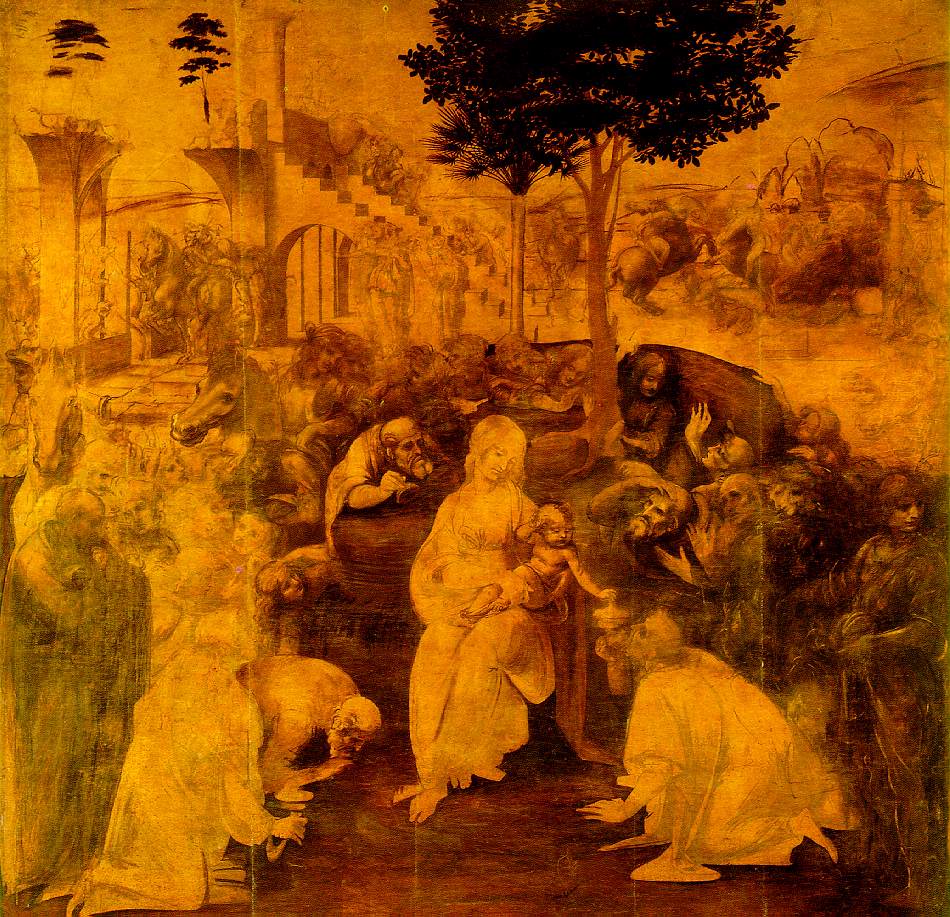
He painted “San Gerolamo” and “The Adoration of the Magi” in 1481, but both of these remain unfinished. In 1482-3 leaves Florence for Milan, in the service of Ludovico Sforza. He paints the “Virgin of the Rocks” (1483-6) and begins to explore human flight (1486). His anatomical drawings in the manuscripts are drawn between 1488 and 1489. He designs a flying machine in 1492 and this is followed by work on the giant equestrian statue of Francesco Sforza (1493). He paints the second “Virgin of the Rocks” (1494) and “The Last Supper” (1495).

In 1496, he meets mathematician Luca Pacioli, with whom he studies Euclid and paints "Madonna and Child with St. Anne" in 1499. In the same year he leaves Milan to return to Florence, stopping in Mantua and Venice (1500). Cesare Borgia assumes Leonardo as military engineer in 1502 and Leonardo designs war machines and draws topographical maps (1502-3). He draws studies for "The Battle of Anghiari" (1503-6), followed by the famous “Mona Lisa” in 1504.

He studies the flight of birds, designs flying machines, and tries to square the circle in 1505. He studies fluid elements: Water, air and fire in 1506-8, returning to Milan in 1508. He paints "St. Anne" in 1509 and undertakes detailed anatomical research the following year. He goes to Rome seeking the patronage of the new pope, Leo X in 1513. In 1515, Leonardo constructs a mechanical lion for the coronation of Francis I, King of France and also draws the famous “Self-Portrait”. In 1516, he goes to the court of Francis I, Amboise and designs a palace in Romorantin in 1517. He died in Amboise, May 2, 1519.

Monday, 14 April 2008

EDITH PIAF


“I don't think of all the misery, but of all the beauty that still remains” - Anne Frank

Last Saturday we watched Olivier Dahan’s 2007 film “La Môme” with the extraordinary Marion Cotillard bringing to life France’s tragic songstress, Edith Piaf. The film was extremely well made, and Ms Cotillard well deserved her Oscar. I had heard conflicting reports of this movie, especially berating the flash forwards and flash backs, but once we started watching we were hooked and the story of one of the most famous of French singers that was unfolding on the screen hooked us completely.

The movie is well directed and acted and is quite brutal in its depiction of one woman’s tortured life. Piaf was raised away from her mother and father in a cheap bordello, lost her sight for a time, travelled with the circus, sang and slept in the streets, lost her child at 20, was wrongly accused of murder, struggled with a drug addiction, lost her true love and other dear ones in her life, and still had the courage to get up on stage at the end of her life to sing "Je ne Regrette Rien" (I regret nothing).

The film is obviously filled with much music and song, with all the favourites of Piaf’s repertoire making an appearance. Although for the most part Piaf’s recordings are used on the soundtrack, French singer Jil Aigrot is credited with the vocals for some of Piaf's songs, particularly those from Piaf's younger years (e.g. Mon Homme, Les Mômes de la Cloche, Mon Légionnaire, De Gris, L'Accordéoniste, Comme un Moineau and Les Hiboux), songs for which there are no recordings by Édith Piaf or where the song was presented in a manner different from anything recorded by Édith Piaf. The climax of the film is Piaf at the end of her life, hobbling on to the stage of the Olympia Hall in Paris and singing her signature tune, “Non, Je ne Regrette Rien”.

A note about the name of the film. In most English speaking countries, the film is known as “La Vie en Rose” (Life through Rose-coloured Lenses), but in the original French, “La Môme” means the kid, the urchin and “Piaf” is sparrow. Hence, “La Môme Piaf”, which was the singer’s assumed name when she first started singing means the little sparrow.

Watch this film, although sad and gritty, it is strangely uplifting, also…

Sunday, 13 April 2008

ART SUNDAY - PAUL KLEE


“Harmony makes small things grow, lack of it makes great things decay.” – Sallust

Paul Klee. “Hermitage”. 1918. Watercolor on chalk ground. 18.3 x 25.4 cm. Paul Klee Foundation, Kunstmuseum, Berne, Switzerland.

For Art Sunday, the art of Paul Klee, with one of my favourite paintings of his. Paul Klee was born in Munchenbuchsee, Switzerland in 1879. He studied art at the Munich Academy of Fine Art (1898-1901) and later became associated with the Blaue Reiter group. Artists in the group believed that they had a responsibility to "heal the gaping wound that separates man from his environment".

Klee was living in Germany during the First World War and in 1916 was called up by the German Army. He was not sent to the front-line and spent some of his time painting aeroplanes. His war experiences appeared in his book, Diaries: 1898-1918.

After the Armistice Klee taught at the Bauhaus in Weimar and Dessau. Klee was a brilliant and undogmatic teacher and a stimulating writer on art. The most important book Klee wrote during this period was, Pedagogical Stetchbook (1925).

With the emergence of Adolf Hitler and the Nazi Party in Germany, Klee returned to Switzerland. A large number of his paintings on display in Germany were confiscated by the Nazis as degenerate. The growth of fascism in Europe affected Klee badly and he began to suffer from acute depression. In 1935 Klee developed scleroderma, a rare debilitating disease. Paul Klee died in 1940.

Saturday, 12 April 2008

DEAF CALLAS


“He who hears music, feels his solitude peopled at once.” - Robert Browning

Yesterday on the train, commuting to work I was struck by a young man who was listening to his iPod. Even though he was sitting about 3-4 seats away from me, I could hear the loud music he was playing through his headphones. Surely he must have been deaf to be able to withstand the music playing that loudly in his ears. Bemused, I looked on and the woman sitting next to me started a conversation about the loudness of the music and what that young man was doing to his hearing. Today I did some searching on the net and was interested to find a treasure trove of studies on this topic.

Teenagers seem to know that loud music can damage their hearing, yet most see no reason to lower the volume on their iPods. Students at two high schools in the Netherlands were interviewed by researchers and found that the teens were aware that blasting an MP3 player could harm their hearing. Most said they usually played their own players at maximum volume and had no plans to change that. Like many teenagers, the students often denied their own personal risk. Most knew the general hazards of loud music, but believed they had a "low personal vulnerability" to hearing loss, the researchers report in the Journal of Pediatrics.

Parents can also look for signs of a problem, like when a child complains of ringing in the ears or sounds being "muffled”. Many parents may be unaware of the hearing risks posed by MP3 players, and of the 73 students in the study, few said their parents had warned them that playing the devices too loud could harm their hearing. Many students in the study said they did not know how to tell when their MP3 players were too loud. Volumes at or above 90 decibels (dB) are believed to be hazardous, but noise levels need to reach 120dB to 140dB to become uncomfortable or painful. Manufacturers, according to the researchers, could equip MP3 players with an indicator that displays the volume level in terms of decibels, along with a signal - such as a flashing light - that goes off when decibel levels reach the danger zone.

As a general "rule of thumb", MP3 users should set the volume no higher than 60 per cent of its full capacity when using "ear bud" style headphones -like those that come with iPods. With over-the-ear headphones, they recommend 70 per cent as the maximum. Just as there are safety standards for occupational noise exposure, researchers suggest that more long-range studies are needed to develop safety guidelines for "leisure-time" noise exposure.

Here is something to caress your ears, the immortal Maria Callas singing “Casta Diva” from Bellini’s opera “Norma”. The opera is about a druidic priestess in ancient Gaul, during the occupation by the Romans. She falls in love with a Roman, they become lovers and she intercedes on his behalf when he is captured by her fellow Gauls. Unbeknownst to her he is having an affair with another priestess, her close friend. Here Norma sings an invocation to the “Chaste Goddess”, the moon. The opera ends tragically with Norma burnt alive on a pyre, but at last she is joined by her lover, who realizes it is her he truly loves.

Friday, 11 April 2008

MOOD FOOD


“The only way to keep your health is to eat what you don't want, drink what you don't like, and do what you'd rather not.” - Mark Twain

Are you angry? Feeling anxious, edgy, frustrated? Maybe you are suffering from depression or dire melancholy. Forget psychoanalysis, medication, counseling or prozac. Research is suggesting that what you eat may affect your mood. The evidence that is beginning to accumulate in support of this “food as medicine” notion is varied and is being published widely. One of its early proponents is Dr Khursheed Jeejeebhoy (formerly of the University of Toronto see: http://jeejeebhoy.ca/lifeliner/jeej/) who maintained that consumption of some foods is associated with a feeling of happiness and an optimistic mood.

Studies at the University of Wales support this hypothesis and show when students were given different breakfast combinations, their emotional responses varied. A breakfast low in kilojoules, carbohydrates and fat, but high in fibre gives a boost to happy feelings and optimism, but also improves memory. Contrariwise, other studies have shown that typical junk foods loaded with simple carbohydrates, low in fibre, high in fat and calories combined with stress lead to irritability, anger, panic attacks, impatience, fuzzy thinking and addictive behaviours. Jack Challen, a nutrition expert, has labelled this dietary consequence as the “pissy mood syndrome”.

The scientific basis for these observations may have a lot to do with the chemistry of the brain. Serotonin, noradrenaline and dopamine are all chemical messengers that transmit signals between nerve cells. Food can influence levels of these compounds in the body. Carbohydrates increase the levels of serotonin, causing a feeling of well-being but also drowsiness. Dopamine and noradrenaline increases cause feelings of alertness, heighten reaction times and increase energy. Protein-rich foods raise levels of these compounds in the brain: Meat, chicken, fish, soy, nuts, eggs and dairy products.

It should be kept in mind, however, that overeating will cause drowsiness as the more food in the stomach, the more blood is drained away from the brain to the intestines for the digestion process. Hence the feeling of sleepiness after a very heavy meal. A light meal of relatively few calories that is protein rich is the best for an alert mind.

Depression is relieved b foods that are rich in omega-3 fatty acids: Salmon, prawns, lobster, walnuts. Drinking lots of water and keeping hydrated also helps one’s mood. In this respect, cutting down coffee and alcohol (which are both diuretics and hence can cause dehydration) intake may help.

If you still feel aggressive and not quite relaxed, chomp on some chocolate. This has been used from ancient times by Aztecs as a healthful food and modern science has confirmed that it contains over 300 compounds that influence mood. Just make sure it’s good quality dark chocolate, as high sugar intake is definitely bad for one’s mood. Immediately after one eats sugar, there is a short-lived “Sugar high” followed soon after by a “sugar low” where despondency and dejection set in.

A healthy diet will certainly improve your mood, but this is helped by regular exercise. The latter causes an increase in body chemicals called endorphins. These substances produced within the body, have a positive effect on the brain, rather similar to morphine.

So in summary, for good mood:
• Low fat, low carbohydrate, low kilojoule, high protein, high fibre diet
• Regular exercise
• Drink lots of water
• Keep coffee and alcohol consumption down
• Eat shellfish
• Dark chocolate
• Low sugar

Enjoy a healthy meal, enjoy a healthy life.

Thursday, 10 April 2008

AVENS


“To keep the body in good health is a duty...otherwise we shall not be able to keep our mind strong and clear.” - Buddha

The plant for this day’s birthdays is avens (herb Bennet), Geum urbanum. The generic name of the plant is supposedly derived from the Greek word for “to taste”, geuomai. This is related to the use of the root of the plant as an additive to ale, preventing it going sour and conferring upon it a clove-like flavour. The root was also used as a substitute for cloves in stewed apples and apple pies. Bennet is a corruption of Benedict, after the Saint, as it was considered a plant sacred to him. The plant was attributed with miraculous healing properties, especially for all internal injuries and chest complaints. The upper leaves with their three leaflets symbolised the trinity in medieval times, while the five-petalled yellow flower symbolised the five wounds of Christ on the cross. Astrologically, avens is under the dominion of Jupiter.

Avens is still used nowadays by herbalists as a medicine, because of its astringent effect. Avens-based herbal cures are mainly used to treat disorders that affect the region of the mouth, the region of the throat, as well as problems that affect the gastrointestinal tract of a person. Avens-based herbal medications lead to the tightening of soft gums; it can heal canker sores, and makes a really good gargling solution to treat infections in the region of the pharynx and the larynx. Avens-based herbal medications also help in bringing about a reduction in the irritation affecting the stomach and the gut. Avens-based herbal cures can be used in the treatment of disorders like peptic ulcers, problems such as irritable bowel syndrome, in the treatment of diarrhoea and chronic dysentery. The herb is included in many herbal lotions and ointments, these can bring soothing relief from the symptoms of haemorrhoids. Avens can also be made into an herbal douche to treat problems like excessive vaginal discharge; a herbal avens-based douche can also be used for general cleansing of the vaginal cavity. One more reputed property of the avens is that it possesses a mild quinine type effect and can supposedly bring relief from a fever by lowering the body temperature.

And our word of the day is:

herbalism |ˈ(h)ərbəˌlizəm| noun
The study or practice of the medicinal and therapeutic use of plants, now especially as a form of complementary and alternative medicine.
ORIGIN Middle English: via Old French from Latin herba ‘grass, green crops, herb.’ Although herb has always been spelled with an h, pronunciation without it was usual in British English until the 19th century and is still standard in the U.S.

Wednesday, 9 April 2008

STRANGE HARMONY OF DISCORD


“Opposition brings concord. Out of discord comes the fairest harmony.” - Heraclitus of Ephesus

The Ying and the Yang conspire within yet again, as northern hemisphere memories and southern hemisphere realities meld and vie for supremacy. The shade of gray that results will depend on the amount of white mixed in with the black. Heraclitus, that distant relative smiles and, yes it’s April once again…

April in the Antipodes

My heart stirs silently like a seed,
Swollen, its thirst slaked after a long Winter’s rains.
Green vibrant juices begin to flow
Under a cracking husk.
I feel within me rise Spring’s viridian sap;
Life awakens yet again,
The seed must germinate, the flower must bloom.
The clock within has struck the hour.

But all the Spring that I conceal within
Each April dies as Antipodean moon
Wanes, waxes cold, looking at me
Up in the sky fixed upended.

The burgeoning cotyledons every April will unfurl,
In cold grey Autumn skies and chilling winds
They find no shelter, no encouragement.
The first, emerald-green leaves will wither,
As yet another seedling lies shrivelled up, yellow, unfulfilled.
Sleep yet again my Northern April,
As Winter, Winter follows,
Spring merely poetic licence...

ἐκ τῶν διαφερόντων καλλίστην ἁρμονίαν…

Tuesday, 8 April 2008

ANIMAL CRUELTY


“Cruelty, like every other vice, requires no motive outside of itself; it only requires opportunity.” - George Eliot

The human being is considered to be the peak of evolutionary progress, the paragon of intelligence, the richest in emotional responses, the very centrepiece of creation. Human beings are gifted with reason, with compassion, with altruism, with a rich inner world that allows them to live life to the full, protecting the weak and innocent, to take care of their world, think of the future. Humans have music, have art, have culture. They live to write poetry and paint canvases, sing songs and dance ballets. What a wonderful world we humans live in, enjoying it as we do when each of us is endowed with such wondrous and marvellous gifts…

Aren’t idyllic dreams of a perfect world wonderful? The most despicable, the most horrendous, most terrible, most barbaric acts are those carried out by humans beings. Whatever can be imagined in the most warped mind can be realized by humans. Whatever can be dreamed in the most terrible nightmare can be made grim reality by humans. Whatever can be thought of in order to degrade, torture, despise, denigrate, terrify, terrorise other humans, we see reported in the news daily. And it does not stop there. We humans can even become more monstrous, more mindlessly destructive and repulsive. We can extend our activities to torture animals, not for the perhaps defensible purpose of food provision, but for the sake of… art!

Animal lovers and welfare activists beware, what follows is highly distressing and thoroughly sickening.

Guillermo Vargas a.k.a. ‘Habacuc’ (born 1975) is a Costa Rican “artist” who used a starving, sick street dog as part of an exposition in Managua, Nicaragua. He allegedly found the dog tied up on a street corner in a poor Nicaragua barrio and brought it to the showing. He tied the dog, according to furious animal lovers, in a corner of the exhibition salon where it died in his “art installation”. His point was, that there are thousands of dogs around Costa Rica dying every day and nobody cares. Using his “artistic sensibilities” he heightened public awareness of their plight… This is the link to a YouTube video on the exhibition (in Spanish and not for the faint-hearted!)

It is reported that the dog was left to die with no food and no water as patrons passed by in the gallery. The director of the Códice Gallery has stated that the animal was only tied up for 3 hours on one day and was fed and that finally the dog escaped. Guillermo Vargas has been selected to represent Costa Rica at the Bienal Centroamericana Honduras 2008 and an online petition has been made with over 1.8 million signatures against this selection (see here).

The controversy rages whether in fact the dog died of starvation in the gallery or whether it was released (see here). To have to consider that the dog was used in this way at all, for the sake of “art” is disgusting. There are millions of people worldwide who do really good work in animal shelters, stray animal hospitals, volunteer organisations, the RSPCA. Doing what Mr Vargas did to the dog to draw attention to its plight is like torturing a human on Oprah to draw attention to the fact there are millions of people being tortured worldwide. Or raping someone in the midst of a public gathering to draw attention to the plight of rape victims. Or putting a child in a cage on display and not feeding it to draw attention to the millions starving worldwide.

That not one of the refined “art lovers” went to liberate that tied dog I find even more repulsive than the cruel act of tying up the dog. “One of the ill effects of cruelty is that it makes the bystanders cruel.” Said Thomas Fowell Buxton, and though we find cruelty inherent in our human nature, at least we should make every effort to quash it, because it should seem unnatural to us. We have reason and intellect, we have emotion and sensitivity enough to be able to renounce the baser instincts of our humanity and rise above that in order to ennoble ourselves. Or is the world going completely mad?