Friday, 9 October 2009

THE NOBEL PEACE PRIZE


“Peace cannot be achieved through violence, it can only be attained through understanding.” - Ralph Waldo Emerson

The award of the Nobel Prize for Peace to US president Barack Obama has given rise to controversy throughout the world. The Nobel Committee as a justification for its choices, cited “his extraordinary efforts to strengthen international diplomacy and cooperation between peoples”. However, even his staunchest supporters know that none of these dreams have yet come true. A prize for a dream and for a politician’s visionary and nebulous promises may be seen by many as hasty and ill-advised.

On the one hand it is reassuring to see the Nobel Committee choosing to reward an idea, an intention, a pipe dream, if you like. On the other one wonders if this is a much more canny decision. Is this award a means of keeping a politician honest and a good way to ensure that he delivers on his promises? There has been an enormous responsibility placed on the US president now to make his dreams a reality. If he does not deliver, then the outcry will be worldwide and the clamour much louder than that of the controversy surrounding his award.

Many opponents of the Nobel Committee’s choice are the usual war-mongering, pro-war fraternity who wish to see a US president reign by inciting fear and waging war as a means of preserving peace. They wish their president to be powerful and feared, rather than be seen as weak and pro-peace. They see the award of the prize to Obama as an affirmation of his socialist leanings and weakness in matters of international policy.

This view is diametrically opposed by another group of dissenters, who agree only on one point with the former group, and that is they concur with the error of the prize award to Obama. These latter objectors remark that “actions speak louder than words”. The prize should be better given to a peacemaker of action, someone who has worked actively and with the proven results of making the world a better place to live in. Who, for example, would object to the 1999 Nobel Peace Prize winners, the group Médecins sans Frontières (Doctors without Borders)? Was a Nobel Peace Prize better awarded than to this group of doctors who travel the world in order to help bring medical care to sick people irrespective of race, creed or political convictions?

I have mixed feelings about this year’s choice for the Nobel Peace Prize. I would rather have had a similar group like the Doctors without Borders be awarded. On the other hand, I sincerely hope that the US president will now feel the weight of responsibility heavy on his shoulders and realise his grandiloquent promises. I can only hope that the number the Nobel Committee has put its chips on to win, will do so – much is riding on it…

For Music Saturday, an apt choice perhaps, Gustav Holst’s “Venus – The Bringer of Peace” from his “Planets” suite, played by the Berlin Philharmonic and conducted by Sir Colin Davis.

CERTIFIED ORGANIC


“Nature provides a free lunch, but only if we control our appetites.” - William Ruckelshaus

A new national standard was introduced in Australia today assuring consumers that food labelled “organic” really is such. The standard that was adopted outlines the minimum requirements that are needed to be met in order get the “organic or biodynamic tick of approval”. It also simplifies the criteria and lessens the categories of certification from eight to three. The standard makes provision for production, preparation, transport, marketing and labelling practices and also requires the maintenance of strict records by producers and marketers.

The voluntary standard requires the organic label to be held off for at least three years after the required farming practices are adopted. Similarly the same period must be allowed for the use of organic or biodynamic livestock feed. This of course ensures that any traces of “non-organic” contamination are dissipated before the truly organic product reaches our table. Once these procedures have been carried out and once the certification is attained, the product can be certified organic.

It is hoped that this new standard will help the consumer answer this question: “How can I trust organic?” The new standard suggests that this will be easy as the consumer can look for a “certified organic” logo on the product to be absolutely certain a product is truly organic. Unlike claims such as “green”, “sustainable” and “natural”, which are often misused and falsely applied, the certified organic industry relies on recognised standards and most importantly independent auditing and certification to back those claims.

More information is available from the Australian Food News (AFN) site.

Thursday, 8 October 2009

THE FINE LINE BETWEEN RACISM AND SATIRE


“Satire is a sort of glass, wherein beholders do generally discover everybody's face but their own.” - Jonathan Swift

The newspapers today are full of the public reaction to a TV show last night. The show was a blast from the past, the highly popular “Hey Hey It’s Saturday”, which has its second reunion special. The show was a fixture on Saturday nights in the 70s and 80s and its evergreen host Daryl Somers was a popular TV personality for decades. The show, which went off air in 1999, was resurrected for these comeback performances and this latest instalment attracted an average national audience of 2.3 million viewers (100,000 more than watched the first reunion special last week). The show obviously has nostalgia value for many, although personally, I was never a fan of this inane frivolity…

However, it appears that times have definitely changed and the show really overstepped the boundaries of good taste. In a segment of the show called “Red Faces” there is a talent quest-like competition and contestants front up to showcase their special gifts. The show was accused of being racist after a skit featured a group done up in black face paint (à la black and white minstrel show) re-enacting a Jackson Five song. The same group performed the same act on the show 20 years ago. Harry Connick Jr, was one of the segment judges, and he took offence at the act and gave it a zero. He said if the skit had appeared on television in the US, the show would have been terminated.

This sparked off a furious controversy here in Australia (and abroad, especially the USA!). Australia has been accused of being racist, backward and redneck, while Australia has said the people offended have no sense of humour, are over-reacting and are representing political correctness gone crazy. Anand Deva is the frontman of the skit, and he is a prominent Sydney-based plastic surgeon. He together with the host Daryl Somers apologised on Thursday morning, but said it was ironic that he’d been called racist, given his Indian background.

I seem to recall a 2004 movie called “White Chicks” in which two black men were made up to look like white, blonde women. This did not raise any ruckus and while the film was quite bad, nobody screamed racist or sexist or blondist. I found it an inane and unwatchable movie, just as the concept of the black skit on the TV show leaves me quite cold. However, the Harry Connick Jr over-reaction is also offensive and way over the top. I would agree that political correctness nowadays has gone over the top.

Some of the best Irish jokes are told by Irish people (who are successful, smart and resourceful), blondes tend to laugh most at blonde jokes (while themselves being very clever and astute), Jewish jokes are made up by witty, successful and entertaining Jews, Greeks take the mickey out of themselves because they have a sense of humour… All of course being done in good taste. There are crass and offensive jokes, and there are clever, witty, satirical ones. Harry Connick Jr has to protect himself from the backlash when he goes back home and his reaction is a protective mechanism. Had he reacted in any other way, he would have been in very hot water when he returned home.

I am a tolerant, non-racist person who comes from a minority myself. At school I was taunted and was the butt of racist remarks, so I know what it feels like. However, nowadays I think nothing of it and even if I come across a racist I quickly make it clear to them that they have the problem not me. However, I have heard some excellent jokes about Greeks and will often tell them myself while laughing at the exaggerated quirks of my ethnic group. Satire is a wonderful thing. Let’s not lose it in the name of political correctness.

I personally did not see the skit, but from the descriptions of it and knowing the type of show “Hey Hey It’s Saturday” was, I would say that the skit was not in good taste and would be closer to unacceptable than humorous. However, banning it or pronouncing it as a cause of axing the show to me is an over-reaction.

satire |ˈsaˌtīr| noun
The use of humour, irony, exaggeration, or ridicule to expose and criticise people's stupidity or vices, particularly in the context of contemporary politics and other topical issues.
• A play, novel, film, or other work that uses satire: A stinging satire on American politics.
• A genre of literature characterised by the use of satire.
• (in Latin literature) a literary miscellany, esp. a poem ridiculing prevalent vices or follies.
DERIVATIVES
satirist |ˈsatərist| noun
ORIGIN early 16th century: from French, or from Latin satira, later form of satura ‘poetic medley’ from Greek saturos, a follower of Dionysos, Greek god of wine and drama.

Jacqui BB hosts Word Thursday

Tuesday, 6 October 2009

SPRING FUNERAL


“Spring has returned. The Earth is like a child that knows poems.” - Rainer Maria Rilke

Finally got home at 1:30 am this morning after delays with connecting flights and delayed baggage deliveries. The time difference (Melbourne is three hours ahead of Singapore) helped with the late night, but it was harder to wake in the morning. Consequently, I was late into work, getting in there at about 9:00 am, instead of my usual 7:15 am. The weather here was cold and wet and the crispness in the air was a welcome relief from the tropical sogginess of Singapore…

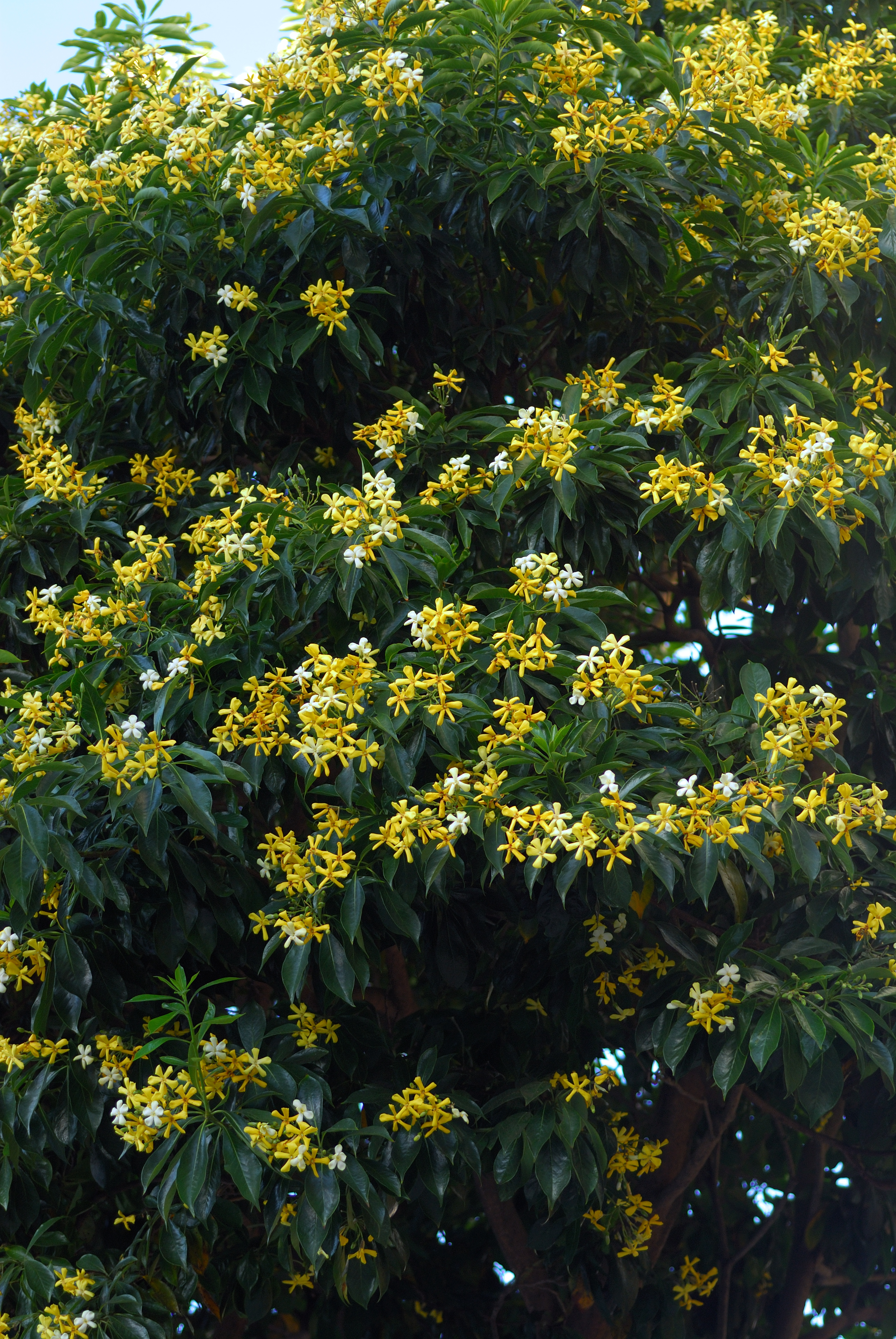
The garden has started to bloom in earnest now and the irises, primulas, roses and jasmine are beginning to look glorious. Our native frangipani, Hymenosporum flavum in the front yard is in full bloom and the delicious fragrance of the blooms was a welcome in the darkness of the night as I turned the key in the front door. The grey skies this morning, the wet streets and the cold, crisp air triggered in my mind some memories. Passing by the Melbourne cemetery in the morning also may have helped in inspiring this poem that was jotted down on a paper bag, to be transferred here tonight.

Spring Funeral

Spring wakes deep in earth the sodden seeds
Making more acute my pressing needs;
The rain that gently falls will wash me clean
No more my painful memories will I glean.

I loved you such a long time ago
And yet I chose dreams to forego.

The greenwood leaves unfurl and open fresh
The breeze still cool, tempers my burning flesh;
Desires, passions, loves I bury deep in earth
Path chosen, heart dies, mind more is worth.

I loved you such a long time ago
But now allegro turns to largo.

As flowers fresh are laid by a new dug grave
All your thinly disguised betrayals I forgave;
The falling night will usher in the stars
Silence – except for mournful cries of nightjars.

I loved you such a long time ago
Now where to turn? To whom to go?


Jacqui BB is hosting Poetry Wednesday

COMING BACK HOME...


“To get away from one's working environment is, in a sense, to get away from one's self; and this is often the chief advantage of travel and change.” - Charles Horton Cooley

Travelling back home today, but it will be a long haul, seeing how it is Singapore to Melbourne via Sydney. The trouble with Sydney airport is that:
(a) it is not a 24-hour airport and the last flight out is at about 10:30 pm, and,
(b) the international terminal is quite a distance from the domestic terminal, necessitating a bus trip.

Nevertheless, it will be good going back home, this trip was rather long and arduous…

Sunday, 4 October 2009

MOVIE MONDAY - A LITTLE SPICE


“Our hearts where they rocked our cradle,
Our love where we spent our toil,
And our faith, and our hope, and our honour,
We pledge to our native soil.
God gave all men all earth to love,
But since our hearts are small,
Ordained for each one spot should prove
Beloved over all.” - Rudyard Kipling

I watched a movie at the hotel last night, which was pleasant enough although not great film-making nor was it an outstanding script. Nevertheless, it kept up interest and the lead was beautiful to look at. It was Paul Mayeda Berges’s 2005 film “Mistress of Spices”. It starred the famous Bollywood beauty, Aishwarya Rai and Dylan McDermott as the romantic leads, although the chemistry between them was not all that great. Nitin Ganatra, Anupam Kher, Adewale Akinnuoye-Agbaje and Zohra Seghal gave good supporting perfomances.

The film is based on the novel by Chitra Banerjee Divakaruni, and is a mystical, magical romantic story that plays like a modern fairy tale. We are first taken to India where a baby girl is born to a poor family, who only regard her birth as a future dowry-debt. However, as the child grows up, her parents realize that she has special powers that enable her to find lost things as well as foretell the future. Bandits learn of her existence, and in their quest for wealth, abduct her, but she manages to escape and lands on a shoreline where a woman is teaching young girls how to be “Mistresses of Spices”. She is taken into this group, and named Tilo (Sesame). She becomes a Mistress of Spices, and like all others must follow three rules for all her life: Look after desires of others; never leave the spice store; and never touch anyone else's skin. When she grows up, she is put in charge of a store, the “Spice Bazaar” in San Francisco. There she begins to dispense her spices helping people’s lives. We are immersed in her interactions with older Indian man called Dada, a man named Kwesi, a woman called Myisha, a taxi-driver named Haroun, the teenager Jagjit and his mother, as well as a man named Doug and later his girlfriend. She prepares special spice mixtures for them to improve their lives. Tilo soon begins to be attracted to Doug, breaking the first rule; she also leaves the store to visit Haroun, and she starts to feel - thus breaking all the sacred rules.

I was reminded a little of the film “Chocolat” with Juliette Binoche by this film. However, this film deals with the problems of cultural clashes and the spices are metaphor for the culture of the “old country” which one must compromise in order to live fully a fulfilling life in the “new country”. The conflict between duty and filial love, with the more egotistical desires of self-fulfilment and romantic love are contrasted. As Tilo begins to break the rules the vindictiveness of the spices is shown with not only Tilo suffering, but also her formerly happy customers paying the price of her non-compliance.

McDermott looks uncomfortable right throughout the movie and it is really Aishwarya Rai who carries the film, looking very luscious and doing much acting with her eyes and face. Those who are not fans of voice-overs may find the extensive use of this device a trifle tiresome, but I did not mind it too much. As most of the film takes place inside the spice shop (remember Tilo is forbidden to come out of it), the director makes the most of the rich colours and interesting shapes and textures of the spices. However, the close-ups of the chilli peppers were a bit hackneyed and overused after about three times…

The concept of spices being used medicinally and for mental problems is not too far fetched with traditional Indian Ayurvedic and Islamic Unani medicine using all of these spices therapeutically. Overall I found the movie a little too simple, its character development almost non-existent, the plot too thin, and the chemistry between the leads weak. However, it was pleasant enough to watch and if the book falls into my hands I think I would rather like to read it and see whether it is in fact better.

Saturday, 3 October 2009

SUNDAYS IN SINGAPORE


“Earth provides enough to satisfy every man's need, but not every man's greed.” - Mohandas K. Gandhi

Whenever I come to Singapore, if it is Sunday, I am always amazed by the large numbers of Filipinas that congregate on Orchard Road (after morning mass is over, of course). Most of them work here as maids, cleaners and service staff. They flock towards Lucky Plaza and rush to the upper floors where the money remittance offices are. They queue there for a long time until their turn comes and then they can send some money to their families back home. They wear their Sunday best and they smile, chatter to each other and dream. They queue again at the internet outlets where they can cheaply talk with their relatives over Skype. Then they can go and have a cheap meal with their friends or even a picnic lunch on one of the sidewalks in the streets off Orchard Rd, for which they get their comstibles in the cheap Filipino shops. And so it was today also…

They flocked around me as I walked down Orchard Rd, their happy voices twittering like the songs of tropical birds, their smiling faces full of Sunday happiness. Their day of rest dedicated to their family and their fellow Filipinas here in Singapore. The outing providing them with the opportunity to talk their language, share their stories, alleviate their homesickness, share a smile. I’ve heard that many of them have to work long hours for low wages and even have to cope with bad working conditions and perhaps even a cruel boss. The Filipina maid here in Singapore is an expendable commodity and if the one you have is not what you are looking for, there are many others willing to take her place. The placement agencies (many in Lucky Plaza once again) have hundreds of advertisements, photos upon photos of available service staff. To be placed in a household attracts a hefty fee for the agent, which the worker has to pay.

The same goes for Indonesians, Indians, other SE Asians who wish to come to Singapore and work, taking advantage of the buoyant economy. Indian workers are willing to be shipped here and work in construction sites and willing to pay their first 6-12 months of wages to the agent that places them. In return they get dormitory space to sleep in and their meals. If they then stay on, they will get the money in their pockets to send back home… One sees them by the truckload early every morning being taken to the site and returning late in the evening.

The haves and the have nots. The struggle for survival versus the greed of the rapacious egotistical society that rewards avarice and the search for status and endless luxury. The riches of our century are unimaginable, but the prices is that poverty of our century is unlike that of any other. Poverty in times before was the result of natural scarcity, however, nowadays poverty is the result of a set of priorities dictated by the rich. The modern poor are written off as rubbish. Our consumer economy views the poor with disdain and ignores them as no-hopers, idlers and as those who fail to take the opportunities given to them. They are not indeed social entrepreneurs as the conference I attended concluded…

SOMETIMES I FEEL LIKE A BLACK SHEEP...


"I am of the opinion that my life belongs to the whole community and as long as I live, it is my privilege to do for it whatever I can. I want to be thoroughly used up when I die, for the harder I work the more I live." - George Bernard Shaw

Today was the last day of the conference and as I attended all three days I was considering by the end of today what the conference achieved, what I learnt and also what I could do on my return home. As is the case with such conferences, there are a lot of very clever people present and many fantastic ideas are vocalised. There are visionaries and impassioned idealists, some socialist and altruistic social reformers, but also there those who are vain and self-centred, and of course there are the hypocrites and the opportunists.

Dr Ting Choon Meng is a local Singaporean who has developed an innovative monitoring wristwatch that is used to record cardiac parameters on a 24-hour basis in patients with heart disease (with great commercial success). It has saved the life of many people who are under increased threat of stroke and heart attack. He was one of the panellists in one of today’s sessions and he related a story of a Chinese man who lived in a remote part of China. This man for the last 40 years had carried out a job that he felt was essential for this community. He lived in a village, which several decades ago had become bisected in two because of geological upheavals and the re-coursing of a river through the middle of it. As the two halves of the village became separated by the river, this man sold his house, bought a boat and became the ferryman for the village. He demanded no payment for the job and he survived completely on his fellow-villagers’ contributions to his daily needs in terms of food, clothing, etc. Quid pro quo. Dr Ting gave this as an example of an individual being someone who responded to a social need by innovating and resolving a problem in the community, all for the social good.

I was thinking about that all day, especially in the context of what had transpired over the last three days of the conference. This ferryman was certainly an altruist and maybe even a socialist, but he was certainly not a “social entrepreneur”, which was what the conference was about. Had he been one, he would have sold his house, asked for more money from the villagers (his backers) and he would constructed a bridge to span the river. He would have charged a toll every time someone crossed it and in time not only recovered the initial capital, but also made a profit – while at the same time responding to the social need…

I then reconsidered the substance of the conference. Most of the attendees were very much capitalists. They were industrialists and bankers, company directors, CEOs of multinational companies. They were relating their experiences following an “epiphany” they had had regarding sustainability and environmental care, social reform. The classic case was Rob Walton the heir of the “Walmart” fortune. He related how he spearheaded the “greening” of his company and how suddenly, Walmart became a company with an environmental and social conscience. This is of course was in response to a huge public outcry about unsustainable company practices and the selling of products that were quite clearly not “green” nor particularly socially conscientious. Walmart’s turning “green” was an astute business decision which assured their continued profits and shareholder satisfaction with company performance.

My concern with the conference that has been niggling me a little was whether this “social entrepreneur” focus was not simply a front for capitalist interests. Green is sexy nowadays and it sells products. A company can be made or broken based on its green (or otherwise) policy. It also makes sense for large corporations to sponsor environmental causes (as well as the obvious good PR, it is also a good tax break). Am I being too much of a cynic here? I think not. The DBS bank of Singapore was the “diamond sponsor” of the conference. Its representative at the conference was quick to point out that the bank did not indiscriminately back socially worthy projects, but rather the projects with “connections” had a better chance of being “supported” (and he made it clear that this “support” was not necessarily of a financial type). They were even gracious enough to waive bank charges for the supported projects! How generous!

There was a message that came through the conference which on reflection grated on me. It was the concept of “success” being equated with “financial success”. Our Chinese ferryman would not have been deemed to be very successful if he attended the conference and I doubt if he would have got any award. Mr Walton of Walmart (personally worth a cool $25 billion) on the other hand won the jackpot award of the Social Innovation Park of Singapore. He got awarded as the Super Duper Grand Fellow or something or other. He was obviously the “social entrepreneur” that we should all aspire to be.

Another representative from Conservation International got on my nerves today. Firstly, he left the panel discussion before the designated finish time as he had another “important” appointment (which was very rude in terms of the conference attendees, some of whom had come thousands of kilometres to hear his pearls of wisdom). He was wearing his Armani designer suit, his Rolex watch, his Prada shoes (I suppose – do they make men’s shoes? I wouldn’t know) and no doubt earning an annual salary that could support several third world country families for several years. What made it all the more annoying – no, stronger than that – more infuriating, was that his salary was paid by public contributions to appeals and by company handouts. No doubt, he is doing some good, I suspect that some good must come out of the efforts of such groups, but at what cost? I am not suggesting that he should have come to the conference in overalls and gumboots, but are annual salaries of hundreds of thousands of dollar and a branded image necessary for someone representing Conservation International?

The concept of branding came up. Building a successful brand for a social entrepreneur was deemed to be of prime importance as this was to contribute to being successful commercially. Dignity of underprivileged and third world country populations was equated to their ability to purchase commodities and “brands” at the same level as a first world country. This struck me as another attempt by the capitalist system to survive in a climate that is still causing extreme hardship in the countries that built it. The USA will suffer from many more years from the effects of the economic recession, and the greed and avarice that caused it is now being peddled as “social enterprise”. We know that Communism didn’t work, we are experiencing the failure of rampant Capitalism, is “social enterprise” sand in our eyes? Is it thinly-veiled capitalism set to take advantage of us again?

Don’t get me wrong, I am not red. Perhaps a little pink, but Communism doesn’t appeal to me, it is as extreme as capitalism is. A socialist regime with strong government overseeing of national resources, control of public utilities, fair taxes, realistic limits of financial control, and many incentives for social equity is perhaps what represents me politically these days. At the same time, enterprise and personal hard work should be rewarded and sloth penalised. But I cannot support the system that rewards one individual’s work with an annual salary that runs into millions. No one person’s work is worth that much.
What I did not hear at the conference was an acknowledgement of the work of the ordinary person. To be a worker in a factory and earn a decent salary that allows you and your family to live a decent life was not even mentioned. To be a farmer who tills the earth and puts bread on the table was not something that was considered to be a worthy thing. To be an artist, or an intellectual, or a musician was not acknowledged as an essential part of our social fabric (unless of course one was a “brand” and earned millions)…

I need to think more about this. I am quite wound up over it at the moment, I need to consider it more, ruminate upon it further, discuss it with some people. I am worried that during these three days something did not ring true… Your thoughts on the matter will be appreciated.

Friday, 2 October 2009

DINING IN STYLE


“Nothing would be more tiresome than eating and drinking if God had not made them a pleasure as well as a necessity.” - Voltaire

Last night the Conference Gala Dinner was held at the Marina Barrage. This was an amazing event where all stops were pulled out in order to demonstrate to the world Singapore’s ability to host an “event” to world standards. Marina Barrage bags top honours at international environmental engineering awards and is an architectural showpiece, which is both functional and aesthetically pleasing. 
The waterfront icon is the first Singapore project and only the second project outside of the USA in ten years, to win the top award at the American Academy of Environmental Engineers (AAEE)’s Excellence in Environmental Engineering Competition. It was conferred the Superior Achievement Award - the highest honour of the competition for the best project entry – at the AAEE Annual Awards Luncheon held in Washington, DC, USA. Widely considered to be the most prestigious of professional, peer-recognition awards focussed exclusively on the environmental engineering field, the award defines the best in environmental engineering practice: A holistic environmental perspective, innovation, proven performance and customer satisfaction, and contribution to an improved quality of life and economic efficiency. The Marina Barrage beat 33 other entries to take home the top prize in the competition organised by the American Academy of Environmental Engineers (AAEE), becoming the second project outside of USA to win the award, in the last decade.

The dinner was scheduled for 7:00 pm, with cocktails before to welcome the guests and to have them enjoy a special prformance by the Singapore Youth Brass Orchestra. The courtyard in front of Marina Barrage is built on a monumental scale and the ambience is ne of luxury and imposing grandeur. The pre-cocktail menu consisted of champagne or fruit punch accompanied by hors d’ oeuvres: Watermelon with goat cheese and cracked pepper; smoked salmon, lime, crème fraiche and Asian pear; prawn Daikon roll, rosemary ginger vinaigrette; spiced chicken samosas, cilantro and yoghurt.

The dinner was created by Jean-Georges Vongerichten who has received the James Beard award for best chef and best new restaurant, and Esquire magazine voted him the Chef of the Year 1997. His restaurant also holds three Michelin stars, one of the four New York restaurants holding this accolade. The dinner menu was as follows:

Entrée: Crispy crab cake, cucumber, lime and crystallized ginger.
First plate: Sea bass crusted with nuts and seeds, served with a sweet and sour jus.
Main course: Parmesan crusted organic chicken, artichokes, basil and lemon butter.
Dessert: Cinnamon parfait, chocolate sorbet and coconut sago.
Afters: Mooncakes and pralines.

The wines were:
O:TU Estate Sauvignon blanc 2008, New Zealand; and
Lazy Monkey Cabernet Sauvignon 2006, California.

During the dinner there was entertainment, with the Odyssey Dance Theatre performing an excerpt from the ballet “Red Tears”. Then the 13-year-old child star Julia Abueva performed a couple of songs and finally Simon Ng sang and led the orchestra in a musical performance. Following that, there were the Singapore Social Innovation Park awards, which honoured achievements by local and overseas attendees to the conference.

The night was quite a brilliant affair which was enjoyed by everyone and it set off the day’s more intellectual activities quite well.

Thursday, 1 October 2009

FUSIONOPOLIS & THE ENVIRONMENT


“The sun, the moon and the stars would have disappeared long ago... had they happened to be within the reach of predatory human hands.” - Havelock Ellis

This morning I started off with an appointment at 8:30 in the City. While there, we felt a slight tremor. This of course was part of the shocks felt throughout the region as a result of the terrible earthquakes in Indonesia that has claimed close to 1,000 lives. This is in the wake of the Samoa earthquake and the horrific floods in the Philippines. The earth is certainly objecting to the horrible things we human are doing to her.

After my appointment I proceeded to Fusionopolis where the conference I am attending is hosted. Fusionopolis, is ground-breaking science and technology powerhouse for Singapore, which brings together, under one roof, research scientists, engineers and technology experts from the public labs of the Agency for Science, Technology and Research (A*STAR) and those from the private sector. Although their missions differ, these organisations share the common goal of advancing technology to create a better world. To achieve this goal, working teams have to be formed from researchers in the different disciplines housed in the Fusionopolis, including materials science and engineering, data storage, microelectronics, manufacturing technology, high performance computing, and information and communications. Fusionopolis is a point of convergence where companies with capabilities in infocommunications and interactive and digital media come together to test-bed new concepts and products.

The conference I am attending is the Global Social Innovators Forum (GSIF), which is a signature platform of Social Innovation Park (SIP), seeking to bring together a highly trusted community of influential minds from the public, private and social sectors. The aim is to seek opportunities to collaborate and embrace innovations that will define business, government and society. Hopefully the end result will be to build a more inclusive, sustainable and better world.

Last year, the GSIF attracted over 50 speakers and more than 300 delegates from 22 countries, which provided enlightening insights, thereby forging instant bonds and collaborations. This year, the theme is on “Collaborative Innovations: Investing in Team Earth & an Inclusive World”, with focus on collaborative innovations around the 3 ‘P’s – Profits, Planet and People, in ensuring a sustainable earth where the land, air, oceans and people can thrive within the global ecosystem. It will explore sound strategies in business, social, entrepreneurship and innovation in the green to gold movement, to create social, environmental and economic returns for stakeholders.

One of the highlights of the conference was the keynote address by Alvin Toffler of “Future Shock” fame. He and his wife spoke of the need for immediate action on multiple levels so that we ensure that we are able to cope with the crisis that we are experiencing at this stage worldwide. It is already too late in many respects and if we do not do anything to actively resolve many of the environmental issues that we now face, the battle may be lost. Another speaker of note was Robson Walton of Walmart fame. As a multibillionaire he outlined the way that Walmart became greener and demonstrated that being sustainable and environmentally friendly is not completely divorced from being profitable.

One of the best presentations was by staff of Conservation International, represented by Peter A. Seligmann, Chairman of the board and chief executive officer. A very strong message was passed on regarding sustainability, conservation of biodiversity, saving of threatened habitats and species and also the concept of “we > me” – working together in teams for the good of many, rather than the striving of the few to benefit themselves. More information can be got from the group’s website.

SINGAPORE, AGAIN...


30/9/09
“To travel is to discover that everyone is wrong about other countries.” - Aldous Huxley

Flew into Singapore today and got there just in time for an afternoon appointment I had. I always like visiting Singapore as it is a vibrant, vivacious and ever-busy city. There is quite an energy here, which always manages to draw one in and immerse one in it. Staying at the Holiday Inn, which is quite central and handy to the MTR, the underground train system that is convenient for getting around.

Singapore was founded as a British trading colony in 1819. It joined the Malaysian Federation in 1963 but separated two years later and became independent. Singapore subsequently became one of the world's most prosperous countries with strong international trading links (its port is one of the world's busiest in terms of tonnage handled) and with per capita GDP equal to that of the leading nations of Western Europe. I always think of Singapore as the “Switzerland of Asia”, and this is certainly justified in terms of its small size, prosperity and influence in the region.

One of the things that was immediately obvious was the smoky haze in the atmosphere here. This is because of the immense Indonesian fires that have put a pall of smoke over the region. The massive burning-ff that happens annually so often gets out of control and as well as destroying the rain forest it causes other environmental damage on a wide scale.

Tomorrow I have more appointments, but also over the next three days I am attending the Global Social Innovators Forum 2009, which is a premier event for showcasing achievements in sustainability, social equity and achievement both personal as well as organisational.

Tuesday, 29 September 2009

CYBERJAYA


29/9/09
“Technology... is a queer thing. It brings you great gifts with one hand, and it stabs you in the back with the other.” - C.P. Snow

Another busy day today with much to do in Cyberjaya, at the University College of Medical Sciences. Cyberjaya is a technology park adjacent to Putrajaya. It was launched in 1999 by the country’s fourth Prime Minister Dr Mahathir Mohamad. Cyberjaya was developed to help affirm Malaysia’s status as a country of Knowledge-Based Economy. A fully integrated city complete with modern amenities and facilities, it is easily accessible via major highways from Kuala Lumpur City Centre to Cyberjaya, a mere 26km or 20 minutes away. With a total land area of 7,000 acres, the Cyberjaya Flagship Zone is a self-contained intelligent city with world-class IT infrastructure, low-density urban enterprise, as well as state-of-the-art commercial, residential, enterprise and institutional developments.

The planning was made in such a way to provide comprehensive infrastructure with principal emphasis on its enterprise and office development as the catalyst for the growth of ICT enterprises and the multimedia industry in Malaysia. It is also to promote Cyberjaya as the regional and local ICT hub to rival the best in the world. 

Its competitiveness as a global ICT hub has made Cyberjaya one of the top three destinations for business support services and outsourcing in the world. The city is also expected to see a large boom in population growth over the next 10 to 15 years, with residential developments expected to reach a population of 210,000, business developments providing for up to 120,000 employees and institutional establishments providing for 30,000 students.

Today, Cyberjaya is home to many multinational companies such as Shell, EDS, Ericsson, BMW, HSBC, DHL and many more. It is also the chosen location for the nation's top smart schools and institutions such as Limkokwing University College of Creative Technology, Multimedia University and Cyberjaya University College of Medical Sciences. The town also provides a good living environment with convenient amenities such as hotels, boutique malls, recreation centres, community clubhouse and more.

Tomorrow morning, off to Singapore again!

PUTRAJAYA


28/9/09
“I soon realized that no journey carries one far unless, as it extends into the world around us, it goes an equal distance into the world within.” - Lillian Smith

I have appointments in central Kuala Lumpur, but also in Putrajaya, at the Cyberjaya University. Putrajaya is a city and federal territory of Malaysia, 25 km south of the capital and serves as the country’s administrative centre. Prior to the construction of Putrajaya, the Malaysian government offices were housed at various locations across Kuala Lumpur. With increasing traffic congestion, however, the distance between the offices began to hinder administrative processes. Consequently, the government resolved to create a new city where the scattered offices could be relocated and reassembled to form a more efficient administrative hub.

The prime minister’s office moved to Putrajaya in 1999. While Kuala Lumpur continued to function as Malaysia's capital (it was the site of both houses of parliament and the first royal palace) Putrajaya gradually expanded to include the Federal Court, the second royal palace, and many other administrative buildings. It was declared a federal territory in 2001. Putrajaya is managed by a corporate body that controls its development. Built on the former site of rubber and oil palm plantations, Putrajaya was developed as a “garden city.” It has an expansive man-made lake and many areas devoted to parks, botanical gardens, and wetlands. From its conception, the city was envisioned as part of a growing high-technology communications research and development corridor stretching southward from Kuala Lumpur. Putrajaya is accessible by numerous rail lines and highways and is in close proximity to the Kuala Lumpur International Airport. It has a population of about 100,000 people.

The photograph is of the Prime Ministerial precinct and palace.

Sunday, 27 September 2009

KUALA LUMPUR


27/9/09

“Travel is fatal to prejudice, bigotry, and narrow-mindedness, and many of our people need it sorely on these accounts. Broad, wholesome, charitable views of men and things cannot be acquired by vegetating in one little corner of the earth all one's lifetime.” - Mark Twain

Kuala Lumpur is capital of Malaysia and is located in western-central Peninsular Malaysia, midway along the west coast tin and rubber belt and about 40 km east of its ocean port, Port Kelang, on the Strait of Malacca. It is the Malaysian federation’s largest urban area with about two million people, and is also its cultural, commercial, and transportation centre. In 1972 Kuala Lumpur was designated a municipality, and in 1974 this entity and adjacent portions of surrounding Selangor state became a federal territory.

Kuala Lumpur lies in hilly country astride the confluence of the Kelang and Gombak rivers. its name in Malay means “Muddy Confluence.” Malaysia's Main Range rises nearby to the north, east, and southeast. The climate is equatorial, with high temperatures and humidity that vary little throughout the year. The area receives about 2,400 mm of rain annually; June and July are the driest months.

We are staying in central Kuala Lumpur in the Crowne Plaza Hotel and it quite a good hotel in a very handy location. As soon as we arrived here today we took a taxi from the airport, which is about 70 km to the South of the capital. That’s quite a long way, but fortunately the taxi fares are very reasonable (about $33 AUD). The way the system works is that there is a central taxi booking desk inside the terminal where one prepays the fare and gets a voucher. The taxi driver gets the voucher instead of cash and then redeems it later. The traveller is well protected and there is also protection of the taxi industry from scalpers and touters that sometimes work illegally, as I have seen in other places around the world.

On the way to the city, the heavens opened up and a good lot of rain fell, making us very glum indeed as we believed we would be unable to have a walk around and see the city a little on a Sunday afternoon… However, as soon as we checked in and settled in, the weather fined up and we were able to go “Jalan Jalan” (on walkabout!) and see some of the city. It is a vibrant, busy place with much going on all the time it seems, even on a Sunday afternoon!

We ended up in the Sungei Wang Plaza, an enormous shopping centre in the Asian style. Numerous shops are arranged on several floors and one can wander through there for quite a long time, not necessarily shopping, but rather taking in all the activities, the comings and goings, the people, the hustle and bustle. In fact while it is all very fascinating, one can only take so much of it, so after a couple of hours there we decided we had enough and we started to walk back to our hotel. The temperature was quite high, as well as the humidity, but nevertheless it was a pleasant walk. Tonight I think we’ll have an early night as the trip from Melbourne to KL via Singapore was quite a tiring one…

Saturday, 26 September 2009

TRAVELLING AGAIN!


26/9/09
“The whole object of travel is not to set foot on foreign land; it is at last to set foot on one's own country as a foreign land.” - G.K. Chesterton

Today we are leaving for Singapore and Malaysia. This will be a very busy time as I have appointments in both places back to back and there will be hardly any time for sightseeing. Nevertheless, we shall try to sneak some in here and there. And there is always the evening, course. The flight from Melbourne to Singapore is about seven and a half hours. Singapore to Kuala Lumpur is less than one hour. What we always enjoy in Singapore is the airport, which is surely one the best in the world if not the best.

In Melbourne today the weather was cold and rainy, which according to some is the best weather for the football Grand Final. The match between St Kilda and Geelong will draw quite large crowds as both these teams have many fans. Although I don’t follow the football, I have always had some sympathy for Geelong, seeing how they have often climbed up the adder and so often they have been beaten in the Grand Final.

I am still proof-reading and will send off another lot of corrections to the publisher from the airport while taking another chapter to proof-read on the plane. Nothing like having something to pass the time on a long flight!

Friday, 25 September 2009

PEACHES AND CREAM


“I prefer to regard a dessert as I would imagine the perfect woman: subtle, a little bittersweet, not blowsy and extrovert. Delicately made up, not highly rouged. Holding back, not exposing everything and, of course, with a flavor that lasts.” - Graham Kerr

We have had a wonderful lot of rain today and more is predicted over the next couple of days. The temperatures have dropped and Spring seems to have vanished temporarily. However, to see the water coming down form the sky is wonderful. We need much of it to break our drought!

Today was the football Grand Final parade in the city, and yes it rained on the parade... As we now have the school holidays, and with the Royal Melbourne Show in full swing (17 - 27 September 2009), and the Grand Final tomorrow, the mood in the city today was quite festive, rain notwithstanding. In any case, football is a game that is best played on a muddy ground!

The touches of Spring are still around, nevertheless, as in the bunches of Spring flowers on sale in the sidewalk stalls, the first spring fruit on sale, with even some peaches of all things! This brought to mind a favourite recipe, which I shall reproduce here, although we won’t be trying it for a couple of months yet…

Roast Peaches with Marzipan

Ingredients (for 6 people)
6 peaches, peeled, cut in half and stoned
200 g marzipan
4 tbsp Amaretto liqueur
70 g unsalted butter (molten)
12 tsp icing sugar
Double cream

Method
Halve the peaches and remove the stone carefully. Place them in a buttered baking tray. Blend the marzipan with the Amaretto. Fill the cavity in the peaches with the marzipan/liqueur mixture. Brush the peaches with the molten butter and dust each peach half with a spoonful of the icing sugar. Bake in a moderate oven until they are golden-brown. Serve with double cream on the side.

I wonder if one can make this with canned peach halves? I don’t see why not. Maybe I’ll try it soon. However, not this weekend, not the next. Travelling to Malaysia for work tomorrow and from there to Singapore.

Enjoy your weekend!

Thursday, 24 September 2009

READING, 900-PROOF


“Unto those Three Things which the Ancients held impossible, there should be added this Fourth, to find a Book Printed without errata.” - Alfonso de Cartagena

These past few days I have been very busy proof-reading endless sheaves of my text. This is on top of my ordinary work and generally this proofing takes place in the evening, at night and early hours of the morning. I am up to Chapter 18 out of a total of 24 chapters and the end seems to be nearer, although the last few chapters are the longest… In any case I shall be glad to finish this task and come that one step closer to the published book. It looks as though it will have about 900 pages, so it’s not something to be scoffed at.

Predictably, my word for this Word Thursday:

proofread |ˈproōfˌrēd| (also proof-read) verb ( past and past part. -read |-ˌred|) [ trans. ]
Read (printer's proofs or other written or printed material) and mark any errors.
DERIVATIVES
proofreader noun
ORIGIN: Middle English preve, from Old French proeve, from late Latin proba, from Latin probare ‘to test, prove.’ The change of vowel in late Middle English was due to the influence of prove. Current senses of the verb date from the late 19th century + Old English rǣdan, of Germanic origin; related to Dutch raden and German raten ‘advise, guess.’ Early senses included [advise] and [interpret (a riddle or dream)].

Jacqui BB hosts Word Thursday, visit her blog for more words!

Wednesday, 23 September 2009

GLOOMY SPRING


“To be interested in the changing seasons is a happier state of mind than to be hopelessly in love with spring.” - George Santayana


Spring is supposed to be a joyful season, but still there’s many a tradition and legend that looks at Spring through a dark prism and imbues it with a mournful air. Many old civilisations celebrated Spring’s arrival with sacrifices (sometimes human!) to ensure fertility. Others held their feasts of the dead in Spring (and to marry in May’s still unlucky as the Romans considered Maius a sad and unlucky month, thus dedicated it to the dead, and celebrated no weddings in this month). The ancient Greeks honoured their dead in March with a feast of flowers. In ancient Egypt, the Spring Harvest Festival began to be celebrated on the Spring equinox. The festival honoured the goddess Isis, the mother-goddess who also protected the dead and was the patroness of sailors. Rituals were carried out in her honour and sacrifices were made. Lent is a solemn Spring festival, often lasting well into the middle of Spring…

It was a gloomy Spring day today, with grey clouds and rain. Fleeting warm sun, cold wind, rain. Certainly a day to contemplate the solemnity of Spring and to think dark thoughts and to brood…

Spring Rains

The equinox balances day and night
And sun aligns itself most carefully.
Spring showers turn to rain
And iron weeps rust.

The air is warmer, birds soar into flight
But moon wanes most mournfully.
The deep ache turns to pain
And dreams into dust.

Spring is a most melancholy season
Despite the wild burgeoning of green.
Flowers suit more the grave,
And bitter thought.

I try to find in all a rhyme, a reason,
But deep down is my vengeful spleen;
How easier if all I forgave
No longer fought…


Jacqui BB hosts Poetry Wednesday!

Monday, 21 September 2009

CAR-FREE DAY


“Every time I see an adult on a bicycle, I no longer despair for the future of the human race.” - H.G. Wells

Today is International Car-Free Day, which has been instituted to celebrate an environment without cars. This important international sustainability initiative was launched in 2001 by the Division for Sustainable Development of the UN, in partnership with The Common’s long-standing World Car-Free Days collaborative program. The future organisation and details of this highly innovative and much appreciated collaborative effort is currently under discussion. However, many countries around the world have chosen September 22nd to be the day when this initiative is brought to the fore and many activities around big cities all over the world are making people aware of just how big a difference we can make by choosing not to use our car as much as we are able to.

Although it is important every September 22nd to make everyone aware that we do not have to rely so much on our cars in this car-dominated society that we have become, we do not want just one day of celebration and action and then a return to “normal” car-dependent life. We should take the opportunity for showing people that when people shed their cars, they should and can stay out of their cars. We and the people who govern us need to create permanent change to benefit pedestrians, cyclists, users of public transport, and other people who do not drive cars. The Car-Free Day must be a showcase for just how our cities might look like, feel like, and sound like without cars all year round. See this website for some great ideas and resources.

As climate change begins to alter our environment more and more, as the Antarctic ice begins to melt, as droughts and floods destroy our precious resources, World Car-free Day is the perfect time to take the heat off the planet, and do something to make a difference. I try and make every day a car-free day by using public transport to go to work. Today this gave me a special satisfaction because I knew that with this little contribution personally, I am making a difference, however small it is. It up to every one of us to do this, but also to demand from city planners and politicians to give priority to cycling, walking and public transport, instead of to the car.

As the time for the December Copenhagen Summit on Climate Change approaches it is important to activate and ensure that our views are made crystal clear to our politicians. Australia’s first ever Climate Change Minister, Penny Wong, has just revealed that the Australian Federal Government has been working on a legal structure that could appease developing nations unwilling or unable to commit to economy-wide targets to ensure that greenhouse gas emission targets are achieved. This of course is an issue that has been hotly contested between the developed and developing countries in the face of climate change strategies.

Wong proposes a differentiated approach where nations can choose how they reduce emissions instead of having a set of economy-wide targets imposed on them. The actions that countries take to fulfil their commitments will reflect different national circumstances. For example, one nation may choose to become legally bound to generate energy via renewable sources, while another may choose to attain a certain technology standard or a third may choose to abide by a target to reduce deforestation.

Car-free days give us the opportunity to “Think Globally, Act Locally”. This is now a widely held precept which purports that global environmental problems can turn into action only by considering ecological, economic, and cultural differences of our local surroundings. This phrase was originated by René Dubos as an advisor to the United Nations Conference on the Human Environment in 1972. In 1979, Dubos suggested that ecological consciousness should begin at home. He believed that there needed to be a creation of a World Order in which “natural and social units maintain or recapture their identity, yet interplay with each other through a rich system of communications”. In the 1980's, Dubos held to his thoughts on acting locally, and felt that issues involving the environment must be dealt with in their “unique physical, climatic, and cultural contexts.”

Happy Car-Free Day, today and every day!

LES PARAPLUIES DE CHERBOURG


“Love is the poetry of the senses.” - Honoré de Balzac

We watched the 1964 Jacques Demy film “Les Parapluies de Cherbourg” (The Umbrellas of Cherbourg) at the weekend. This was quite a famous and controversial film in its time and even today manages to generate quite few comments. The story is nothing special – trite one could even call it: Geneviève, aged 17 years, lives with her widowed mother, the owner of an umbrella shop in Cherbourg (hence the title of the movie). Geneviève and Guy, a twenty-year-old auto mechanic, are secretly in love and want to marry, but when she reveals this to her mother, her mother objects on the grounds that Geneviève is too young and Guy is not mature or well-established enough, particularly since he has not yet done his compulsory military service. Shortly after this, Guy is conscripted and he is to serve in the war in Algeria.

Before he leaves, Geneviève and Guy spend the night together, which results in her becoming pregnant. While Guy is away they drift apart, and Geneviève, strongly encouraged by her mother, accepts a marriage proposal from a well-to-do gem dealer named Roland Cassard, who has fallen in love with her at first sight and has promised to bring up her child as his own. Geneviève accepts and they get married. Guy returns and finds that his Geneviève, now married, has moved away from town. The rest you’ll have to see for yourselves…

A B-grade melodrama, you might say. Well, yes it is but there is quite difference from your ordinary melodrama. Firstly because it is precisely that, literally a melodrama in its original sense of “sung play”. The whole film is sung, all lines of dialogue uttered in recitative and occasional “aria”. A musical or modern opera, call it what you like, sung it all is. Even “Change the oil in car, Guy!” The film also is beautifully directed and the colours are quite stunning (this after all was the first French musical in colour).

Demy wrote the script and dialogues, as well as directing the film and it was Michel Legrand who imbued the film with its sultry sadness by writing the very atmospheric music for it. Everyone knows the song “I Will Wait for You…” which is melodramatic and romantic to the nth degree. Here it is in context, in the scenes where Guy and Geneviève part when he is conscripted.


The film still surprises and delights, shocks and moves one. The final scene at the Esso station is a legendary one in cinematic history. The acting is superb (and one wonders sometimes how the actors manage to keep a straight face while singing about changing engine oil) and Catherine Deneuve looks beautiful and innocent immersed in the joy and sorrow of first love.

Definitely have a look at this movie, and see what you make of it. It does grow on you and there is much to discover on second viewing.

For Movie Monday, also look at Dangerous Meredith's blog with some really good reviews on three or four movies!